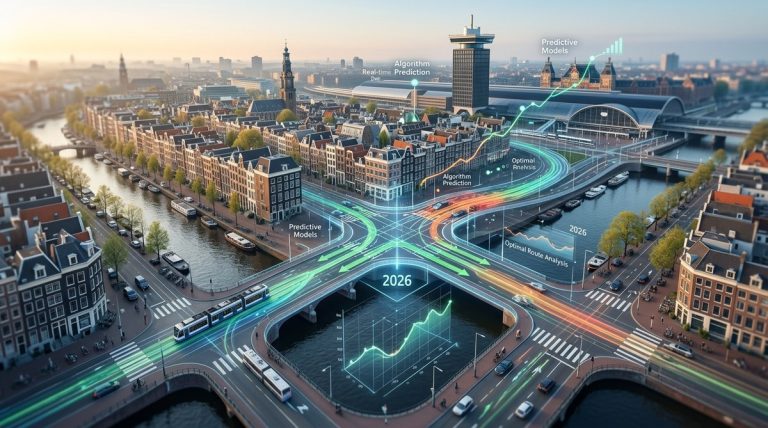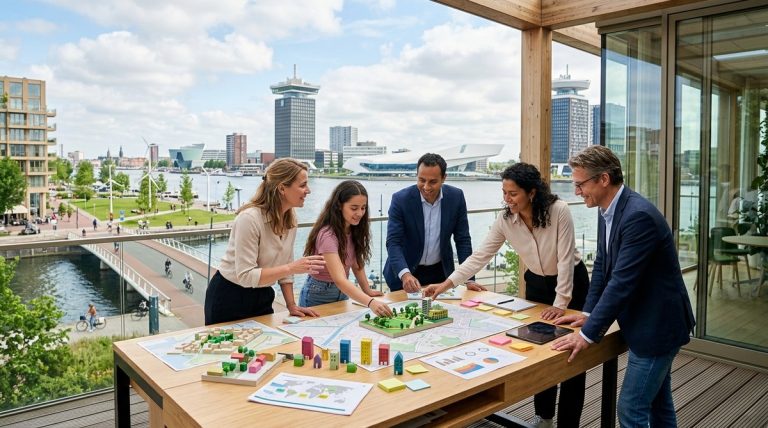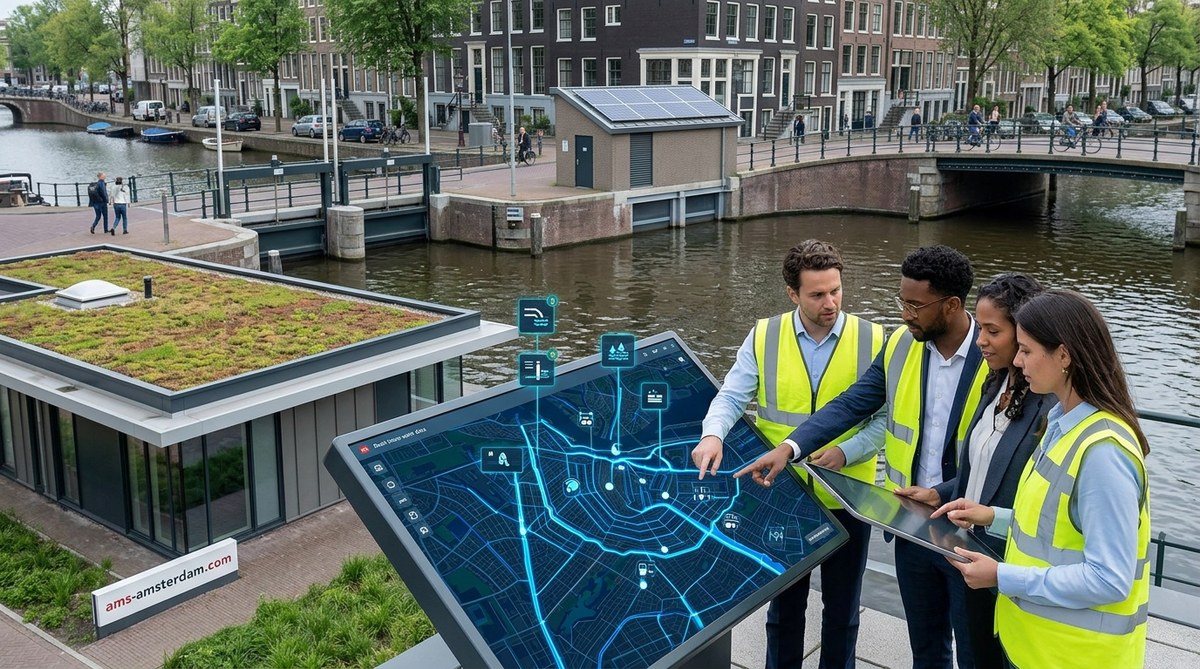
Amsterdam is a city built on water. Its canals, bridges and gabled houses draw millions of visitors each year. But for the people who live here, water is both a blessing and a constant risk. With more than a quarter of the city lying below sea level, heavy rain can turn streets into rivers in a matter of minutes. Climate change is making storms more intense, and the old system of draining water away simply cannot cope. That is why Amsterdam has become a global testbed for something smarter.
It is not just about bigger pipes or higher dykes. The city is using sensors, artificial intelligence, and nature based solutions to predict, store and slow down water before it causes damage. The approach is already saving millions of euros and is being studied by urban planners from London to Jakarta.
Amsterdam’s smart water management combines a digital twin of the city, real time IoT sensors, green roofs, and public water squares to absorb and redirect floodwater. Urban planners can replicate this by starting with high resolution data, then layering small scale green infrastructure with community engagement. The result is a replicable model for climate adaptation in any city.
The challenge of urban flooding in a low lying city
Amsterdam sits in a delta where the river Amstel meets the IJ and the North Sea Canal. Much of the city’s land was reclaimed from marshes and lakes. The polders are kept dry by a network of pumps and ditches that have been refined over centuries. But that system was designed for a climate that no longer exists.
In recent years, summer storms have dumped more than 50 millimetres of rain in a single hour. The combined sewer system, which carries both rainwater and waste water, quickly reaches capacity. When that happens, water backs up into streets and gardens. Basement flats, particularly popular in the city centre, are at high risk. The damage from a single flood event can run into tens of thousands of pounds for homeowners.
The municipality realised that simply enlarging underground pipes would be eye wateringly expensive and would take decades. They needed a smarter, faster way to manage water at the surface. That is where the concept of a sponge city came in. The idea is to absorb, store and use rainwater where it falls, rather than rushing it away.
The four pillars of Amsterdam’s smart water management
Amsterdam’s strategy rests on four interconnected approaches. Each one uses technology, but they also rely on good old fashioned urban design.
1. A digital twin that sees rain before it lands
The city has built a high resolution digital twin. This is a 3D virtual model of Amsterdam that includes every building, street, canal and green space. It is fed with data from weather radars, ground sensors and satellite images. The model can simulate where water will flow during a storm, which streets will flood first, and where water can be safely stored.
The digital twin runs continuously. When a heavy storm is forecast, water managers run multiple scenarios to see how the system will react. They can then open or close weirs, adjust pumps, and warn residents before the rain starts. This predictive ability is a game changer. Instead of reacting after a flood, the city can prepare in real time.
2. Green roofs that work like a sponge
Amsterdam now has more than 500,000 square metres of green roofs. These are not just decorative. A typical green roof can hold between 20 and 40 litres of water per square metre during a storm. The water is slowly released through evaporation or taken up by plants. This reduces the peak flow into the sewers by up to 60 per cent.
The city offers a subsidy of 30 euros per square metre to residents and businesses that install a green roof. There is also a bonus if the roof is designed to store extra water in a dedicated layer. Many new buildings are now required to include green roofs as part of the planning permission. The result is a city that literally holds water above its head.
3. Water squares that double as public space
In older neighbourhoods where there is no room for new parks, Amsterdam has created water squares. These are sunken plazas that look like ordinary public spaces most of the time. Children play, people sit on benches, and market stalls set up. But when it rains heavily, the square fills up like a giant bathtub.
The water is held there for a few hours while the drainage system catches up, then it is slowly released or pumped to a canal. One of the most famous examples is the Bellamyplein in the Oud West district. During a normal day it is a lively neighbourhood square. After a downpour it becomes a shallow lake that can hold half a million litres of water. The design is so effective that the square has never flooded surrounding homes since it opened in 2021.
4. Smart canals that talk to each other
Amsterdam’s canals are not just pretty. They are part of a managed water system with sensors that measure water level, flow, temperature, and water quality. These sensors send data every five minutes to a central control room. When a storm hits, operators can adjust the sluices and pumps to lower the canal level in advance, creating extra capacity.
The sensors also detect pollution spikes, such as when sewage overflows into canals. This allows engineers to contain the contamination before it spreads. The system has reduced the number of emergency overflow events by more than 40 per cent since 2024.
Practical steps for urban planners: a numbered list
If you are an urban planner looking to adapt Amsterdam’s methods, here is a straightforward sequence to follow.
- Map your city’s water flow in high resolution. Start with LiDAR data and historical flood records. Create a digital model that shows where water naturally pools and how it moves during a 1 in 100 year storm.
- Install a network of low cost sensors. Use IoT devices in sewers, canals and on rooftops to measure rain, humidity and water depth. Feed this data into your model continuously.
- Prioritise small, distributed interventions. Choose streets or squares that flood most often. Build a water square or install green roofs on public buildings first. Measure the impact and then expand from there.
Key technologies that make it work (bulleted list)
- IoT water level sensors. These are placed at strategic points in canals and sewers. They send data via low power wide area networks.
- Machine learning forecasting models. The city uses a neural network trained on 30 years of weather data to predict rainfall intensity an hour ahead.
- Cloud based control platform. All sensor data is aggregated in a secure cloud platform that water managers can access from any device.
- Automated sluice gates. These open and close based on real time conditions, without human intervention.
What experts say: a blockquote
“We used to rely on gut feeling and experience. Now we have a digital twin that shows us exactly what will happen. It means we can prevent floods instead of cleaning up after them. That shift in mindset is the most important thing we have done.”
— Dr. Marleen van der Molen, senior water engineer at Waternet (Amsterdam’s water authority)
Lessons for other cities: a handy table
| Technique | Common mistake | How Amsterdam avoids it |
|---|---|---|
| Green roofs | Not maintaining plants, leading to clogging and waterlogging | Regular inspections by community groups; subsidies tied to upkeep |
| Water squares | Building them in low traffic areas where they are unused | Place them in busy neighbourhoods with seating and play areas |
| Real time sensors | Installing too few sensors, leading to blind spots | Use a dense grid of sensors (one every 500 metres in flood prone zones) |
| Digital twin | Making the model too complex to update | Keep it modular; update only the layers that change (e.g., new buildings, road works) |
What makes Amsterdam’s approach different from other cities
Many cities have invested in grey infrastructure like storm drains and retention tanks. Amsterdam’s innovation is in combining hard data with soft, green solutions. They have created a system that is both high tech and low carbon. The green roofs and water squares also improve air quality, reduce the urban heat island effect, and provide pleasant spaces for residents. It is a rare example where flood defence actually makes daily life better.
For urban planners in the UK, there are direct parallels. Cities like Manchester, Leeds and Glasgow face similar challenges with flash floods and combined sewer overflows. The Dutch model shows that you can start small and scale up. You do not need a huge upfront investment. One water square, one green roof, one sensor at a time.
Building a smarter water future
Amsterdam is not stopping with what it has today. By 2028 the city plans to have a fully autonomous water management system that can respond to any storm without human input. The digital twin will be updated every 30 seconds. And every new public building will include a green roof or water storage as standard.
For anyone involved in urban planning or environmental engineering, Amsterdam offers a living laboratory. The data is open. The designs are replicable. And the results are impossible to ignore. Next time you are in the Netherlands, spend an hour walking around the Bellamyplein water square. Then look up at the rooftops and imagine what your own city could do with a bit of Dutch thinking. It starts with seeing water not as a problem to get rid of, but as a resource to manage wisely.
If you want to see the full story of how Amsterdam is using smart water management to combat urban flooding, you can read the in depth analysis on our pillar page. And for more on how data and AI are reshaping the city’s policies, have a look at our article on the role of data and AI in Amsterdam’s urban policy. These examples show how one city is turning a climate risk into a global case study for resilient urban growth.
About the Author