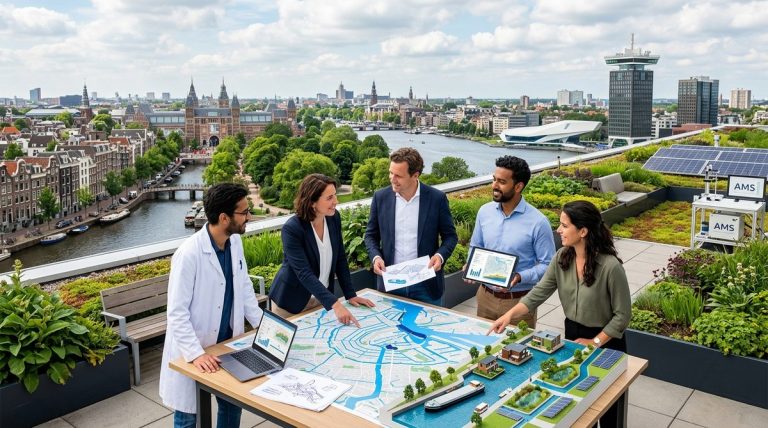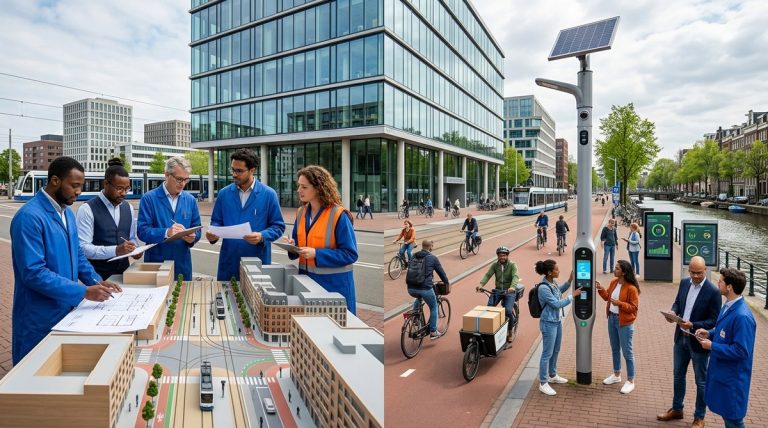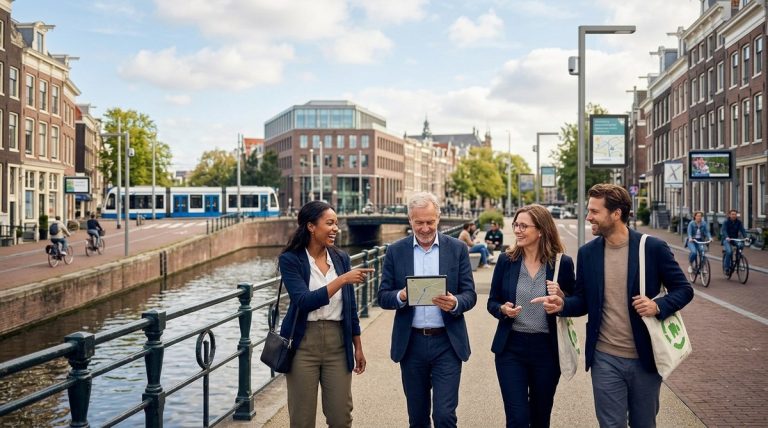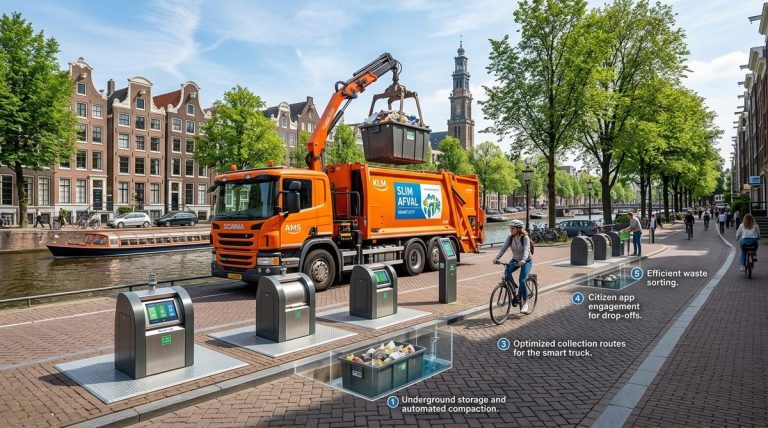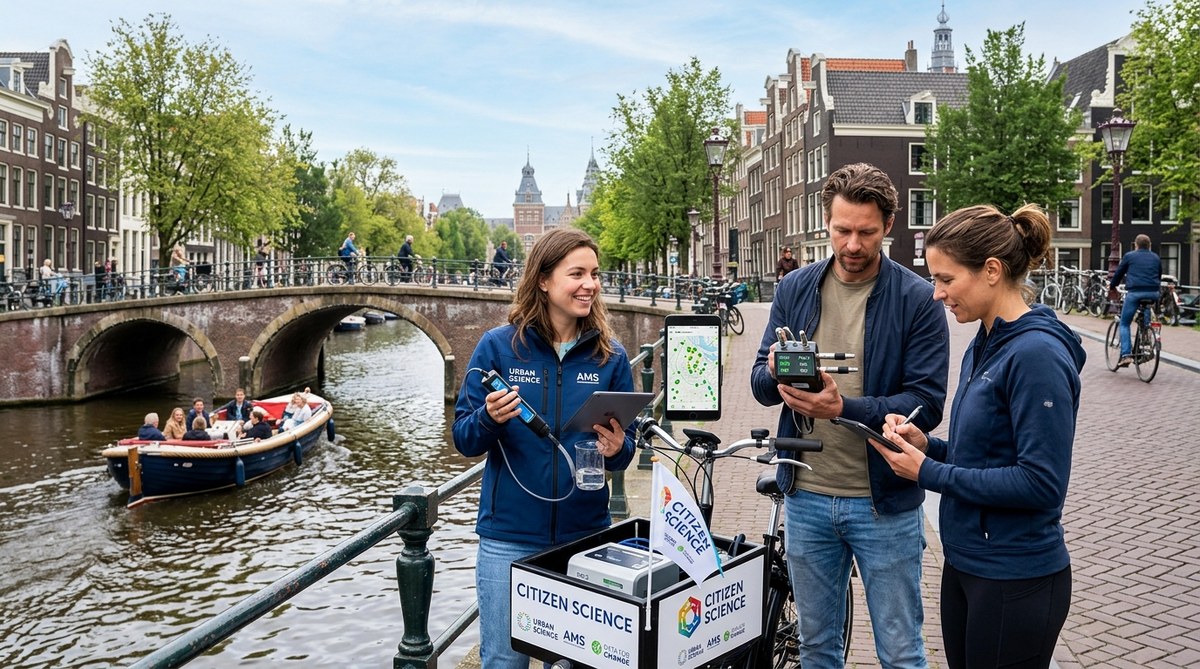
Amsterdam has a secret weapon against pollution. It lives in the pockets and hands of its residents. Across the city, ordinary people attach small sensors to their bicycles, clip monitors to their backpacks, and log observations on their phones. They are not paid scientists. They are citizens. And together, they are gathering data that government agencies and universities can use to tackle urban pollution more effectively than ever before. This is citizen science in action. It is democratic, it is local, and it is producing results that matter.
Amsterdam’s citizen science projects are reshaping how the city understands and fights pollution. By equipping residents with affordable sensors and digital tools, these initiatives generate hyperlocal data that official monitoring networks often miss. For planners and policymakers, this grassroots information provides a richer, more accurate picture of air and water quality, noise levels, and plastic waste. The result is smarter interventions, greater public trust, and a model that other cities can adopt today.
What Makes Citizen Science Different from Official Monitoring
The city of Amsterdam operates a network of official air quality stations. They are accurate. They are reliable. But they are also sparse. A single station might represent a whole neighbourhood, missing the pollution hot spots that form near busy junctions, school gates, or canal bridges. Citizen science fills the gap. It puts measurement where people actually live, cycle, and breathe.
The table below shows how traditional monitoring compares to citizen science approaches used in Amsterdam.
| Aspect | Official Monitoring | Citizen Science Approach |
|---|---|---|
| Sensor cost | GBP 10 000+ per unit | GBP 50 to GBP 300 per unit |
| Data frequency | Hourly averages | Minute by minute readings |
| Spatial coverage | One station per several km² | Hundreds of points per km² |
| Maintenance | Professional engineers | Community volunteers with remote support |
| Data ownership | Government / research institution | Open access (often Creative Commons) |
| Public engagement | Passive (citizens receive results) | Active (citizens collect and interpret data) |
Each approach has strengths. Official stations give you the big picture. Citizen data gives you the local story. When you combine them, you get the best of both worlds. Amsterdam has been doing exactly that through partnerships with organisations like the Amsterdam Institute for Advanced Metropolitan Solutions and the citizen science lab at the University of Amsterdam.
How Amsterdam Citizen Science Projects Operate in Practice
Getting involved is simpler than most people think. Here are the typical steps a resident takes to contribute to a project tackling urban pollution.
- Choose a pollutant to track. Most projects focus on fine particulate matter (PM2.5 and PM10), nitrogen dioxide (NO₂), or noise. Some also monitor plastic litter along canals.
- Get a sensor kit. Projects like iSPEX (which uses smartphone attachments) or the Smart Citizen Kit provide low cost hardware. Many are available for loan from local libraries or community centres.
- Install and calibrate. Follow the instructions to attach the sensor to your bike, window, or backpack. A short calibration step ensures your readings are comparable with others.
- Collect data over several weeks. Consistency matters. The more days you log, the more reliable the map becomes. Many projects run for two to four weeks per participant.
- Upload your readings. Use a smartphone app or a simple web portal. The data is automatically labelled with GPS location and time.
- Review the combined map. After the campaign ends, researchers publish an interactive map. You can see how your street compares to others and where the city might need to act.
One successful example is the Amsterdam Smart Citizen Lab, which launched a campaign in 2025 to measure NO₂ around primary schools. Parents volunteered to wear small diffusion tubes for two weeks. The resulting map showed that four playgrounds had levels above the European Union safety guideline. The municipality used that evidence to redirect traffic away from those schools and install green barriers.
Benefits That Go Beyond Data
Citizen science does not only produce numbers. It also builds community awareness and political pressure. Consider these advantages:
- Local knowledge is validated. People who have always suspected that a particular intersection is polluted now have proof.
- Trust grows between residents and officials. When citizens help produce the data, they are more likely to accept the policy changes that follow.
- Costs stay low. A single official station can cost more than a whole citizen campaign.
- Data is publicly available. Researchers, journalists, and campaign groups can all use it to hold decision makers accountable.
- Behaviour changes naturally. Participants often start cycling alternative routes, avoiding certain streets at peak hours, or supporting car free zones.
As Dr. Marleen van der Kamp, a researcher at the University of Amsterdam, puts it:
“Citizen science flips the old model. Instead of asking people to trust experts blindly, we invite them to become experts themselves. When a mother measures the air her child breathes at the school gate, she becomes an advocate for change. That is powerful. That is how real progress starts.”
Overcoming the Challenges
No approach is perfect. Citizen science faces hurdles that the city is actively working to solve.
Data quality is the most common concern. A sensor that costs GBP 80 cannot match the precision of a GBP 10 000 instrument. Amsterdam addresses this by co locating a subset of citizen sensors next to official stations. The readings are compared and a correction factor is applied. The margin of error is usually within 15 percent, which is acceptable for identifying trends and hot spots.
Participant fatigue is another risk. Many people sign up enthusiastically but stop after a week. To keep engagement high, projects use gamification elements. The city’s app for the “Clean Air for Kids” campaign awards badges for consecutive days of logging and shows a leaderboard of streets with the most contributions.
Privacy also matters. A sensor on your bicycle could reveal when you are home, where you shop, and how often you cycle. Amsterdam requires all projects to anonymise data by default. GPS coordinates are rounded to the nearest 50 metres, and personal accounts are stored separately from readings.
Practical Tools for Urban Planners and Researchers
If you are an environmental researcher or an urban planner considering a citizen science approach, here are three tools from Amsterdam that you can adapt.
- The Amsterdam Data Exchange (AMDEX). This platform lets citizens share their data under terms they control. You can request access to specific datasets for your own analysis.
- The Smart Citizen Kit. An open source hardware and software package that measures temperature, humidity, light, noise, and air quality. The code is freely available on GitHub.
- The iSPEX add on for smartphones. A clip on filter that turns your phone camera into a spectrometer for measuring aerosol particles. It was developed by the Royal Netherlands Institute for Sea Research.
These tools have already been exported to other European cities. Bristol, for example, ran a similar campaign in 2024 using Amsterdam’s sensor calibration method.
Amsterdam Citizen Science Urban Pollution Projects to Watch in 2026
Right now, several initiatives are gathering momentum. Here are the most notable ones.
- Plastic Scan Amsterdam. Volunteers walk canal sides and log every piece of plastic they see. The data feeds into a map that helps the water authority prioritise clean up routes.
- NoiseQuest. Residents use a smartphone app to record noise levels at different times of day. The goal is to identify quiet corridors that could become car free zones.
- AirCasting NL. A continuous campaign where cyclists carry a sensor pod on their handlebars. The route based data is visualised in real time on a public dashboard.
Each project shares its results openly. You can download the raw datasets from the City of Amsterdam’s open data portal.
How You Can Start a Project Today
You do not need a big budget or a university affiliation. Here is a list of steps to launch a citizen science campaign in your own neighbourhood.
- Identify a pollution issue that residents care about. Air pollution near schools or noise around parks are good starting points.
- Recruit a coordinator group of five to ten volunteers. They will handle communication, sensor distribution, and data checks.
- Choose a sensor that fits your budget. The Smart Citizen Kit costs about GBP 200 per unit. For a campaign of 20 units, that is roughly GBP 4 000.
- Set a short, clear measurement period. Two weeks is usually enough to get meaningful data.
- Plan a public event to share the results. A map display in a community centre or a local library works well.
- Share the data with your local council. Offer to help them interpret it.
Amsterdam has plenty of support networks too. The city runs a citizen science hub that offers free training workshops and sensor loans. They also publish a toolkit for first time organisers.
The Role of Technology in Scaling Citizen Science
Sensors have become smaller, cheaper, and more reliable. But the real breakthrough is in data handling. Amsterdam uses machine learning to clean and standardise citizen collected data automatically. Outliers are flagged. Drift is corrected. The algorithms even learn the typical sensor behaviour for different weather conditions.
This technical layer is what makes citizen science credible to policymakers. When a resident uploads a reading, the system checks it against nearby sensors within seconds. If the value is suspicious, it is marked for review but not discarded. This keeps the data honest without silencing genuine outliers that might be caused by a local event like a construction site.
For a deeper look at how data and AI reshape urban policy in Amsterdam, refer to the analysis on data driven urban policy.
Why This Matters for UK Cities
British cities face similar challenges. London’s air quality is a persistent issue. Birmingham and Manchester have active citizen science groups. Amsterdam’s experience offers clear lessons.
First, start small. A campaign with 50 sensors in a single ward can generate enough evidence to justify a traffic change. Second, partner with a local university for calibration and data analysis. Third, make the results visible immediately. Amsterdam’s real time dashboards create a sense of progress that keeps volunteers engaged.
The role of citizen engagement in shaping smart city initiatives is well documented. Amsterdam proves that when residents are treated as partners, not just users, the quality of urban interventions improves.
Joining the Movement for Cleaner Amsterdam Air
Amsterdam citizen science projects are not a side experiment. They are becoming a permanent part of how the city monitors and manages pollution. The data they produce feeds into official reports. The volunteers become informed advocates. And the policies that emerge are more targeted and more trusted.
If you are an environmental researcher, an urban planner, or simply a concerned resident, the door is open. You can join an existing campaign. You can start your own. You can borrow sensors from the city library. The hardest step is the first one: deciding to measure what is in the air you breathe.
The people of Amsterdam have already taken that step. Thousands of readings now flow into the city’s servers every day. Each one is a small act of care. Together they are building a cleaner, healthier urban future. And you can be part of it.
About the Author