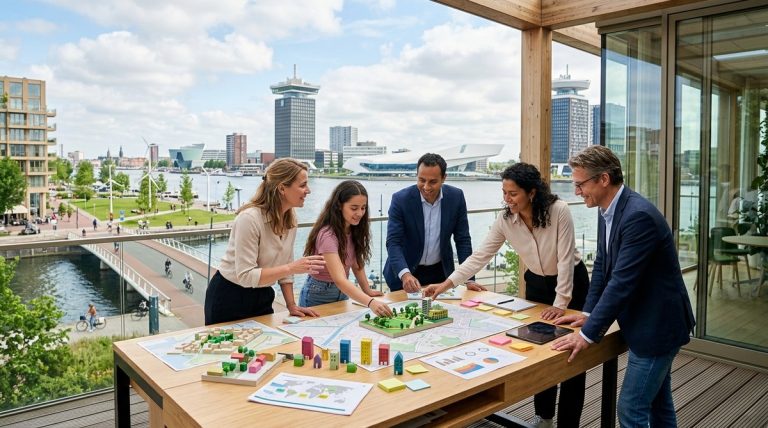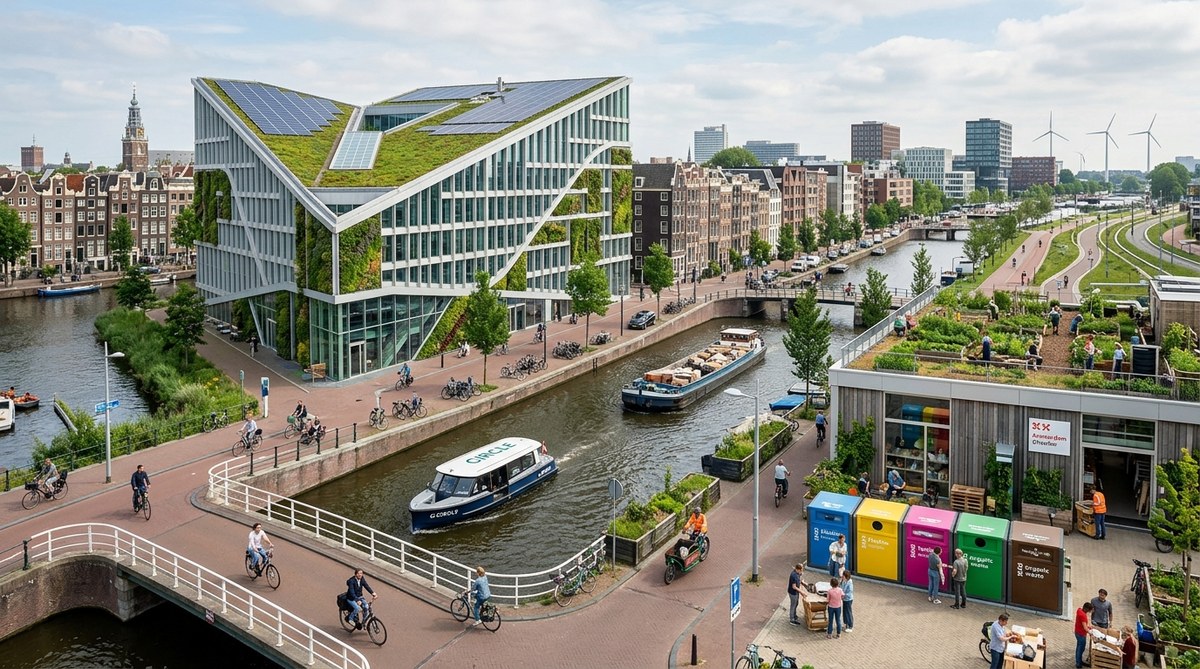
Amsterdam is known for its canals, its bikes, and its pragmatic approach to big problems. But there is another revolution happening in the Dutch capital. It is quieter than a football match at the Johan Cruyff Arena, yet it has the power to change how cities around the world use resources. The city has set itself a bold target: to become fully circular by 2050, with an interim goal of halving its use of virgin raw materials by 2030. That is not just a slogan on a government website. It is a live experiment playing out in neighbourhoods, business parks, and council offices across the city.
Amsterdam aims to become a fully circular city by 2050, with an interim goal of halving virgin raw material use by 2030. This article explores five concrete initiatives turning that vision into reality. From circular construction districts to textile innovation hubs, these projects show how the city rethinks waste, design, and community participation. Each initiative offers practical lessons for urban sustainability enthusiasts, policy makers, and planners seeking to apply circular principles in their own cities.
Amsterdam’s Circular Vision in Practice
The circular economy is not a new concept in Amsterdam. The city published its first circular strategy back in 2020, and since then it has built a reputation as one of Europe’s most experimental urban laboratories for sustainability. But what does that mean on the ground? How does a city of roughly 900,000 people actually move from a linear “take make dispose” model to a circular one?
The answer lies in a mix of grassroots projects, municipal programmes, and public private partnerships. Amsterdam treats the circular economy as a practical challenge, not a theoretical one. Each initiative starts with a specific problem: too much construction waste, too many discarded textiles, too many single use materials. And each one builds a solution that can be measured, improved, and scaled.
Let us look at five initiatives that show how Amsterdam circular economy initiatives are changing the urban landscape in 2026.
Buiksloterham: Circular Construction in Action
Buiksloterham is a former industrial area in Amsterdam Noord. For decades it was home to shipyards, factories, and warehouses. Today it is a living lab for circular construction. The goal here is simple: build new homes and offices using as few virgin materials as possible.
Developers in Buiksloterham follow a strict set of circular principles. They use modular building techniques so that components can be reused later. They source materials from demolition sites elsewhere in the city. And they design buildings that can be disassembled at the end of their life. The result is a neighbourhood that feels modern but also functions as a material bank for the future.
One standout project is the Circular Pavilion, a temporary events space built entirely from reused materials. Its steel frame came from an old factory in Rotterdam. Its insulation came from recycled denim. When the pavilion reaches the end of its life, every component will go back into the supply chain.
For a closer look at how technology supports these efforts, read our article on how Amsterdam uses smart technologies to create a more sustainable city.
De Ceuvel: A Creative Circular Hub
If Buiksloterham is about construction, De Ceuvel is about everything else. This former shipyard in Amsterdam Noord has been transformed into a creative workspace and cultural venue that operates on closed loop principles. The site runs on solar energy, treats its own wastewater with helophyte filters, and uses biomass for heating.
What makes De Ceuvel special is its approach to waste. Nothing leaves the site that cannot be reused or composted. Food scraps go into worm farms. Human waste goes into a biogas digester. Even the site’s cafe serves food grown in on site greenhouses. It is a small scale demonstration of what a fully circular neighbourhood could look like.
De Ceuvel also hosts startups and artists who work on circular design and clean technology. The site functions as an incubator for ideas that later scale to other parts of the city. If you are interested in how experimental spaces drive change, our piece on 10 key lessons from Amsterdam’s urban innovation labs offers more context.
The Circular Textile Programme: Closing the Loop on Fashion
Textile waste is a growing problem across Europe. Amsterdam alone generates thousands of tonnes of discarded clothing every year. Most of it ends up in incinerators or landfills. The Circular Textile Programme aims to change that by building a local system for textile reuse, repair, and recycling.
The programme works on three levels. First, it funds collection points across the city so residents can drop off old clothes easily. Second, it partners with local repair shops and tailors to extend the life of garments. Third, it supports startups that develop new fabrics from recycled fibres. The goal is to create a closed loop where no textile waste leaves the city.
One of the programme’s successes is the Amsterdam Textile Hub, a facility that sorts, grades, and processes used clothing. High quality items go to second hand shops. Lower quality items are shredded and turned into insulation or new yarn. The hub processes over 500 tonnes of textiles each year and the number is growing.
The Construction Material Exchange
Construction and demolition account for roughly one third of Amsterdam’s total waste. The Construction Material Exchange is a digital platform that tackles this problem head on. It connects builders, contractors, and demolition companies so that surplus materials can be traded or donated instead of thrown away.
The platform works like a marketplace. A contractor demolishing an office block can list steel beams, bricks, and fixtures on the exchange. Another builder working on a renovation nearby can claim those materials for free or at a reduced cost. The platform also calculates the carbon savings from each transaction, giving users a clear environmental benefit.
In 2025 the platform facilitated the reuse of over 30,000 tonnes of materials. That figure is expected to grow as more construction firms adopt circular practices. The exchange is now being studied by cities like Copenhagen and Helsinki as a model for reducing construction waste.
The Circular Innovation Programme: Funding and Scaling Ideas
The initiatives above did not appear by magic. They were supported by the Circular Innovation Programme, a municipal fund that provides grants, mentorship, and office space to circular economy startups. The programme targets businesses that can demonstrate measurable environmental impact and a clear path to scaling.
Since its launch, the programme has supported over 100 startups. Some focus on food waste, others on packaging, others on electronics repair. The common thread is that each startup must show how its product or service keeps materials in use for longer.
One notable success is a company that turns spent coffee grounds into furniture. Another uses mushroom mycelium to create biodegradable packaging. These startups not only reduce waste but also create jobs and attract investment to the city.
To see how the wider ecosystem supports this kind of innovation, read about how Amsterdam’s urban innovation ecosystem is accelerating sustainable city solutions in 2026.
How They Work: A Shared Process
Each of these initiatives follows a similar process. Understanding that process can help other cities and organisations replicate Amsterdam’s success.
-
Identify the material stream. Every circular project starts with a specific waste problem: construction debris, textiles, food scraps, or electronics. The first step is to measure how much of that material flows through the city each year.
-
Map the stakeholders. Who produces the waste? Who can collect it? Who can process or reuse it? A circular initiative works only when every link in the chain is connected.
-
Build the infrastructure. This could be a physical hub like the textile sorting facility, a digital platform like the material exchange, or a regulatory change like a ban on certain single use items.
-
Create economic incentives. Circular solutions need to be cheaper or more profitable than the linear alternative. Grants, tax breaks, and procurement rules help level the playing field.
-
Measure and iterate. Each initiative tracks its impact in tonnes of material diverted, carbon saved, and jobs created. Those numbers inform the next round of funding and policy.
Comparing the Five Initiatives
| Initiative | Sector | Core Mechanism | 2025 Impact | Scalability |
|---|---|---|---|---|
| Buiksloterham | Construction | Modular design and material passports | 60% reduction in virgin material use | High for new developments |
| De Ceuvel | Mixed use | Closed loop site operations | 100% energy and water self sufficiency | Medium for small sites |
| Textile Programme | Fashion | Collection, repair, and recycling network | 500+ tonnes processed annually | High for cities with collection systems |
| Material Exchange | Construction | Digital trading platform | 30,000 tonnes of materials reused | Very high for any urban area |
| Innovation Programme | Cross sector | Grants and incubator support | 100+ startups funded | High for cities with R and D budgets |
What Local Experts Say
“Amsterdam’s approach to the circular economy shows that sustainability and economic growth can go hand in hand. By focusing on collaboration between government, businesses, and residents, we are building a city that uses resources more wisely. The key is to start small, test ideas in real neighbourhoods, and scale what works.”
Marieke van Doorn, Circular Economy Programme Manager, City of Amsterdam
Applying Amsterdam’s Lessons in Your City
You do not need to be a city official to take inspiration from these projects. Whether you are an urban planner, a researcher, or a community organiser, there are practical steps you can take right now.
- Start with one material stream. Pick something local and measurable, like coffee cups or office furniture.
- Map the existing players. You might find that a waste collector, a university lab, and a local charity are already doing circular work without coordination.
- Use data to make the case. A simple audit of what goes into your local landfill can be a powerful tool for change.
- Look for quick wins. Repair cafes, tool libraries, and swap events build momentum and public support.
- Advocate for policy changes. Procurement rules that favour reused materials can shift entire markets.
The Road Ahead for Amsterdam Circular Economy Initiatives
Amsterdam is not resting on its early successes. The city’s 2026 circular roadmap includes tougher targets for construction waste, a citywide ban on certain single use plastics, and a new fund for neighbourhood level circular projects. The goal remains the same: a fully circular city by 2050, with measurable progress every year along the way.
What makes Amsterdam’s approach stand out is its honesty. Not every project works. Some pilots fail to scale. Some materials are harder to close the loop on than others. But the city treats each failure as a learning opportunity, not a reason to give up.
If you are working on urban sustainability, keep an eye on Amsterdam. The city is showing that circular economy initiatives are not just good for the planet. They are good for the economy, for communities, and for the quality of everyday life. The next time you visit Amsterdam, look beyond the canals and the stroopwafels. Look at how the city builds, how it wastes, and how it reuses. There is a lesson in every brick.
About the Author