Amsterdam is not just a city of canals and bicycles. It has become a living laboratory for the circular economy. For sustainability professionals and supply chain managers, the Dutch capital offers something rare: proof that circular principles work at scale. The city’s ambition is to be fully circular by 2050, but the most interesting part is how it is getting there. The focus is not on grand theories. It is on practical, sometimes surprising, changes to logistics and production. Let us look at five unexpected ways Amsterdam’s circular economy is redesigning the supply chain.
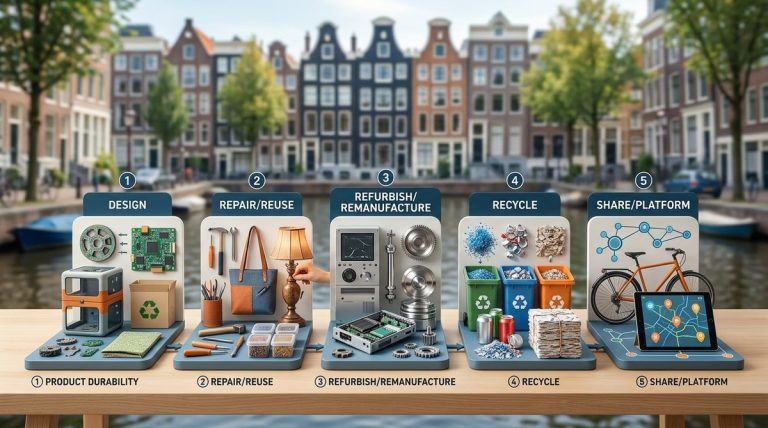
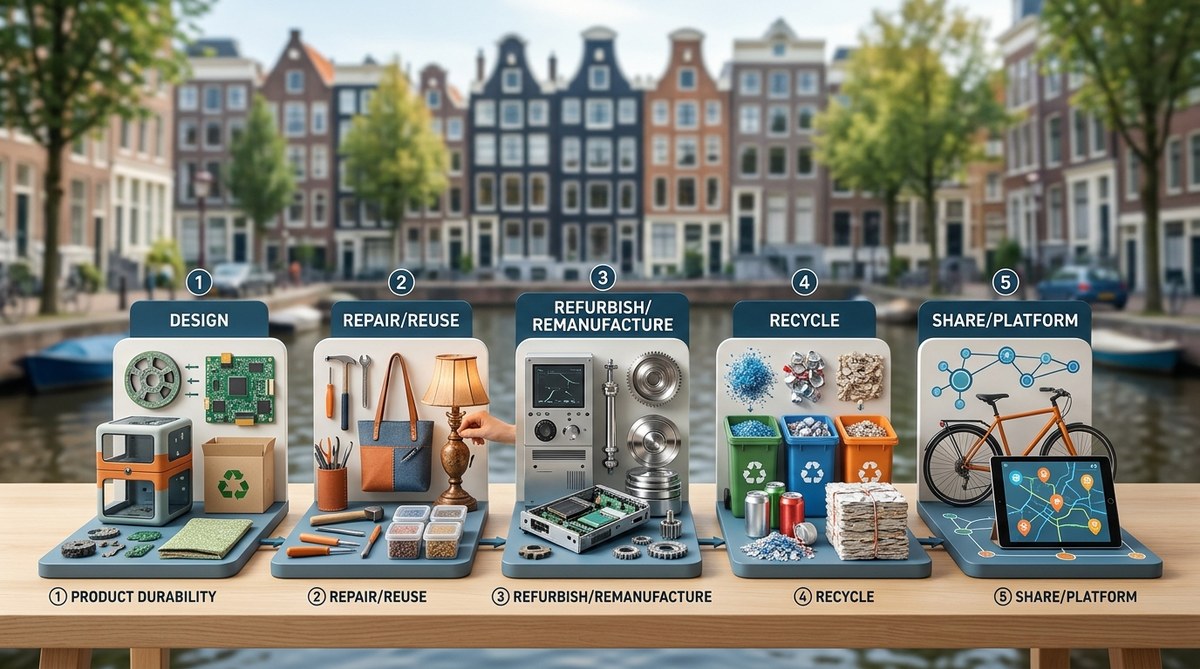
Amsterdam’s circular economy relies on five practical shifts: urban mining for construction materials, shared logistics platforms that cut empty van miles, bio-based feedstocks replacing fossil inputs in manufacturing, product-as-a-service models that flip ownership, and digital passports that track materials through their lifecycle. These are not pilot projects. They are operational systems reshaping how goods flow through the city.
Urban mining turns buildings into material banks
When you think of a mine, you probably picture a hole in the ground. Amsterdam sees its buildings. The city has embraced urban mining: recovering steel, concrete, copper, and timber from structures that are being renovated or demolished. Instead of sending rubble to landfill, contractors separate materials on site and feed them back into new construction projects.
The supply chain impact is significant. Traditional construction relies on virgin materials extracted elsewhere and shipped long distances. Urban mining shortens that chain dramatically. A demolition site becomes a local supplier. The Buiksloterham district, for example, has a material depot where reclaimed bricks and beams are stored and sold for new builds. This reduces the carbon footprint of construction by cutting transport and processing stages.
What makes this work is a digital inventory. The city maintains a database of materials embedded in public buildings. When a structure is scheduled for renovation, planners know exactly what will become available. This foresight allows project managers to design new buildings around materials that are already in the city.
- Identify buildings scheduled for demolition or renovation.
- Audit materials using the city’s digital inventory.
- Match recovered materials to upcoming construction projects.
- Arrange logistics for on-site separation and collection.
- Process materials for reuse, either as-is or after refurbishment.
This process has cut construction waste by 30% in pilot districts. For supply chain managers, the lesson is clear: the built environment holds immense value. Treating buildings as material banks changes procurement from a global search to a local loop.
Shared logistics platforms slash empty miles
One of the biggest inefficiencies in any supply chain is the empty van. A delivery truck arrives in Amsterdam, drops off goods, and drives back to a warehouse outside the city with nothing in the back. That is wasted fuel, wasted time, and unnecessary emissions.
Amsterdam has tackled this with shared logistics platforms. These digital marketplaces allow different companies to pool their transport needs. A florist sending bouquets to the city centre can share a van with a bakery delivering pastries. The platform optimises routes so that vehicles are full in both directions.
This is not a niche experiment. The city’s Cityhub initiative connects over 40 logistics companies. They use a central depot on the edge of the city where goods are consolidated before final delivery by electric cargo bikes or small vans. The result is a 25% reduction in delivery vehicle kilometres in the inner city.
For a supply chain manager, this changes the role of the logistics provider. You are no longer just contracting a fleet. You are joining a network. The platform handles the matching, the routing, and the billing. Your goods still arrive on time, but they share space with products from other businesses. This model works especially well for fast-moving consumer goods, office supplies, and hospitality deliveries.
- Reduced congestion in the city centre.
- Lower last-mile delivery costs for businesses.
- Cut in carbon emissions per parcel delivered.
- Better use of warehouse space at the urban edge.
- Improved reliability through consolidated scheduling.
The platforms are open to any business operating in Amsterdam. You do not need to be a large corporation. Small independents have been among the earliest adopters, because the cost savings are immediate.
Bio-based feedstocks replace fossil inputs in manufacturing
Amsterdam’s circular economy strategy goes beyond recycling. It aims to eliminate waste at the design stage. One way it does this is by switching to bio-based feedstocks. Instead of using petroleum-based plastics or chemicals, manufacturers in the city are turning to agricultural residues, algae, and organic waste.
The supply chain for these materials looks very different. A traditional plastic supply chain involves oil extraction, refining, and polymer production. A bio-based chain starts with a farmer or a food processor. For example, the company Reflower takes flower waste from the auction houses in Aalsmeer and turns it into bioplastic pellets. These pellets are then used by local injection moulders to make products like phone cases and packaging.
This creates a local loop. The raw material is grown or produced within a few dozen kilometres of the factory. The processing happens in the same region. The finished product stays in the Dutch market. This short chain is more resilient to global disruptions. It also supports local agriculture by creating a new revenue stream for what was previously waste.
The city has invested in processing facilities to make this work. A bio-refinery in the Amsterdam port area converts organic waste into lactic acid, which is the building block for biodegradable plastics. This facility accepts waste from households, restaurants, and food manufacturers. It turns a disposal cost into a raw material supply.
“We stopped thinking about waste as something to get rid of. We started seeing it as a feedstock. That shift in mindset changed our entire procurement strategy.” – Project lead at Amsterdam’s Waste-to-Product programme
For manufacturers, the implication is that supply chain resilience can come from local biological sources, not just from diversifying global suppliers. The technology is mature enough to scale. The main barrier is changing procurement habits.
Product-as-a-service flips ownership and logistics
Amsterdam has become a testing ground for product-as-a-service models. Instead of buying a washing machine, a lighting system, or even an office chair, customers pay for the use of it. The manufacturer retains ownership and responsibility for maintenance, repair, and eventual end-of-life recovery.
This changes the supply chain fundamentally. In a traditional model, the manufacturer ships a product to the customer and the transaction ends. In a service model, the product must be designed for durability and easy repair. The manufacturer must also manage the reverse logistics chain: collecting the product when the contract ends, refurbishing it, and putting it back into service.
Amsterdam’s approach to this is pragmatic. The city itself acts as a customer for several service models. Municipal buildings lease lighting from a provider who guarantees a certain level of brightness and energy efficiency. The provider owns the LED fixtures and replaces them when they fail. The old fixtures are refurbished and reused in other buildings.
This model creates a closed loop for materials. The manufacturer never loses control of the valuable components. The supply chain becomes a continuous cycle of forward and reverse flows. Logistics providers in Amsterdam have adapted by offering dedicated take-back services. They collect used products from customers and deliver them to refurbishment centres in the port area.
| Traditional Model | Product-as-a-Service Model |
|---|---|
| Customer buys product | Customer pays for use |
| Manufacturer ships once | Manufacturer manages forward and reverse logistics |
| Customer disposes at end of life | Manufacturer recovers and refurbishes |
| Design for low cost | Design for durability and repairability |
| Revenue from new sales | Revenue from long-term contracts |
This table highlights the shift. For supply chain professionals, the biggest change is the need to manage reverse logistics as carefully as forward logistics. That means investing in collection networks, sorting facilities, and refurbishment lines. Amsterdam has shown that this is viable for categories like electronics, furniture, and textiles.
Digital passports track materials through their lifecycle
None of these circular strategies would scale without data. Amsterdam has pioneered the use of digital product passports. These are digital records that accompany a material or product from its creation through each stage of its life. They contain information about composition, origin, carbon footprint, and recyclability.
The supply chain application is straightforward. When a building is designed, the passports for all materials are uploaded to a shared platform. When the building is eventually deconstructed, the passports tell contractors exactly what is inside and how to handle it. This eliminates the guesswork that often leads to materials being downcycled or landfilled.
The city has mandated digital passports for all new public buildings since 2025. Private developers are following suit because the passports add value. Buildings with full material documentation achieve higher ratings on sustainability certifications. They also attract tenants who want to report their own supply chain emissions.
For a manufacturer supplying materials to Amsterdam, having a digital passport is becoming a requirement. The passport includes data on recycled content, transport distance, and end-of-life options. This data flows into the buyer’s own reporting systems. It creates transparency across the entire chain.
The technology behind this is not complex. It uses QR codes or RFID tags linked to a cloud database. The challenge is getting all parties to share data. Amsterdam has addressed this by creating a standardised data format that works for small suppliers and large corporations alike.
What this means for UK supply chain professionals
Amsterdam’s circular economy is not a distant ideal. It is a working system built on practical changes to logistics, procurement, and product design. The five approaches outlined above are replicable. UK cities like Manchester, Bristol, and London are already studying Amsterdam’s model.
The key takeaway is that circular supply chains are not about sacrifice. They are about designing smarter flows. Shared logistics reduce costs. Urban mining shortens transport distances. Bio-based feedstocks create local resilience. Service models build customer loyalty. Digital passports improve data quality.
For sustainability professionals and supply chain managers, the first step is to identify one product stream or one logistics route where circular principles could apply. Start small. Run a pilot. Measure the results. Amsterdam did not become circular overnight. It tested, failed, adjusted, and scaled. That same iterative approach is available to any organisation.
If you want to see how these principles connect to broader urban innovation, read our article on how Amsterdam uses smart technologies to create a more sustainable city. For a deeper look at the policy framework behind these changes, see what British urban planners can learn from Amsterdam’s circular economy model in 2026. And for a broader view of the city’s approach to sustainable growth, check out 5 circular economy initiatives transforming Amsterdam’s urban landscape.
The next time you look at a supply chain, ask yourself one question: what would happen if nothing in this chain was wasted? Amsterdam is showing us the answer. It is time to start applying those lessons closer to home.
About the Author