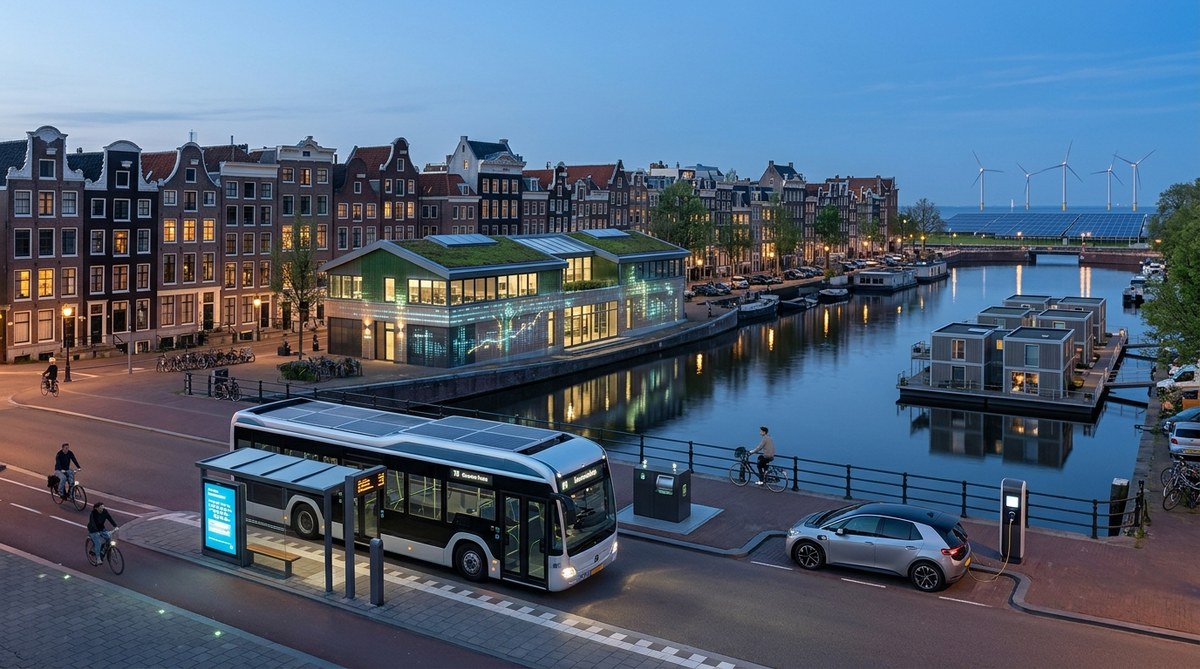
Amsterdam has a reputation for being ahead of the curve. Its canals, bikes, and compact streets already whisper sustainability. But in 2026, the city is doing something louder. It is using data, sensors, and community power to shrink its carbon footprint faster than many thought possible. For sustainability professionals, urban planners, and researchers, the question is not whether Amsterdam is a smart city. It is how these innovations actually work on the ground to cut emissions.
Amsterdam’s carbon reduction success comes from a mix of open data platforms, IoT sensors, citizen engagement, and bold policy. Smart grids, dynamic traffic management, and circular building practices each play a specific role. The city proves that technology alone is not enough – it needs collaboration between government, startups, and residents.
How Amsterdam Uses Smart Energy to Cut Emissions
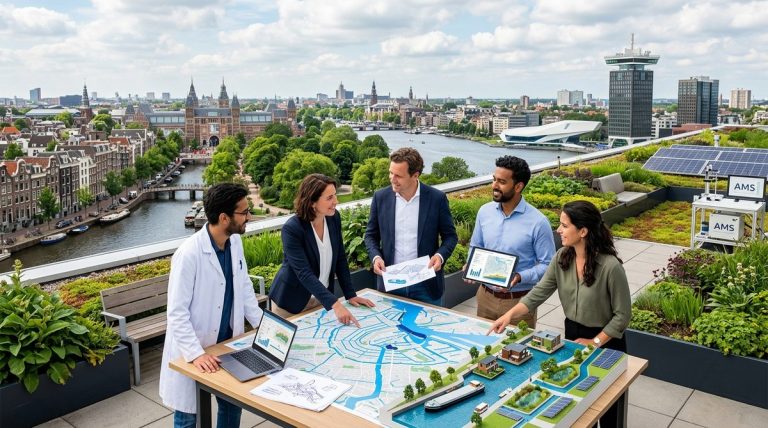
The core of Amsterdam’s smart city strategy is energy. The city has rolled out smart grids that balance renewable supply with demand in real time. Thousands of households now have solar panels connected to a central platform that adjusts charging for electric vehicles and heat pumps.
For example, the Amsterdam Smart Grid project in the Nieuw-West district allows residents to sell excess solar power back to the grid at peak times. This reduces reliance on gas power plants. According to the city’s 2025 climate report, smart grids have already lowered carbon emissions from residential energy by 18% compared to 2020 levels.
Key technologies in this area:
- Smart meters with real time consumption data
- AI driven load forecasting for public buildings
- Battery storage systems shared between neighbours
- Peer to peer energy trading apps
These tools do not just save carbon. They also save money for households, which builds public support for further changes.
Mobility Innovations That Actually Reduce Traffic Emissions
Amsterdam has long been a cycling city, but car traffic still accounts for a big slice of its emissions. The solution is not just more bike lanes. It is about using data to make every trip more efficient.
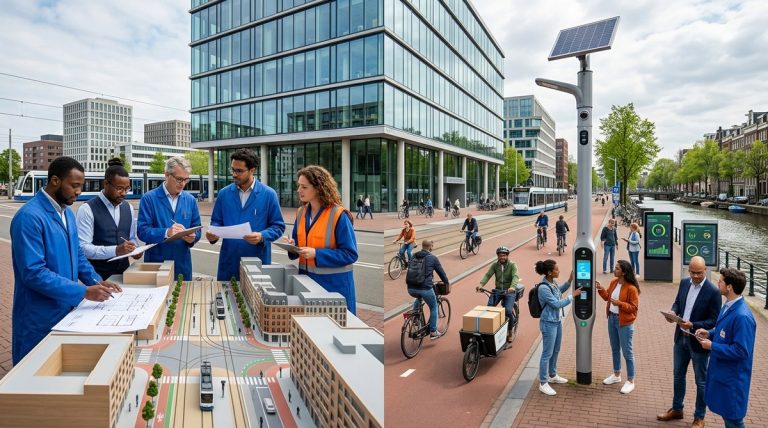
One standout project is the City Traffic Dashboard. This system collects data from traffic cameras, induction loops, and smartphone apps. It then adjusts traffic light timings and suggests alternative routes to reduce congestion. In 2025, the dashboard cut average idling time in the city centre by 22%. That translates to fewer litres of fuel burned and lower CO2 output.
The city also uses smart parking sensors. Drivers can see available spots in real time through an app, which stops them circling the streets. A study from the Amsterdam Institute for Advanced Metropolitan Solutions found that this reduced search traffic by 35% in the Jordaan area.
For fleet operators, Amsterdam has implemented a low emission zone enforced by automatic number plate recognition. Commercial vehicles that do not meet Euro 6 standards get fined automatically. This has pushed many logistics companies to switch to electric vans.
Building Circular Practices into Urban Development
Construction waste is a hidden carbon contributor. Amsterdam is tackling this with a circular economy approach backed by smart tracking systems.
The city requires all new developments over a certain size to use a materials passport. This digital document records every component used in a building – from steel beams to insulation panels. When a building is renovated or demolished, the passport helps workers recover materials for reuse. This lowers the demand for virgin resources and the carbon footprint of manufacturing.
A practical example is the Transformation of the Bijlmerbajes prison complex into a mixed use neighbourhood. The old concrete was crushed on site and reused as aggregate for new foundations. Sensors tracked the amount of material diverted from landfill. The project saved an estimated 4,000 tonnes of CO2 equivalent.
For urban planners, the lesson is clear. Smart city strategies must extend beyond digital screens into the physical stuff of buildings.
Data and AI: The Brain Behind the Carbon Cuts
Data is the invisible thread connecting all of Amsterdam’s innovations. The city runs an open data platform where citizens and researchers can access real time air quality, energy use, and traffic flow information.
Artificial intelligence helps make sense of this data. For instance, the municipality uses machine learning models to predict when public buildings will be empty and adjust heating and cooling accordingly. This is called predictive energy management. It has reduced energy use in libraries, offices, and sports halls by around 12% annually.
One powerful tool is the Amsterdam Climate Dashboard. It shows the city’s carbon footprint updated daily. Decision makers can see which sectors are falling behind and adjust policies immediately. This transparency also builds trust with residents.
“Data is the new soil for urban sustainability. Without it, you are guessing. With it, you can measure what works and scale what does not.” – Dr. Sophie van den Berg, urban data scientist at the University of Amsterdam.
A Practical Step by Step Process for Replicating Amsterdam’s Approach
If you are a planner or policymaker in the UK, you can adapt these methods. Here is a numbered process based on Amsterdam’s experience:
- Install sensors and meters on key infrastructure – traffic lights, waste bins, energy meters, air quality monitors. Start small and focus on high impact areas.
- Build a central data platform that ingests all this information and makes it publicly accessible. Use open standards so third party developers can create apps.
- Run pilot projects with real users – like the smart grid in Nieuw-West. Measure emissions before and after. Publish results honestly.
- Scale what works through public private partnerships. Use the data from pilots to attract investment from businesses and European funds.
- Engage residents with clear benefits – lower bills, better air, less time in traffic. Use apps and dashboards that show progress in plain language.
This process is not theoretical. It is how Amsterdam moved from isolated experiments to city wide change.
Common Mistakes to Avoid When Implementing Smart City Carbon Strategies
Even Amsterdam has made missteps. The table below highlights typical pitfalls and how the city corrected them.
| Mistake | Amsterdam’s Alternative | Carbon Impact |
|---|---|---|
| Installing tech without resident input | Co design workshops with neighbourhoods before rolling out sensors | Higher adoption, less energy waste |
| Focusing only on new buildings | Retrofitting existing housing stock with smart thermostats and insulation | 3x more emissions saved per euro |
| Keeping data proprietary | Opening data to startups and researchers | Accelerated innovation, new apps |
| Ignoring digital divide | Providing free public Wi Fi and training in low income areas | More equitable participation, better data |
| Over relying on technology | Combining tech with behavioural nudges (e.g., gamification of energy savings) | Sustained behaviour change, additional 5% reduction |
These lessons are especially relevant for UK cities that are starting their smart city journeys. For a deeper look at how Amsterdam integrates citizen engagement, read our piece on harnessing citizen engagement to accelerate urban innovation in Amsterdam.
The Role of Citizen Engagement in Reducing the Carbon Footprint
Technology alone cannot lower emissions. People must change habits. Amsterdam runs a programme called Amsterdam Smart City Lab where residents can test new ideas in their own homes. For example, families received smart plugs and energy monitors. They could see exactly how much power their appliances used and adjust behaviour.
One interesting result: households that received real time feedback reduced electricity consumption by 9% on average. When the feedback was combined with a community leaderboard, the reduction jumped to 14%. This shows that social dynamics can amplify technology.
Amsterdam also uses gamification to encourage green commuting. An app called RingRing rewards cyclists with points that can be exchanged for discounts at local shops. In 2025, the app claimed to have replaced 2 million car trips with bike rides. Each trip avoided roughly 200 grams of CO2 per kilometre.
A Look Ahead: What’s Next for Amsterdam’s Smart City Carbon Reduction
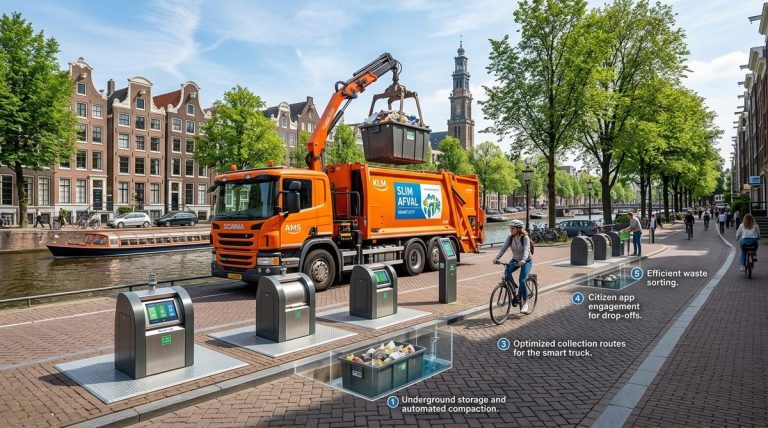
By 2026, Amsterdam has new targets. It aims to cut carbon emissions by 60% from 1990 levels by 2030. To get there, it is experimenting with hydrogen powered boats on the canals, smart waste bins that compact trash and alert collectors only when full, and AI driven district heating networks that reuse heat from data centres.
The city is also scaling up its circular procurement policy. Public tenders now require bidders to show how they will minimise carbon throughout a project’s lifecycle. This pushes innovation across the supply chain.
For a comprehensive view of the technologies driving this change, see our guide on top strategies for implementing smart city technologies in Amsterdam.
What This Means for Urban Planners and Researchers
Amsterdam’s story is not a blueprint to copy paste. Every city has different geography, politics, and social fabric. But the underlying principles are universal: start with data, involve citizens, test small, and scale what works.
The city’s carbon footprint reduction is not a single project. It is the sum of hundreds of small, smart decisions. Smart grids, dynamic traffic systems, circular materials, open data, and engaged residents all add up. For sustainability professionals, the key is to find the combination that fits your local context.
If you want to dig deeper into how Amsterdam uses AI and data to transform urban policy, read the role of data and AI in transforming urban policy in Amsterdam.
And if you are curious about how the city is using blockchain for transparency, our article on how Amsterdam is leveraging blockchain for urban innovation and transparency is a great next step.
Turning Amsterdam’s Lessons into Action
You now have a clear picture of how Amsterdam smart city innovations are reducing its carbon footprint. The city does not wait for perfect solutions. It tries, measures, adjusts, and shares.
Your job as a professional is to take these examples and adapt them. Start a pilot in one neighbourhood. Install a few sensors. Open the data. Talk to residents. You do not need a multimillion pound budget. Amsterdam’s early projects were small. The most important ingredient is the willingness to learn and iterate.
So pick one idea from this article. Maybe it is the smart grid pilot. Maybe it is the materials passport. Go test it. Measure the carbon saved. Then tell others about it. That is how real change happens – one smart innovation at a time.
About the Author