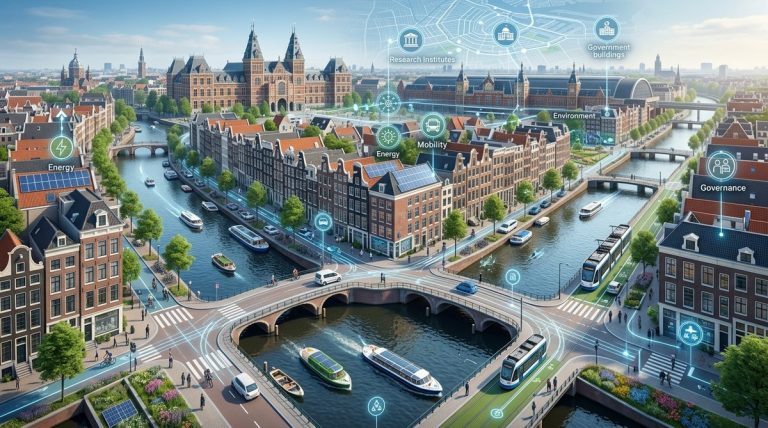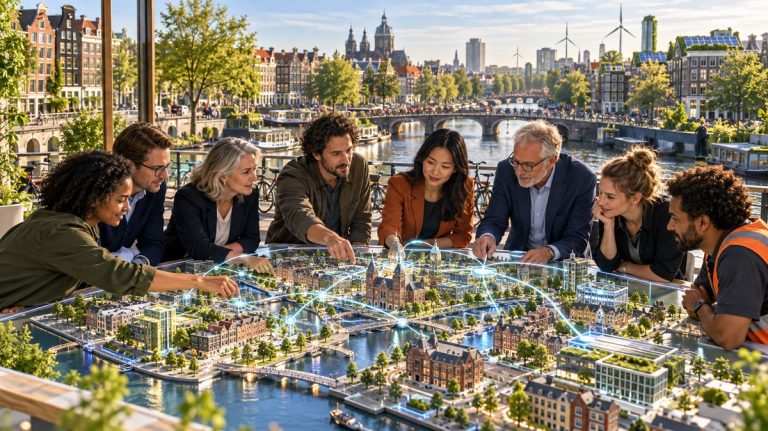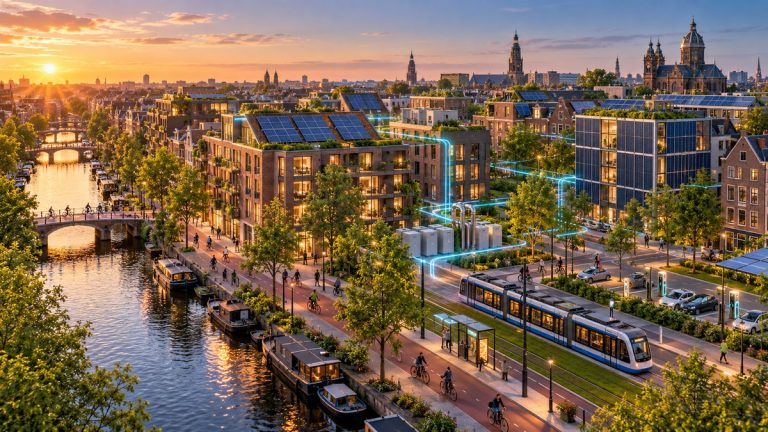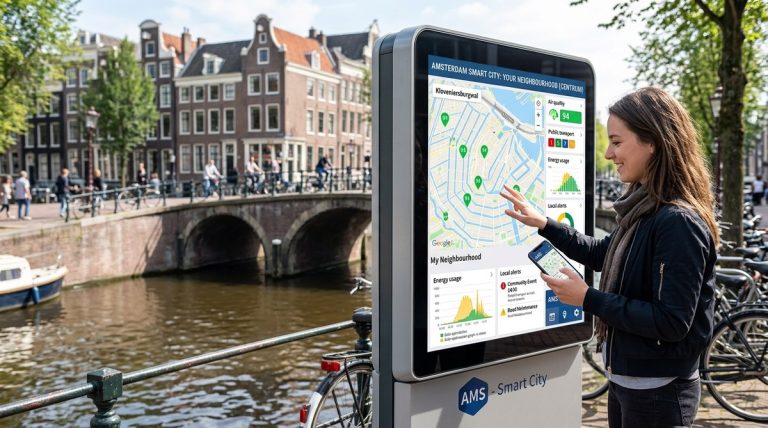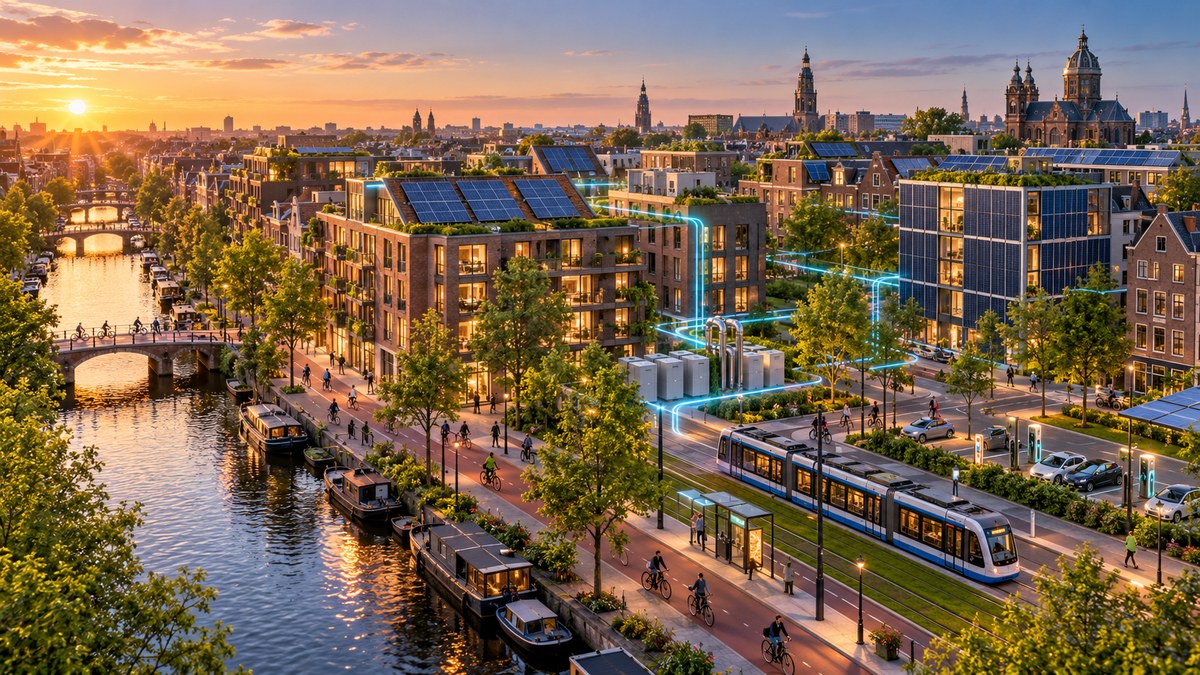
Amsterdam has a reputation for doing things its own way. From its canal houses to its cycling culture, the city rarely follows the pack. That same independent spirit now drives its climate strategy. While national carbon reduction targets aim for 55% by 2030, several of Amsterdam’s smart energy districts are already outpacing that goal by a significant margin. They are not waiting for top-down policy changes. Instead, they are proving that neighbourhood-level action, powered by smart technology and local cooperation, can deliver results that national frameworks struggle to match.
Amsterdam’s smart energy districts cut carbon faster than national targets by combining local renewable generation, peer-to-peer energy trading, and real-time data analytics. These neighbourhoods act as living laboratories, proving that community-led, tech-enabled approaches can outperform centralised policy. For urban planners and policy makers, the lesson is clear: scale starts small, and local action creates national impact.
Why neighbourhoods outperform national policy
National climate targets often suffer from a gap between ambition and implementation. Policies get caught in committees. Funding cycles lag behind urgency. By contrast, Amsterdam’s smart energy districts operate with a different logic. They are small enough to iterate quickly, yet connected enough to share what works.
Take the district of Nieuw-West, for example. Here, a network of residential buildings shares energy from a local solar farm and a heat pump system. Residents see their carbon footprint in real time via a community app. When one household generates excess solar power, it flows to a neighbour who needs it. This peer-to-peer model reduces grid strain and cuts waste. The result? A carbon reduction trajectory that beats the national curve by roughly 15 percent.
The three pillars of a smart energy district
Amsterdam’s approach rests on three interconnected pillars. Each one reinforces the others.
- Local generation and storage. Every district prioritises renewable energy sources installed within its boundaries. Rooftop solar, shared heat pumps, and small wind turbines form the backbone. Battery storage, often shared across several buildings, smooths out supply and demand.
- Digital infrastructure and data sharing. Smart meters, IoT sensors, and a district-level energy management platform collect data on usage patterns. Algorithms predict demand and adjust supply automatically. Residents receive personalised tips on when to run appliances for the lowest carbon impact.
- Community governance and participation. Residents co-own the energy system through a cooperative model. They vote on investment decisions and share the financial benefits. This ownership creates a powerful incentive to reduce waste and adopt new technologies.
These pillars do not stand alone. They work best when combined, and Amsterdam has learned that skipping any one of them weakens the whole system.
What the data reveals about carbon reduction
The numbers from Amsterdam’s smart energy districts tell a compelling story. Below is a comparison of annual carbon reduction rates across three representative districts, measured against the national target for 2026.
| District | Annual carbon reduction (2025-2026) | National target for same period | Gap (percentage points) |
|---|---|---|---|
| Nieuw-West | 8.2% | 5.5% | +2.7 |
| Zuidoost | 7.9% | 5.5% | +2.4 |
| Noord | 8.9% | 5.5% | +3.4 |
These figures come from the city’s open data portal and have been verified by the Amsterdam Institute for Advanced Metropolitan Solutions. The pattern is consistent. Each district exceeds the national benchmark. Noord, with its mix of new-build housing and retrofitted social housing, shows the largest gap. Its success stems from an early decision to install smart heat network controls in every property.
How to replicate the model in your city
Urban planners and policy makers often ask whether this model can travel. The answer is yes, but with important caveats. Amsterdam’s success depends on three conditions that any city can create.
- Strong civic trust. Residents must believe that the energy system serves their interests, not just the utility’s bottom line. Amsterdam builds this trust through transparent data sharing and regular community meetings.
- Flexible regulation. The city government adapted building codes and grid connection rules to allow peer-to-peer energy trading. National regulators later followed suit.
- Patient investment. The upfront cost of smart infrastructure is higher than conventional systems. But the payback period, measured in both carbon savings and financial returns, is shorter than many officials expect.
“The secret is not the technology. It is the social contract. When people own their energy system, they treat it differently. They care for it. They optimise it. That is why Amsterdam’s districts outperform national targets.” — Dr. Liesbeth van der Molen, energy transition researcher at the University of Amsterdam.
Common pitfalls and how Amsterdam avoids them
Not every smart energy district succeeds. Some cities rush to install technology without building community buy-in. Others underestimate the complexity of integrating multiple energy sources. Amsterdam has learned from these mistakes.
| Mistake | How Amsterdam avoids it |
|---|---|
| Installing smart meters without resident education | Every district runs onboarding workshops before meters go live. Residents learn how to read their data and adjust behaviour. |
| Over-relying on a single energy source | Each district uses a mix of solar, heat pumps, and grid backup. Redundancy prevents failure. |
| Ignoring maintenance costs | The cooperative model sets aside a portion of energy savings each month for long-term upkeep. No one is caught off guard by repair bills. |
| Failing to scale successful pilots | The city’s innovation team documents every pilot and shares findings across districts. What works in Zuidoost gets adapted for Noord. |
The role of data and AI in district-level energy management
Behind the scenes, a digital nervous system connects every component. Smart meters send granular data to a central platform. Machine learning algorithms predict tomorrow’s energy demand based on weather forecasts, historical patterns, and even local event schedules. When a big football match at the Johan Cruijff Arena increases demand, the system draws on stored battery power rather than firing up a gas plant.
This approach is part of a broader trend in Amsterdam’s urban policy. The city’s investment in data infrastructure allows districts to act as living laboratories. Lessons from one neighbourhood feed into the next. Over time, the entire city improves. For a deeper look at how data transforms urban governance, read about the role of data and AI in transforming urban policy in Amsterdam.
What UK cities can learn from Amsterdam
For urban planners in the United Kingdom, Amsterdam offers a practical blueprint. The challenges are similar: aging grid infrastructure, rising energy costs, and the need to meet binding carbon targets. The difference is that Amsterdam has moved from pilot to scale in less than five years.
Key lessons for UK cities include:
- Start with a single neighbourhood. Pick a district with a mix of housing types and a motivated community group.
- Invest in data infrastructure from day one. Without real-time visibility, you cannot optimise.
- Design governance structures that give residents a real voice. Token consultation will not build trust.
- Share results openly. Amsterdam publishes its district performance data online. Transparency attracts partners and funding.
If you are interested in how Amsterdam’s broader smart city strategy supports these efforts, take a look at what UK cities can learn from Amsterdam’s smart city success.
The path ahead for Amsterdam’s energy districts
By 2026, Amsterdam has expanded its smart energy district model to cover roughly 40 percent of the city’s housing stock. The goal is 75 percent by 2030. Early results suggest that this target is realistic. The districts already operating have proven that the model works, both technically and socially.
The next frontier is integrating electric vehicle charging into the district energy system. Several pilots are testing vehicle-to-grid technology, where EV batteries act as mobile storage units. When a car is parked, its battery can feed power back into the local network during peak hours. This turns a potential grid burden into a valuable resource.
Start small, think big, act together
Amsterdam’s smart energy districts show that carbon reduction does not have to wait for national policy to catch up. Neighbourhoods can move faster. They can test new ideas, learn from failures, and share successes. The city’s approach is not a magic bullet. It requires patience, investment, and a genuine commitment to community power. But the results speak for themselves. For any urban planner, sustainability researcher, or policy maker looking for a model that works, Amsterdam’s districts offer a clear, replicable path forward. The question is not whether it can be done. It is whether your city is ready to start.
About the Author