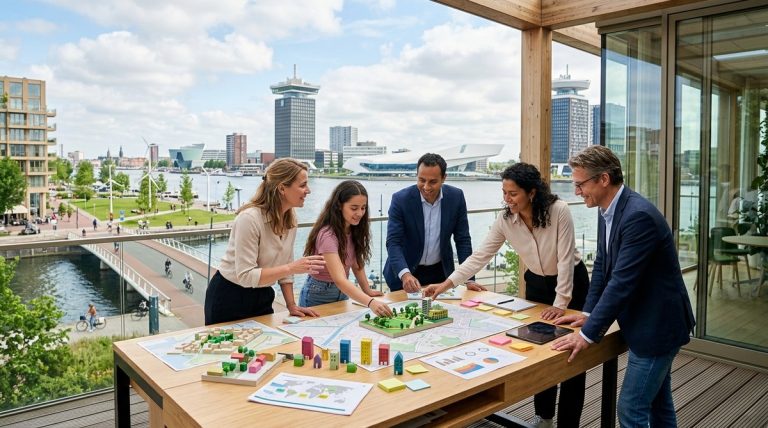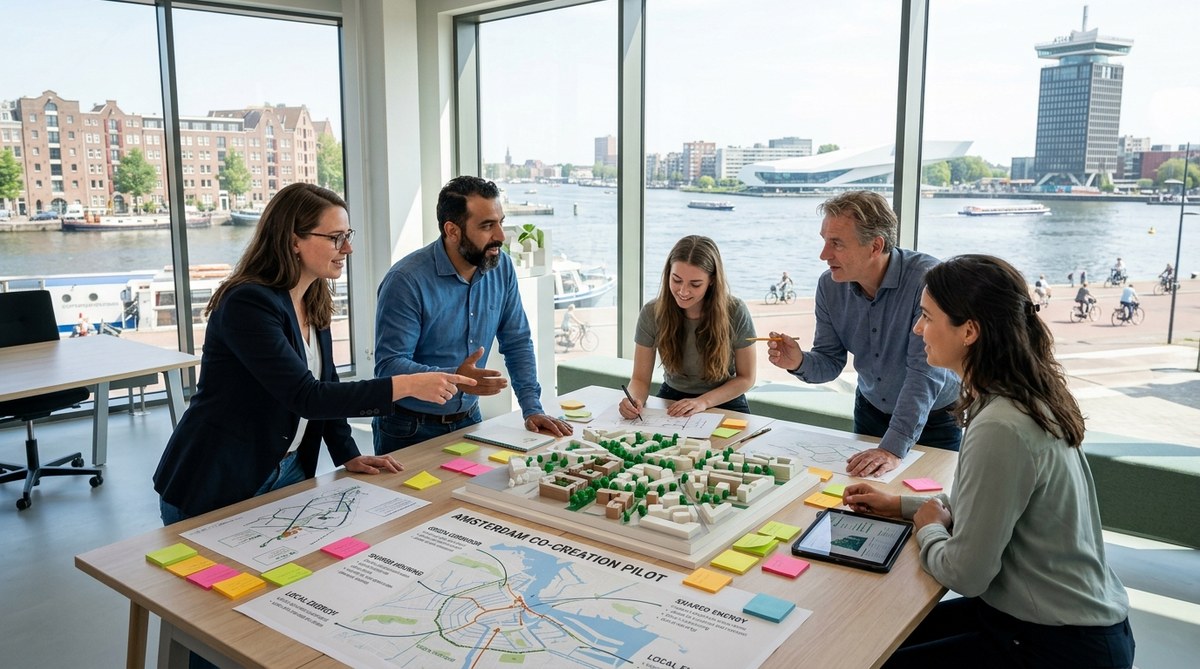
Amsterdam has always had a knack for doing things differently. While many cities still treat residents as passive recipients of top-down planning decisions, Amsterdam has turned the process upside down. Here, citizens sit at the same table as urban planners, data scientists, and policymakers. They sketch, debate, and shape their own streets, squares, and parks. This is not a one off consultation. It is a continuous, messy, and genuinely collaborative way of building the city. It is called urban co creation, and Amsterdam is proving it works.
Amsterdam’s approach to urban co creation shows that lasting neighbourhood change happens when residents are treated as experts of their own environment. By combining real time data, flexible governance, and low threshold participation tools, the city has created a model that reduces conflict, speeds up implementation, and builds genuine trust. For planners and policymakers everywhere, the lesson is clear: co creation is not a box ticking exercise but a long term commitment to shared decision making.
Why Amsterdam Chose Co Creation Over Top Down Planning
Amsterdam faced a familiar challenge: a growing population, pressure on public space, and a housing crisis. Traditional planning methods were too slow and often sparked protests. So the city tried something different. Instead of presenting finished designs, officials started asking open questions. What do you want your street to look like? How should we use that empty plot? The result was a shift from “decide, announce, defend” to “listen, prototype, adapt.”
This change did not happen overnight. It grew out of a series of experiments in the early 2020s, many of which are now standard practice in 2026. The city invested in neighbourhood based innovation labs, digital platforms for real time feedback, and simple tools like pop up bike lanes that let people test changes before they become permanent. Over time, these efforts built a culture where collaboration feels natural.
Five Principles That Make Amsterdam’s Co Creation Work
-
Start with shared problems, not solutions. Amsterdam does not ask residents to react to a pre packaged plan. Instead, it invites them to define the problem together. For example, when discussing traffic calming in the Oud Zuid district, the conversation began with “what worries you about this street?” not “which speed bump design do you prefer?”
-
Use data as a common language. Sensors, mobile apps, and open data dashboards give everyone the same facts. A resident can see real time air quality readings, traffic counts, and noise levels. This helps move debates from opinion to evidence. For a deeper look at how data transforms policy, read about the role of data and AI in transforming urban policy in Amsterdam.
-
Make participation accessible. Digital tools are useful, but Amsterdam also uses physical spaces like local workshops, street stalls, and even door to door conversations. In 2026, the city launched a “co creation bus” that visits different neighbourhoods each week, equipped with maps, models, and a mobile Wi Fi hotspot.
-
Iterate, don’t finalise. Co creation in Amsterdam treats every plan as a prototype. Changes are tested on a small scale first, then adjusted based on feedback. This reduces the fear of making mistakes and encourages creativity.
-
Share power and credit. The city acknowledges that residents are co authors of the outcome. Street naming rights, plaque installations, and public celebrations all reinforce the message that this is a collective achievement.
Common Mistakes vs Amsterdam’s Approach
| What Many Cities Do | How Amsterdam Does It Differently |
|---|---|
| Hold one public meeting then disappear | Run continuous engagement cycles with updates |
| Ask for feedback on detailed drawings | Start with broad, open ended questions |
| Use complex jargon and technical plans | Use simple visuals, models, and everyday language |
| Ignore digital divides | Offer offline and online participation equally |
| Treat criticism as a problem | See critique as useful design input |
| Move too fast toward a final decision | Keep options open through iterative prototyping |
| Claim success but give no credit to citizens | Celebrate co creators publicly and prominently |
This table highlights the mindset shift at the heart of Amsterdam’s success. The goal is not efficiency in decision making but effectiveness in building trust.
How a Neighbourhood Transformed Its Public Square
In 2025, residents of the De Pijp district used the co creation process to redesign the Eerste Van Swindenstraat square. Previously a car dominated through road, locals wanted a place for children to play, a garden for pollinators, and a small market space. The project started with a temporary closure, using planters and reclaimed wood to test ideas. After six months of open air prototypes, the final design was built with full community backing. One organiser told us:
“The best part was that we didn’t just get a nicer square. We got a group of neighbours who now know how to work with the council. When the next issue comes up, we know what to do.”
That sense of ownership is the real prize. It transforms citizens from occasional complainers into permanent partners.
Lessons for Urban Planners and Policymakers
If you are planning to introduce or improve co creation in your own city, here are the most important takeaways from Amsterdam’s experience.
- Invest in facilitation skills, not just technology. Good co creation needs people who can listen, synthesise, and manage conflict.
- Start small with a single street or park. Success there will build momentum for larger projects.
- Be honest about limits. Not every idea can be implemented. Explain why, and offer alternatives.
- Use real time data to keep everyone informed. Tools like traffic sensors and air quality monitors help ground discussions in facts.
- Build partnerships with local organisations. Schools, community centres, and businesses can help reach people who rarely attend council meetings.
For more detail on how Amsterdam harnesses citizen participation, see harnessing citizen engagement to accelerate urban innovation in Amsterdam.
Why 2026 Is the Year to Double Down on Co Creation
As cities around the world face budget constraints, climate pressures, and polarised communities, co creation offers a path that is both democratic and practical. Amsterdam’s model shows that when people feel heard, they are more willing to accept trade offs and support long term plans. The city’s doughnut economy framework, for instance, relies on the same participatory principles to balance environmental and social goals. You can learn about that approach in why Amsterdam’s doughnut economy model is a blueprint for sustainable urban growth.
Of course, co creation is not a silver bullet. It takes time, resources, and a willingness to share authority. But the payoff is enormous: neighbourhoods that are not only well designed but also well loved.
Start Your Own Co Creation Journey
Amsterdam did not invent co creation. But it has turned it into a reliable, scalable method for urban renewal. The tools exist: open data, mobile apps, temporary interventions, and a committed workforce. What matters most is the mindset. Are you ready to treat residents as partners rather than objects of planning? If so, take the first step today. Pick one street, one square, one issue. Invite people to join you. Listen before you speak. And then build together.
For a broader look at how Amsterdam integrates innovation across all its systems, explore innovative urban solutions shaping Amsterdam’s future in 2026.
About the Author