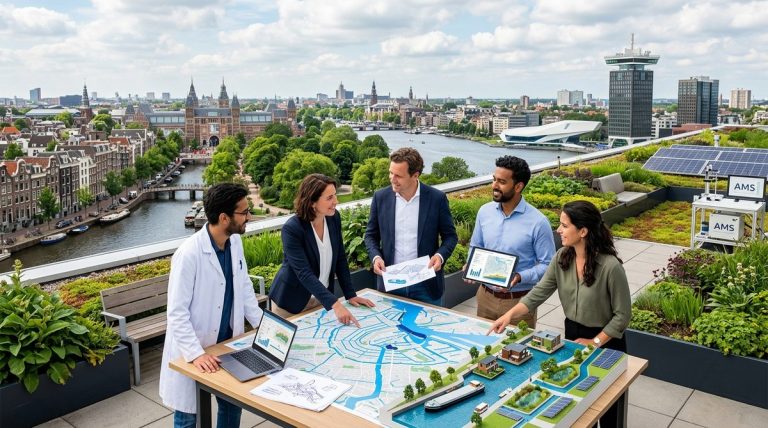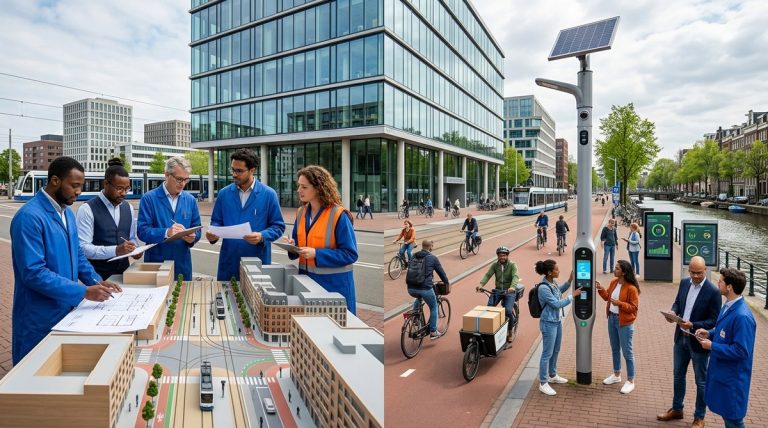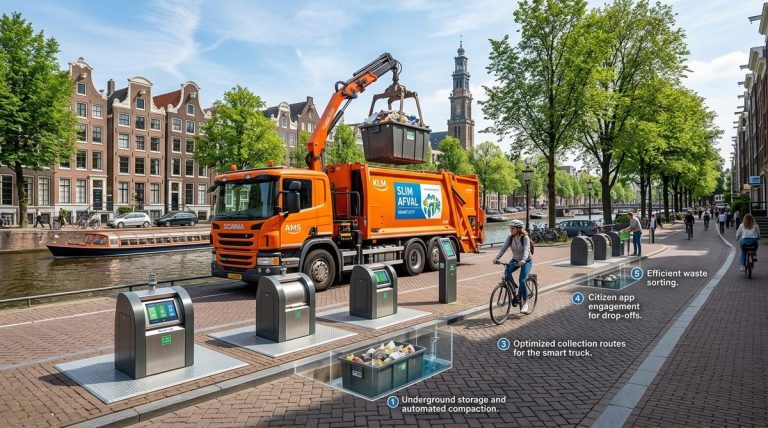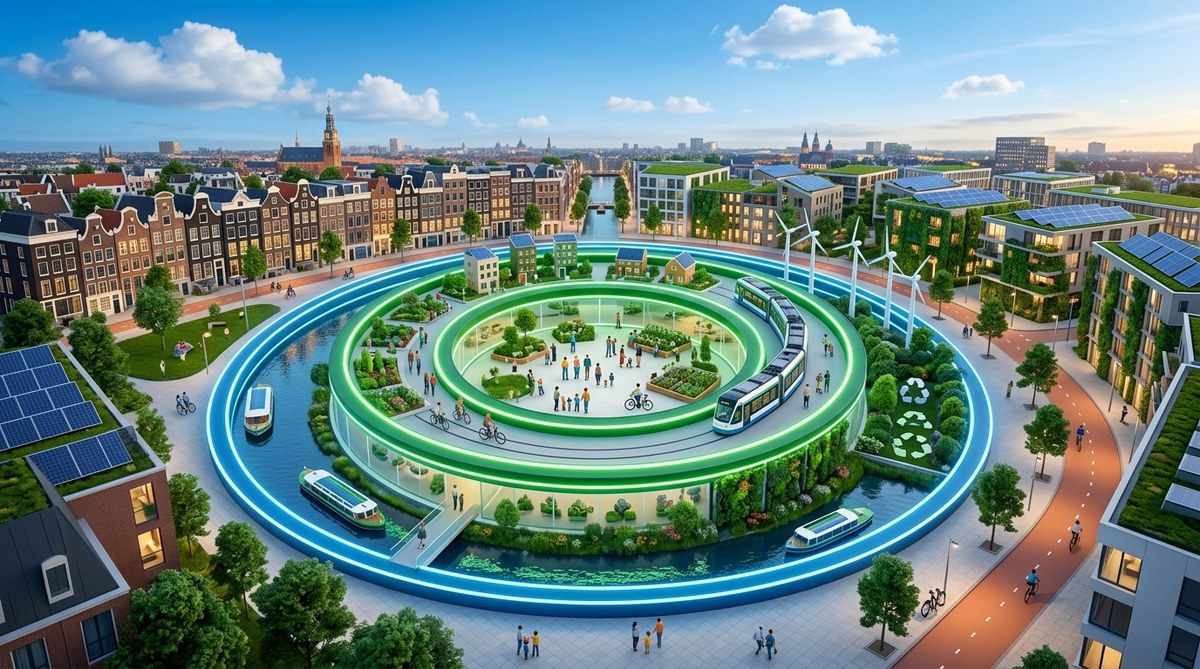
Amsterdam has always been a city of bold ideas. Canals, cycling, and creative thinking are part of its DNA. In 2020, the city adopted something entirely new: the doughnut economy model. It is a way of thinking about urban growth that puts both people and the planet first. No more trade offs between housing and nature, or jobs and clean air. The model asks a simple question: how do we meet everyone’s basic needs without overloading the Earth? Amsterdam is showing that it is possible.
The Amsterdam doughnut economy model is the first city-scale application of Kate Raworth’s economic framework. It sets a social foundation (housing, food, health, equality) and an ecological ceiling (climate, biodiversity, pollution). Amsterdam uses circular strategies, citizen participation, and data driven policies to stay within this safe space. UK cities can adopt similar steps.
What Is the Doughnut Economy Model?
The doughnut economy model was created by economist Kate Raworth in her 2017 book Doughnut Economics. Think of a ring shaped diagram. The inner ring represents the social foundation: the minimum every person needs for a good life. Things like clean water, food, housing, education, income, and political voice. The outer ring is the ecological ceiling: the limits of our planet. Beyond that lie climate change, ocean acidification, biodiversity loss, and other global threats.
Between the two rings lies the safe and just space for humanity. That is where we should aim to live. Not too little, not too much. The model is not anti growth. It is about redistributive and regenerative growth. It asks cities to move from linear take make waste systems to circular ones.
Amsterdam decided to put this theory into practice. In April 2020, the city council adopted the doughnut as its guiding compass. It was the first major city in the world to do so. Since then, it has influenced cities from Brussels to Portland.
How Amsterdam Adopted the Doughnut: A Timeline of Action
Amsterdam’s journey from theory to action happened in stages. Here is a summary:
- 2020: City council officially endorses the doughnut model. The city launches a dedicated programme called “Amsterdam City Doughnut”.
- 2021: The first City Doughnut report is published. It maps Amsterdam’s social and ecological performance. Gaps and overshoots are identified.
- 2022: Sector strategies start. Construction, food, textiles, and electronics become priority areas for circularity.
- 2023: New procurement rules require all public contracts to align with doughnut principles.
- 2024: Citizen assemblies on doughnut topics begin. Residents help decide how to spend local budgets.
- 2025: The city announces a goal to halve material use by 2030 compared to 2020 levels.
- 2026: Current focus on scaling up nature based solutions and affordable housing within ecological limits.
Each phase was supported by data. Amsterdam uses smart technologies to create a more sustainable city, such as sensors that track energy use and waste flows. This data feeds into the doughnut dashboard, which shows progress in real time.
The Four Principles of Amsterdam’s Doughnut Strategy
Amsterdam structures its approach around four principles. These are not just nice ideas. They guide every decision.
- Regenerate: Restore natural systems. For example, the city uses green roofs, urban wetlands, and rewilding projects to bring nature back into neighbourhoods.
- Distribute: Share resources fairly. This means affordable housing targets, living wages, and public transport access for all.
- Circular: Keep materials in use. Construction waste is reused. Electronics are repaired. Food waste is composted.
- Participate: Involve everyone. Citizens, businesses, and community groups co create solutions.
These principles align with several circular economy initiatives transforming Amsterdam’s urban landscape, such as the circular Buiksloterham district and the Oude Westen neighbourhood repairs hub.
Practical Steps for Urban Planners: A Numbered List
If you are an urban planner or policymaker in the UK wondering how to apply this model, here is a repeatable process inspired by Amsterdam.
-
Map your city’s doughnut. Gather data on social indicators (housing, health, income) and ecological ones (carbon, waste, water use). Identify where your city falls short or overshoots. Amsterdam used the “City Portrait” method developed by Doughnut Economics Action Lab.
-
Set local thresholds. Define what “enough” means in your context. For example, what is the minimum living space per person? What is the maximum acceptable air pollution level? Use science based targets where possible.
-
Engage citizens early. Hold town halls, online forums, or citizen assemblies. Let residents decide which social gaps to close first. Amsterdam uses citizen engagement to accelerate urban innovation, ensuring policies have grassroots support.
-
Redesign procurement. Change how the city buys goods and services. Prioritise circular products, local suppliers, and social enterprises. Amsterdam now requires all tender documents to include doughnut criteria.
-
Create a feedback loop. Use real time data to track progress. Publish a public dashboard. Adjust policies based on what works and what does not.
-
Scale sector by sector. Do not try to do everything at once. Pick two or three high impact sectors first. In Amsterdam, construction and food were the starting points.
Tools and Techniques: A Comparison Table
Different approaches to urban sustainability exist. The table below contrasts the doughnut model with traditional planning.
| Aspect | Traditional Planning | Doughnut Model (Amsterdam) |
|---|---|---|
| Goal | Economic growth above all | Safe and just space for all |
| Resource use | Linear (extract, use, discard) | Circular (reduce, reuse, regenerate) |
| Social focus | Minimal welfare safety net | Universal social foundation |
| Environmental limit | Often ignored or offset | Hard ecological ceiling |
| Decision making | Top down, expert led | Participatory, citizen led |
| Metrics | GDP, employment, house prices | Doughnut dashboard: social + ecological indicators |
This framework helps avoid common pitfalls. For instance, building more affordable housing without considering material sourcing might increase carbon emissions. The doughnut model forces you to address both.
“The doughnut helps us see the whole picture. It is not just about recycling or building cycle lanes. It is about asking whether our city provides enough for everyone without destroying the planet.”
– Marieke de Hoop, Amsterdam’s Circular Economy Programme Manager (2024)
Common Mistakes and How to Avoid Them
Even well intentioned cities can slip. Here are errors to watch for.
- Mistake: Treating the doughnut as a branding exercise. Fix: Embed it into budgets and legal frameworks, not just press releases.
- Mistake: Ignoring inequalities. Fix: Use disaggregated data to see which groups are left behind. Amsterdam looks at income, ethnicity, and neighbourhood.
- Mistake: Focusing only on ecological goals. Fix: Balance social and ecological equally. The doughnut is one system.
- Mistake: Forgetting to include businesses. Fix: Create partnerships with local companies. Amsterdam works with Schiphol Airport and Heineken to reduce waste.
Lessons for UK Cities
British cities face similar challenges to Amsterdam: housing shortages, air pollution, climate risks, and inequality. The doughnut model offers a clear direction.
Take Birmingham. It has a strong industrial history and a growing population. Applying the doughnut could mean prioritising retrofitting homes for warmth (social) while using local materials (circular). Or consider Manchester, which already has a climate change framework. Adding a social foundation layer could help address child poverty and poor health alongside carbon targets.
London has already shown interest. The London Borough of Lambeth piloted a doughnut portrait in 2023. It revealed that overshoot in consumption (food, electronics) was damaging ecosystems far beyond London’s borders. The next step is to set local thresholds and involve communities.
What can UK cities learn from Amsterdam’s smart city success? A key lesson is the importance of data openness. Amsterdam shares its doughnut data with everyone. Transparency builds trust and allows citizens to hold the city accountable.
A Blueprint Worth Copying
The Amsterdam doughnut economy model is not a fixed recipe. It is a living framework that adapts as conditions change. What makes it powerful is its clarity. You know when you are in the safe space and when you are not. It replaces vague sustainability goals with a concrete diagnostic.
For urban planners and policymakers reading this in 2026, the time to start is now. You do not need a perfect data set or a massive budget. Begin with a portrait. Talk to residents. Pick one sector that matters most in your city. Small steps, when guided by the doughnut, add up to something big.
Amsterdam is showing the world that a city can thrive without exhausting the planet. That is a blueprint every community deserves to try.
About the Author