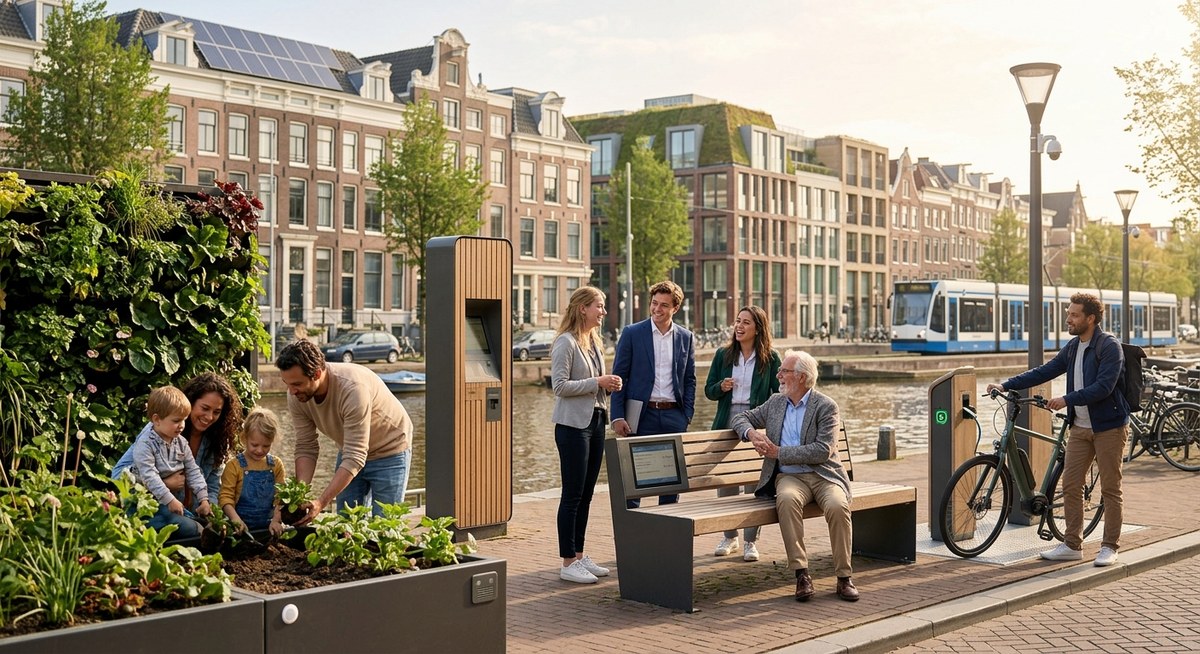
Amsterdam is not trying to become the most high tech city in Europe. It is trying to become the most livable one. That is a subtle but powerful shift. The city’s smart city strategy flips the usual script: instead of asking “What can technology do?” it first asks “What do residents need?”. The result is a set of initiatives that treat wellbeing as the benchmark and technology as a tool, not a goal. For urban planners and policymakers in the UK, this approach offers a refreshing, human centred alternative to the usual tech first hype.
Amsterdam proves that smart city wellbeing flourishes when citizen needs lead technology decisions. The city uses sensors and data to solve real problems like air quality and noise, not to collect data for its own sake. For UK planners, the lesson is clear: start with outcomes like healthier streets, stronger community ties, and equal access. Technology will follow, but people must come first.
Why Wellbeing Becomes the True North
Many smart city projects begin with a sensor. Amsterdam begins with a question. For example, instead of installing smart bins because they look innovative, the city asks “Does this reduce litter and improve how people feel about their neighbourhood?”. This subtle change in order changes everything.
Citizen wellbeing in Amsterdam means cleaner air, less noise, safe cycling routes, affordable housing, and social connections. The city uses technology to support those outcomes, not to dazzle. Take the smart traffic system. It does not just optimise flow. It prioritises cyclists and pedestrians, cutting waiting times at crossings and making the streets safer. That directly improves daily life for thousands of residents.
The shift is a cultural one. Amsterdam’s municipality treats residents as partners, not data points. They run co-creation sessions, neighbourhood labs, and open data platforms where people can see what the city measures. Transparency builds trust. And trust is the bedrock of any successful smart city.
How Amsterdam Redefined Smart City Success
Most cities measure smart city success by the number of connected devices or gigabytes of data collected. Amsterdam measures success by metrics linked to happiness, health, and equity. This table shows the difference:
| Traditional Metric | Amsterdam’s Wellbeing Focused Metric |
|---|---|
| Number of IoT sensors deployed | Reduction in noise complaints per postcode |
| Traffic flow speed | Time saved for cyclists and pedestrians |
| Energy consumption per building | Residents’ satisfaction with indoor comfort |
| Air quality data points | Asthma hospital admissions in vulnerable areas |
| App download numbers | User reported trust in digital services |
The city runs longitudinal surveys alongside its data dashboards. It asks people directly: “Are you breathing easier? Do you feel safer? Can you access green space?”. Those answers shape policy. For instance, when data showed that some neighbourhoods had poor access to parks, Amsterdam planted green corridors and added smart irrigation to keep them thriving with minimal water use.
The Amsterdam Approach: Real World Initiatives
Amsterdam has three concrete steps it follows to keep wellbeing at the centre of every smart project. These same steps can guide UK planners.
-
Start with a community problem, not a tech solution. The city uses neighborhood forums and local councils to identify top concerns. In 2025, residents in the East borough flagged that street noise kept them awake. The city then deployed sound sensors that pinpointed hotspots, rather than blanketing the area with expensive and unneeded hardware. Once the problem was understood, the solution became obvious: redirect late night delivery trucks away from residential streets.
-
Co design the intervention with residents. Amsterdam does not build a prototype and then ask for feedback. It invites residents into the design phase. For the smart lighting project in the Jordaan district, locals chose the colour temperature, brightness schedule, and even the location of each lamp. The result? A 30% drop in complaints about light pollution and a measurable rise in evening street usage.
-
Evaluate against wellbeing indicators, not just efficiency. After implementation, the city reviews data on health, social interaction, and local economic activity. Did the new smart benches (with solar charging) actually increase how long older residents sat and chatted? If not, the bench gets moved or redesigned. The loop of continuous improvement is powered by human feedback, not just algorithms.
Balancing Data Privacy and Public Good
Every smart city initiative walks a line between useful data and intrusive surveillance. Amsterdam navigates this with clear rules and open governance. The city’s data ethics board includes citizens, not just bureaucrats. They review every project that collects personal data before it starts.
“Amsterdam treats data like a public utility, not a private asset. The city does not sell resident data. It publishes anonymised datasets freely so that researchers, startups, and citizens can all benefit. That transparency is the foundation of trust.”
Mieke van der Meer, former Amsterdam Chief Technology Officer (interviewed 2025)
This approach means that smart city wellbeing is never sacrificed for commercial gain. When the city trialled a predictive policing algorithm a few years ago, community backlash was strong. The algorithm was stopped. The lesson stuck: if a technology erodes trust, it fails the wellbeing test.
UK cities can adopt similar principles by establishing citizen data commissions and requiring transparency reports every year. It is not slower. It is smarter.
What UK Planners Can Learn from Amsterdam
The lessons from Amsterdam are practical, not theoretical. They translate directly to UK contexts like Manchester, Bristol, or Edinburgh.
- Involve residents early and often. Amsterdam’s City Talks and Urban Innovation Labs are open to anyone. UK planners can set up similar participatory structures, using digital tools to reach people who cannot attend physical meetings.
- Choose problems that matter most. Air quality, loneliness among older adults, and access to healthy food are universal. Smart technology can help, but only if the problem is well defined first.
- Avoid vendor lock in. Amsterdam uses open standards and modular systems. It buys solutions that can talk to each other. That prevents silos and keeps costs down.
- Measure what people feel. Combine quantitative data with qualitative surveys. A 10% drop in traffic noise might matter less to residents than a new bench where neighbours meet.
- Celebrate small wins. The city highlights things like a smart water pump that helped community gardens thrive. Small successes build momentum and public support.
If you want to go deeper into how citizen engagement shapes policy, read our piece on the role of citizen engagement in shaping Amsterdam’s smart city initiatives.
A Framework for Citizen Centric Smart Cities
Here is a practical summary of techniques to use and mistakes to avoid, based on Amsterdam’s experience.
| Do This | Avoid That |
|---|---|
| Start with a community problem | Start with a cool gadget |
| Co design with residents | Design in a boardroom |
| Use open data and clear ethics | Hoard data and obscure algorithms |
| Measure wellbeing and trust | Measure only efficiency |
| Build modular, interoperable systems | Buy proprietary, closed platforms |
| Publish transparent evaluations | Hide failures |
Amsterdam failed with early smart parking systems that confused drivers. It admitted the error, scrapped the system, and redesigned it with user testing. That honesty is part of the city’s DNA. It recognises that smart city wellbeing is a journey, not a destination.
Building Cities That Serve People, Not Machines
Amsterdam’s smart city story is not about flying shuttles or robot dogs. It is about making a canal city quieter, safer, and greener. It is about giving residents a real voice in how technology shapes their home. For UK planners and researchers, the message is inspiring and actionable.
Start small. Ask your community what bothers them most. Then look for a smart tool that can help, not the other way around. Keep the data open. Keep the governance local. And always measure success by the smiles on faces, not the lights on a dashboard.
If you want to see how Amsterdam uses smart technologies to create a more sustainable city, we have a full case study here. And for a broader view of what makes Amsterdam a global leader in urban innovation, this analysis explains the ecosystem behind the results.
The future of urban living is not about more screens. It is about better lives. Amsterdam shows us how.
About the Author