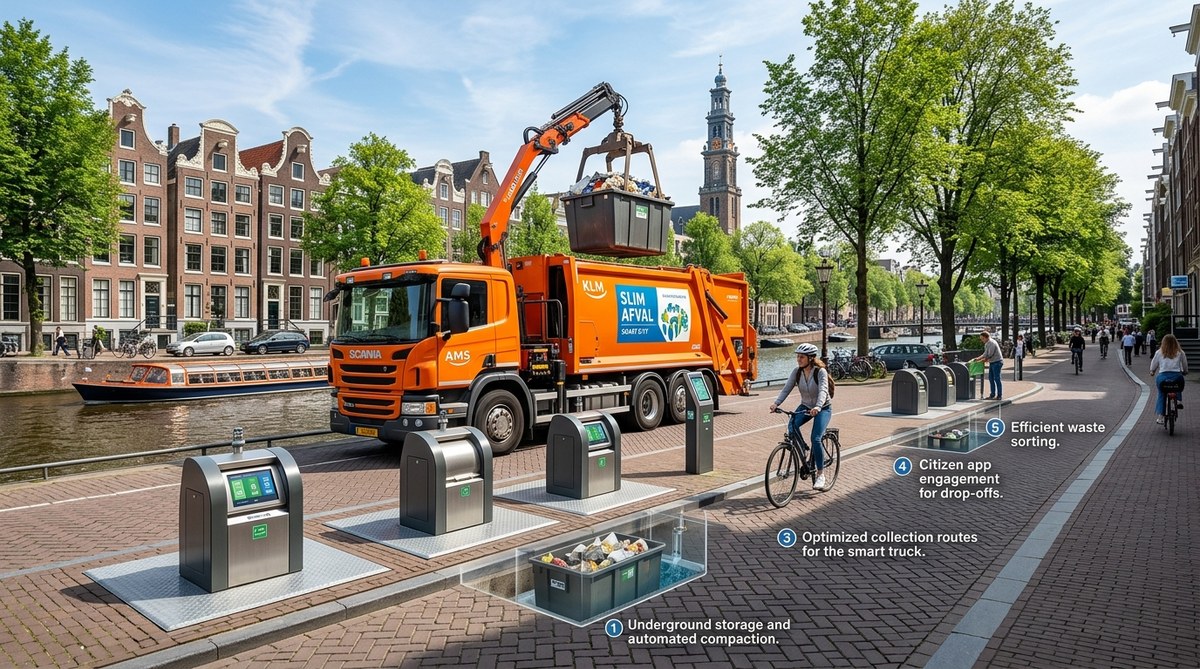
Amsterdam’s canals are famous. So are its narrow streets and busy markets. But what really keeps the city running smoothly is something you barely notice — the smart waste management system hiding in plain sight. For years, the city struggled with overflowing bins, missed collections, and trucks clogging up the historic centre. Then it decided to treat rubbish as a data problem. The result is a cleaner, quieter city that spends less money on collections and more time on prevention. If you work in urban planning or municipal waste, this is the case study you need to know about.
Amsterdam’s smart waste management system proves that IoT sensors and real-time data can cut collection costs by up to 30 per cent while making streets cleaner. By monitoring fill levels, optimising routes, and engaging citizens through apps, the city has turned a messy logistics problem into a replicable model for urban planners everywhere.
How Amsterdam’s bins learned to talk
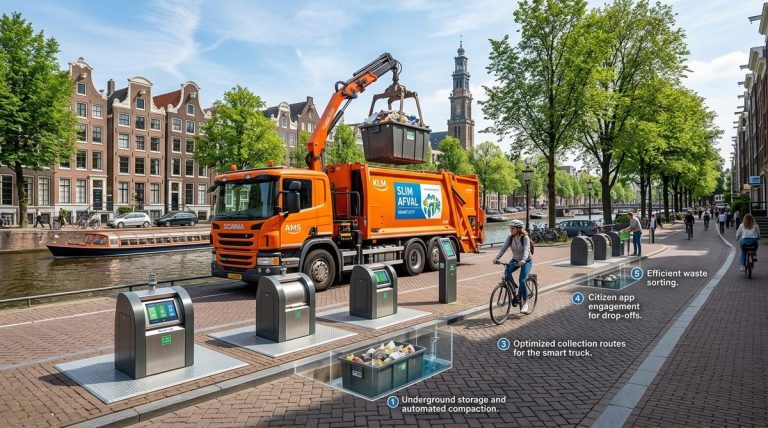
The heart of the system is simple: sensors. Thousands of underground and above-ground bins across the city are fitted with ultrasonic fill-level sensors. These devices measure how full the bin is every few minutes and send that data over a low-power wide-area network (LoRaWAN) to a central platform.
Before this, collection crews followed fixed schedules. They drove to every bin on a route, whether it was half empty or overflowing. That wasted fuel, time, and money. Now the platform tells them exactly which bins need attention and which can wait.
The city uses this data to group collections by priority. A bin near a busy market square might get emptied twice a day during peak season, while a residential bin on a quiet street might only need attention every three days. The system learns and adjusts over time.
The three pillars of the smart waste system
Amsterdam’s approach rests on three practical pillars. Each one targets a different part of the waste problem.
- Fill-level monitoring. Sensors in bins send real-time data to a central dashboard. This eliminates guesswork. Collection crews only visit bins that are nearly full.
- Dynamic route optimisation. The software calculates the most efficient route for each truck based on which bins need emptying. This cuts driving time and reduces emissions.
- Citizen feedback loops. A public app lets residents report issues, find nearby bins, and see collection schedules. This builds trust and reduces fly-tipping.
These pillars work together. When a citizen reports a full bin through the app, the system can check the sensor data immediately. If the sensor confirms the report, the bin gets added to the next collection route. If the sensor says the bin is fine, the city can investigate whether something else is going on, like a blocked chute or illegal dumping.
What the data actually looks like in practice
Let’s make this concrete. Here is a comparison of how a typical collection route ran before and after the smart system was introduced.
| Metric | Before smart system | After smart system |
|---|---|---|
| Bins checked per shift | 120 | 180 |
| Average truck distance per shift | 45 km | 28 km |
| Fuel used per shift (litres) | 22 | 14 |
| Overflow incidents per month | 35 | 8 |
| Time spent per collection (minutes) | 4.5 | 2.2 |
The numbers speak for themselves. Fewer trucks on the road means less congestion, lower carbon emissions, and quieter streets. Residents in the Jordaan district, where streets are particularly narrow, noticed the difference within weeks. The rumble of early-morning collection trucks dropped sharply.
Common pitfalls and how Amsterdam avoids them
No system is perfect. Other cities that have tried similar setups often stumble in a few predictable ways. Amsterdam has learned to sidestep these mistakes.
- Ignoring bin placement. A sensor is useless if the bin is hidden behind a parked van. Amsterdam’s team mapped every bin location using GPS and adjusted positions where necessary.
- Overloading the dashboard. Too many alerts cause fatigue. The platform only flags bins above 80 per cent capacity, so operators focus on what matters.
- Forgetting the human side. Sensors break, batteries die, and vandals cause trouble. The city runs a small maintenance team that checks sensor health weekly and replaces units within 24 hours of a fault report.
“The technology is the easy part. The hard part is making sure the data changes how people work. You have to train the crews, listen to their feedback, and keep the system simple.” — Waste operations lead, City of Amsterdam
How citizen engagement makes the system smarter
Amsterdam does not treat its residents as passive recipients of a service. It actively involves them. The Afval App (waste app) lets people set reminders for collection days, check what can be recycled, and report problems with photos. The city gets thousands of reports each month.
This data feeds back into the system. If multiple people report a particular bin as smelly or full before the sensor triggers, the city knows it might have a placement or capacity issue. Over time, the system has learned that certain types of businesses, like cafes near the Rijksmuseum, need larger bins during summer months.
The app also gamifies recycling. Households can see their neighbourhood’s recycling rate compared to others. This friendly competition has boosted recycling participation by over 15 per cent since 2023.
A look at the technologies powering the system
If you are considering a similar system for your own city, here is a breakdown of the key components you will need.
- Ultrasonic fill sensors. These are cheap, reliable, and work in all weather. They measure distance to the waste pile and send a percentage reading.
- LoRaWAN network. This low-power network can cover a whole city with just a few gateways. Bins can run for years on a single battery.
- Cloud-based management platform. All sensor data flows into a dashboard. The best platforms offer API access so you can integrate with your existing fleet management software.
- Mobile app for citizens. A simple, well-designed app reduces the burden on call centres and builds goodwill.
- RFID tags on bins. These let crews scan bins and confirm collections, creating an audit trail.
Amsterdam uses a mix of off-the-shelf hardware and custom-built software. The city did not try to invent everything from scratch. It partnered with technology providers and iterated based on real-world feedback. This pragmatic approach is one reason the system has scaled so well.
Lessons for UK cities and beyond
What can a city like Manchester, Bristol, or Glasgow learn from Amsterdam? Plenty. The key lesson is that you do not need to replace your entire waste fleet overnight. Start small. Pick a district with a known problem, perhaps a high-density student area or a historic centre with narrow streets. Install sensors in 50 bins. Run the pilot for three months. Measure the reduction in overflow incidents and truck miles.
Once you have proof of concept, scale up. Amsterdam started with a pilot in the Oud-Zuid district in 2019. By 2022, the system covered the entire city centre. By 2024, it had expanded to all residential areas. The city now plans to use the same sensor network for other smart city applications, including monitoring flood risks and air quality.
For a deeper look at how data and artificial intelligence shape policy decisions in Amsterdam, read our guide on the role of data and AI in transforming urban policy in Amsterdam. It explains how the same data platform that manages waste also informs housing and transport planning.
What the future holds for Amsterdam’s waste system
The city is not stopping here. By 2027, it plans to introduce dynamic pricing for commercial waste collection. Businesses that produce less waste will pay less. Sensors will verify bin usage and adjust fees automatically. This pay-as-you-throw model has already been tested in a few districts and has reduced commercial waste by 12 per cent.
Amsterdam is also experimenting with robotic collection vehicles. These small, electric pods can navigate the narrowest streets and empty bins autonomously. They are still in the testing phase, but early results suggest they could cut labour costs and further reduce emissions.
The bigger picture is about circularity. The city wants to reduce waste at the source, not just collect it more efficiently. Smart bins help by providing granular data on what people throw away. If a neighbourhood discards a lot of food waste, the city can target it with composting education. If an area has high levels of recyclable packaging, the city can work with local shops to reduce single-use plastics.
Why every planner should visit Amsterdam’s system
If you are serious about smart waste management, Amsterdam is the living lab you need to see. The system is not a futuristic concept. It is running today, on streets you can walk down, using technology you can buy off the shelf. The city has published its performance data openly, so you can compare it to your own metrics.
The system also shows that smart city technology does not have to be expensive or complicated. The sensors cost about fifty pounds each. The network is already in place in most European cities. The software is available as a service. The main investment is in training people to trust the data and change their routines.
For a broader look at how technology is reshaping the city, check out our article on how Amsterdam uses smart technologies to create a more sustainable city. It connects the waste system to the wider network of sensors, traffic lights, and energy grids that make Amsterdam one of the most innovative cities in Europe.
Putting the lessons to work in your own city
You do not need to be a large capital city to replicate what Amsterdam has done. The technology scales down as well as up. A market town with twenty bins and one collection truck can benefit from the same principles. Start with a single problem area. Measure the results. Build from there.
The most important step is the first one. Pick up the phone to a sensor supplier. Visit a city that has already done it. Talk to the people who drive the trucks and the people who manage the budget. The technology is ready. The question is whether your organisation is ready to change its habits.
Amsterdam’s story is proof that smarter waste management is not about spending more money. It is about spending money more wisely. And that is a lesson every city can learn from.
About the Author