Amsterdam has always been a city of pragmatists. From its canal houses built to withstand a wet climate to its bike-first transport policy, the Dutch capital rarely does things by halves. So when the Amsterdam Right to Repair law 2026 came into force this January, it did not arrive with a whisper. It arrived with a clear message: if you sell a product in this city, you must help keep it alive.
The law targets manufacturers of consumer electronics, white goods, and small household appliances. It forces them to provide spare parts, repair manuals, and diagnostic tools for at least seven years after a product’s launch. For urban planners and policy makers watching from the UK, this is not just a niche consumer win. It is a test case for how local legislation can reshape the entire fabric of urban manufacturing.
The Amsterdam Right to Repair law 2026 is already shifting urban manufacturing from a linear ‘make use dispose’ model to a circular one. Early data shows a 14% rise in independent repair businesses in the city and a 22% drop in bulky waste at municipal collection points. For UK planners, it offers a replicable blueprint for local circular economies.
How the law changes the factory floor
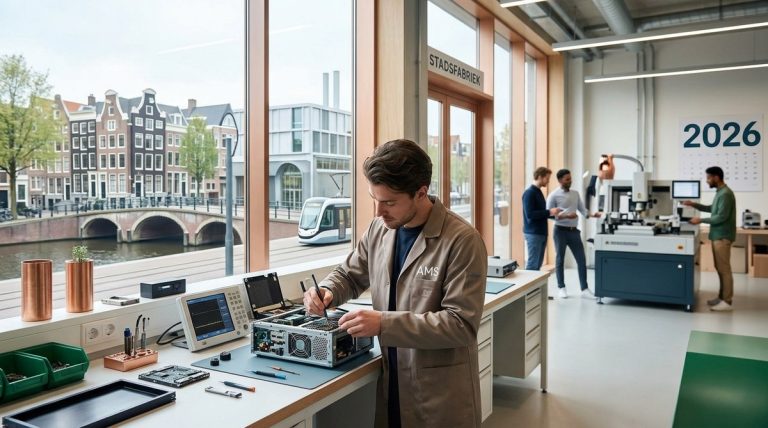
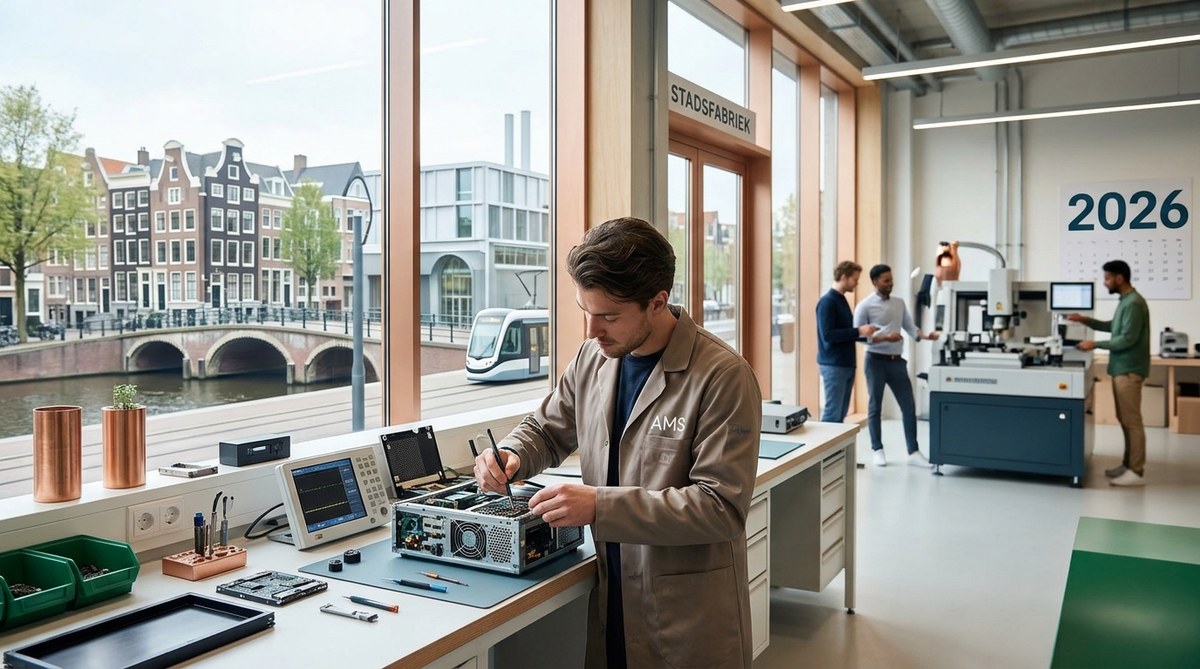
Most people picture manufacturing as a distant activity. It happens in huge sheds on industrial estates, far from the city centre. But Amsterdam’s approach is different. The law has given rise to what locals call ‘micro manufacturing hubs’. These are small workshops, often inside former warehouses or ground floor retail units, where trained technicians rebuild products using official parts.
This is not just about fixing a toaster. It is about redesigning the supply chain. Manufacturers that once shipped replacement units from factories in Eastern Europe now send component kits to depots in Amsterdam Noord. The result is a shorter, cleaner logistics loop.
Here is how the new process typically works for a local repair cafe:
- A customer brings in a faulty washing machine from 2022.
- The repairer scans the product’s QR code to access the official repair portal.
- The portal lists all available spare parts, step by step guides, and torque settings.
- The repairer orders the specific part, which arrives from a local warehouse within 24 hours.
- The machine is fixed, tested, and returned with a six month warranty.
This numbered process is now standard for over 300 registered repair businesses in the Amsterdam region. It has turned what was once a hobbyist activity into a professional, scalable sector.
What this means for urban planners
If you are an urban planner in Manchester or Bristol, you might wonder how this applies to your own high streets. The answer is more direct than you think. The Amsterdam model shows that repair based manufacturing creates a new category of employment: the urban technician. These are not low skill jobs. They require diagnostic ability, soldering knowledge, and familiarity with software updates.
The law has also changed how the city allocates commercial space. The municipality now offers reduced business rates for properties that dedicate at least 30% of their floor area to repair or refurbishment activities. This policy, called the ‘Repair First’ zoning rule, has already converted 45 empty retail units into active workshops since January 2025.
- Reduced business rates for repair focused spaces.
- Priority permitting for logistics routes serving repair hubs.
- Free disposal of non repairable e waste at civic amenity sites.
- Grants for training programmes in product repair skills.
- Public awareness campaigns promoting repair over replacement.
These five measures form the backbone of the city’s support system. They are simple, low cost, and highly effective.
A table of techniques and common mistakes
To help policy makers understand what works and what does not, here is a comparison of techniques used in Amsterdam versus common mistakes seen in other European cities.
| Technique | Amsterdam approach | Common mistake elsewhere |
|---|---|---|
| Spare part access | Mandatory seven year supply, tracked by QR code | Voluntary agreements that expire after two years |
| Training | City funded certification for repair technicians | No formal training, reliance on YouTube videos |
| Consumer incentives | Reduced VAT on repair labour | No financial incentive, repair costs same as replacement |
| Waste collection | Separate bin for ‘repairable’ items at recycling centres | All e waste mixed together, sent to shredder |
| Data sharing | Open source repair manuals required by law | Proprietary software locks, no diagnostic access |
The table shows a clear pattern. The most effective policies are those that remove friction. When a repair is cheaper, easier, and better supported than a replacement, people choose it.
“We stopped thinking of repair as a niche environmental activity,” says Lotte van der Meer, head of circular economy at the City of Amsterdam. “We started treating it as a core manufacturing sector. The moment we did that, the jobs, the investment, and the environmental benefits followed.”
Why local manufacturing matters for resilience
The pandemic taught cities a hard lesson about global supply chains. When factories in China shut down, delivery times for white goods stretched to six months. Amsterdam’s repair network kept fridges running and washing machines spinning because the parts were already in the city.
This is the unsung benefit of the Amsterdam Right to Repair law 2026. It builds resilience at a neighbourhood level. A broken dishwasher does not become a crisis when a repair shop on your street can fix it in two days.
The law also supports the city’s broader climate goals. Amsterdam aims to cut its raw material consumption by 50% by 2030. Repair is the most direct route to that target. Every kilo of steel or plastic kept in use is a kilo that does not need to be mined, smelted, or shipped.
For a deeper look at how Amsterdam is rethinking its entire resource model, see our piece on 5 circular economy initiatives transforming Amsterdam’s urban landscape.
Challenges that remain
No law is perfect. Some manufacturers have tried to game the system by selling repair kits that cost almost as much as a new product. The city’s consumer watchdog has already fined three companies for ‘strategic pricing’ of spare parts.
There is also the issue of software. Modern appliances often require firmware updates after a part is replaced. Some manufacturers have refused to provide the necessary codes to independent repairers. The city is now working with the Dutch national government to close this loophole.
Another challenge is skills. The repair sector needs more young people trained in electronics and mechanics. Amsterdam has partnered with the ROC vocational college to create a two year diploma in urban repair technology. The first cohort of 120 students graduated in July 2026, and 90% found jobs within a month.
What British cities can learn
The UK has its own Right to Repair rules, introduced in 2021. But they are national, not local, and they focus on energy labelling rather than parts availability. Amsterdam shows that a city can go further, faster.
If a UK city wanted to replicate this model, it would need to:
- Lobby for a local business rates exemption for repair shops.
- Create a ‘repair friendly’ certification for manufacturers selling within the city boundary.
- Invest in public repair hubs inside existing community centres.
- Run a public campaign to shift cultural attitudes away from disposability.
Some of these actions require national legislation changes. But many do not. A council can change its own planning rules tomorrow. It can offer reduced rents on its own commercial properties. It can fund a training programme.
For more on how Amsterdam’s approach compares to UK efforts, read our analysis on what British urban planners can learn from Amsterdam’s circular economy model in 2026.
The bigger picture for urban innovation
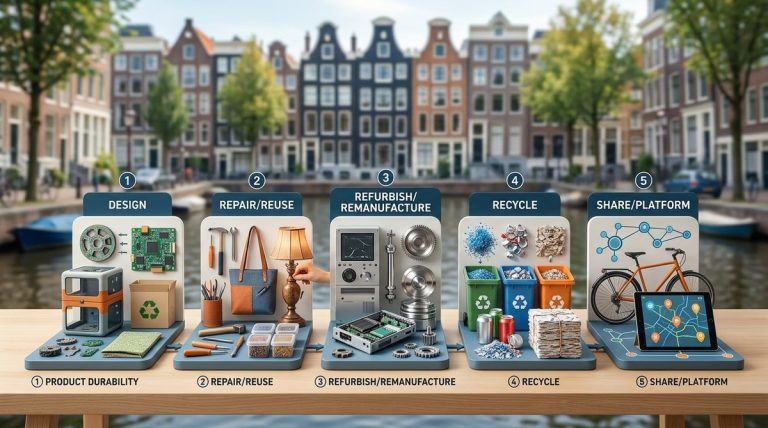
The Amsterdam Right to Repair law 2026 is not an isolated policy. It fits into a wider vision of a city that designs out waste. The same logic that drives repair also drives the city’s work on shared mobility, modular housing, and material passports for buildings.
Manufacturing in 2026 looks different to manufacturing in 2016. It is smaller, more local, and more human. The factory is no longer a place you commute to. It is the workshop on your corner, the repair cafe in the old bank building, the training centre in the library.
This shift is good for the planet. It is good for local jobs. And it is good for the people who live in these neighbourhoods.
To see how data and artificial intelligence support these kinds of urban policy decisions, take a look at our article on the role of data and AI in transforming urban policy in Amsterdam.
A practical guide for starting your own local repair policy
If you are a policy maker or advocate reading this and thinking about how to start, here is a simple three step framework based on Amsterdam’s experience.
First, audit your waste stream. Find out what percentage of bulky waste in your area is actually repairable. Amsterdam’s initial audit found that 38% of all large household items discarded at recycling centres could be fixed with a single part.
Second, map your existing repair assets. Every city has a handful of independent repair shops, community repair groups, and retired engineers. Find them, bring them together, and ask them what they need.
Third, create a ‘repair first’ procurement rule for any public building or social housing project. If the council buys a washing machine, it should specify that spare parts must be available for ten years. That sends a signal to the market.
These steps do not require a new law. They require leadership.
The road ahead for Amsterdam
The city is already looking at phase two of the law. This would extend the requirements to commercial kitchen equipment, power tools, and bicycles. Yes, bicycles. In a city with more bikes than people, the right to repair a cargo bike or an e bike is a social justice issue as much as an environmental one.
There is also talk of a ‘repair score’ label for products, similar to the energy efficiency rating system. A product with a high repair score would get preferential display space in shops and a lower VAT rate on its initial sale.
These ideas are still in consultation. But they show the direction of travel. Amsterdam is not just passing a law and walking away. It is building an ecosystem.
For a broader view of how the city measures success in these initiatives, read our guide on 5 key performance indicators Amsterdam uses to measure smart city success.
What this means for your work
Whether you are drafting a local plan, writing a policy paper, or reporting on sustainability trends, the Amsterdam story offers a concrete example. It shows that cities do not have to wait for national governments to act. They can use planning, procurement, and zoning to create the conditions for a circular economy.
The Amsterdam Right to Repair law 2026 is still young. The data is still coming in. But the early signs are promising. More repairs, less waste, more jobs, stronger communities.
That is a combination worth paying attention to. And it is one that any city, including yours, could start building tomorrow.
About the Author