Amsterdam has always been a city of bold experiments. From its canal-side cycling lanes to its world-famous tolerance policies, the Dutch capital does not shy away from trying new things. In 2026, that spirit of innovation is focused squarely on one of the most pressing challenges for any modern metropolis: public safety.
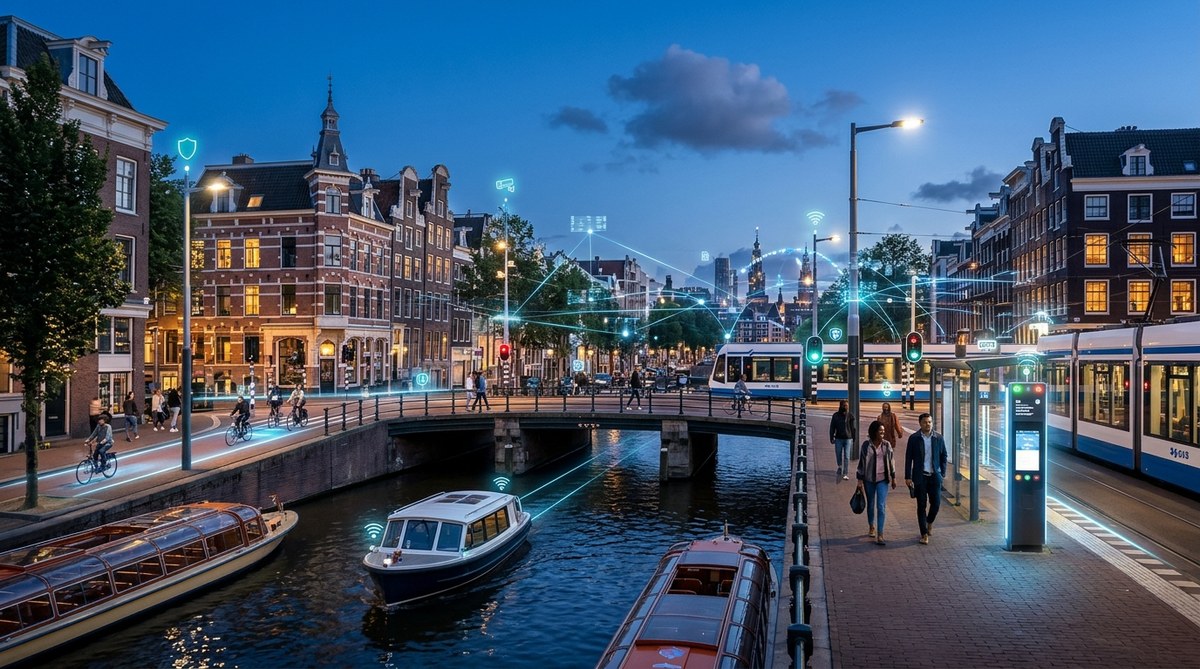
The old model of CCTV cameras and reactive policing is no longer enough. Amsterdam is now a living laboratory for smart city public safety Amsterdam, where sensors, artificial intelligence, and real-time data work together to prevent incidents before they happen. For urban planners, municipal policymakers, and smart city researchers, the lessons from these pilots are invaluable. This is not theory. This is the city testing, failing, iterating, and succeeding in plain sight.
Amsterdam’s smart city public safety pilots prove that technology works best when it serves people, not the other way around. From AI-powered crowd management at festivals to smart lampposts that listen for distress, the city shows how IoT and data can make urban spaces safer without feeling like a surveillance state. For UK planners, these case studies offer a replicable blueprint.
How Amsterdam uses IoT to prevent crime before it starts
The core idea behind smart city public safety Amsterdam is simple: do not wait for a crime to happen. Use sensors and data to spot the conditions that lead to trouble.
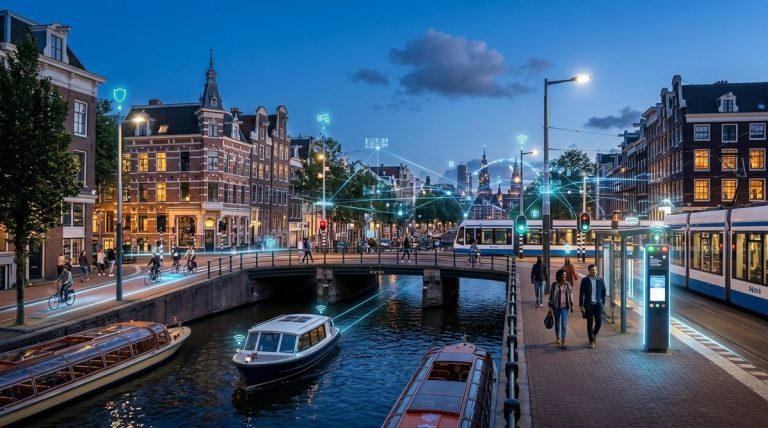
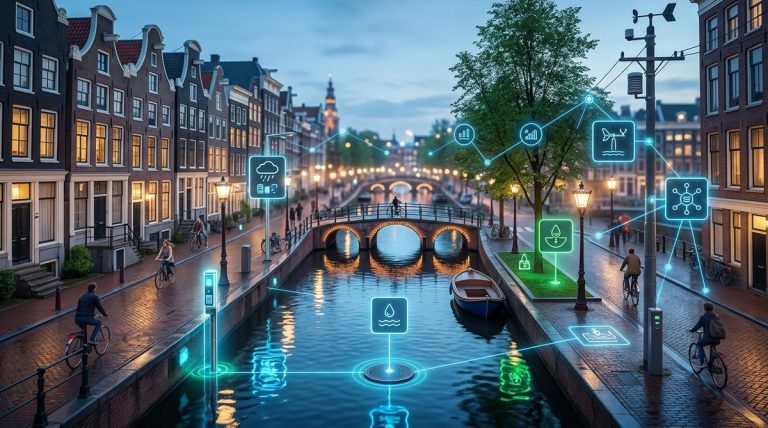
Amsterdam has deployed a network of environmental sensors across the city centre and several residential districts. These sensors measure noise levels, foot traffic density, air quality, and even the vibration patterns of bridges and public squares. The data feeds into a central platform that the municipality’s safety team monitors in real time.
For example, if noise levels in a particular square spike above a certain threshold on a Friday night, the system flags it. This does not mean a crime is happening. It might just be a busy bar. But it gives the local wardens and police a heads-up to increase patrols in that area. The result is a visible presence before tensions escalate.
This approach is a world away from the traditional model of waiting for a 999 call. It is proactive, not reactive. And it relies on one thing that Amsterdam has in spades: a willingness to share data openly between agencies.
The five pilot projects reshaping public safety
Let us look at five concrete pilots that are currently running in Amsterdam. Each one tackles a different aspect of urban safety, but they all share a common thread: they use technology to empower citizens and public servants alike.
-
Smart street lighting with audio analytics
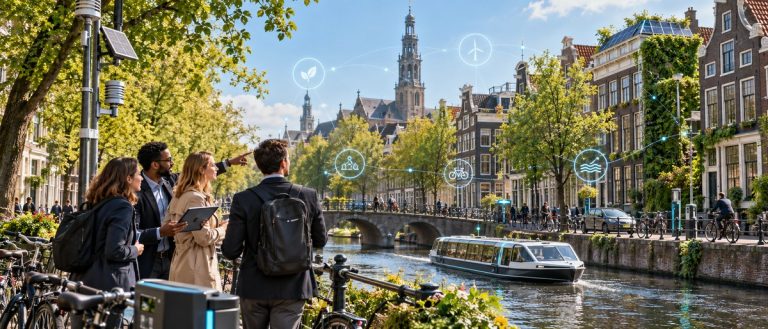
Traditional street lights are dumb. They turn on and off. Amsterdam’s new generation of smart lampposts do much more. They are fitted with microphones that can distinguish between a car horn, a shout, and breaking glass. When the system detects a sound associated with distress or conflict, it automatically brightens the light in that area and sends an alert to the nearest community safety officer. The light itself acts as a deterrent. The pilot covers the Red Light District and parts of the Jordaan neighbourhood. -
AI-driven crowd management at public events
The city hosts hundreds of events each year, from King’s Day celebrations to the Amsterdam Dance Event. Managing crowds safely is a massive challenge. The pilot uses overhead cameras and Wi-Fi tracking to measure crowd density in real time. An AI model predicts where bottlenecks are likely to form and suggests alternative routes to event organisers. In 2025, this system helped reduce ambulance call-outs by 18% during major events. -
Smart water sensors for canal safety
Amsterdam’s canals are beautiful, but they are also dangerous. Every year, people fall in, especially late at night. The pilot installs floating sensors that detect sudden disturbances in the water. When a fall is detected, the sensor sends an immediate alert to the emergency services with the exact GPS coordinates. The response time has dropped from an average of 12 minutes to under 4 minutes in the pilot zone. -
Predictive policing using open data
This is the most controversial pilot, and Amsterdam handles it with care. The system analyses historical crime data, weather patterns, and local event schedules to predict where and when street robberies are most likely. Crucially, the algorithm does not use personal data or ethnic profiling. It only looks at location and time. The police then increase patrols in those predicted hotspots. Early results show a 15% drop in street robberies in the pilot areas. -
Community safety dashboard for residents
Not all safety tools are for the authorities. Amsterdam has launched a digital dashboard that residents can access on their phones. It shows real-time information about road closures, reported incidents, and even the location of defibrillators. Citizens can also report issues like broken street lights or suspicious activity directly through the app. The data is shared with the city’s central safety platform. This turns every resident into an extra pair of eyes and ears.
A practical process for implementing a smart safety pilot
If you are a policymaker or urban planner looking to replicate Amsterdam’s approach, here is a straightforward process to follow. It is based on the city’s own playbook.
-
Start with a specific problem, not a technology.
Amsterdam did not begin by asking “what AI can we use?” They began by asking “why do people feel unsafe in this square at night?” The technology came second. Identify a single, measurable safety issue in your district. It could be street robbery, anti-social behaviour, or road traffic accidents. Define the problem clearly before you look for a tool. -
Run a small, contained pilot.
Do not try to wire up the whole city at once. Amsterdam tested its smart lampposts in just two streets for six months. This keeps costs low and allows you to learn from mistakes without causing a public backlash. Choose a neighbourhood that is representative but manageable. -
Measure what matters.
Set clear metrics before you start. Amsterdam measures response times, crime rates, and citizen satisfaction. Do not just count arrests. Count the things that actually make people feel safer, like the time it takes for a light to brighten or a warden to arrive. -
Engage the community from day one.
Amsterdam holds public meetings in every pilot neighbourhood before the sensors go in. They explain what data is being collected, how it is used, and who can see it. This builds trust. Without trust, even the best technology will fail. -
Iterate based on feedback.
The first version of the crowd management AI was too sensitive. It flagged normal crowd movement as dangerous. The team tweaked the algorithm based on feedback from event stewards. Now it is much more accurate. Treat your pilot as a learning exercise, not a finished product.
Common pitfalls in smart city safety projects (and how Amsterdam avoids them)
Even the best pilots can go wrong. Here is a table that shows the most common mistakes and how Amsterdam’s approach sidesteps them.
| Common mistake | Why it fails | How Amsterdam avoids it |
|---|---|---|
| Ignoring privacy concerns | Citizens reject the technology, and politicians pull the funding. | Amsterdam publishes a clear data ethics charter for every pilot. It explains what data is collected and what is not. |
| Over-reliance on AI | The algorithm makes a mistake, and public trust is lost. | AI is used as a decision-support tool, not a decision-maker. Human operators always have the final say. |
| Poor communication | Residents do not understand why sensors are being installed. | The city holds open meetings and uses plain language in all communications. No jargon. |
| Scaling too quickly | The pilot works in one area but fails when rolled out city-wide. | Amsterdam scales slowly, district by district, and adapts the system to local conditions each time. |
| Ignoring maintenance | Sensors break, data quality drops, and the system becomes useless. | The city contracts a dedicated maintenance team for each pilot. Sensors are checked weekly. |
What UK cities can learn from Amsterdam’s approach
British cities face similar challenges to Amsterdam. Crowded public spaces, late-night safety concerns, and stretched police resources are familiar to anyone working in Manchester, Birmingham, or London. The good news is that Amsterdam’s model is highly transferable.
One of the most important lessons is the value of public-private partnerships. Amsterdam works closely with tech companies, universities, and local businesses to fund and run its pilots. This spreads the cost and brings in expertise that the municipality does not have in-house. For UK councils facing budget cuts, this collaborative model is a lifeline.
Another lesson is the importance of keeping the human element central. Amsterdam’s pilots are not about replacing police officers or wardens. They are about giving those frontline workers better tools. The smart lamppost does not call the police automatically. It alerts a human safety officer, who then decides what to do. This balance between automation and human judgment is critical.
“Technology should never make decisions about safety. It should inform the people who do. That is the golden rule we follow in every pilot.” — Sophie van der Meer, Amsterdam Smart City Programme Lead
The role of data and AI in shaping future policy
Data from these pilots is not just used in the moment. It feeds back into long-term urban planning. For example, the crowd management data from events is now used by Amsterdam’s planning department to design safer public squares. If the data shows that a particular square always gets overcrowded during festivals, the next redesign will include wider exits and more open space.
Similarly, the predictive policing data is helping the city allocate its community safety budget more effectively. Instead of spreading resources thinly across all neighbourhoods, the city can focus on the areas that need the most support. This is not about stigmatising certain districts. It is about being smart with public money.
For a deeper look at how data and AI are transforming policy in Amsterdam, read our article on the role of data and AI in transforming urban policy in Amsterdam.
How to measure success in smart city safety
It is easy to get excited about the technology and forget to ask the most important question: is it actually working? Amsterdam uses a balanced scorecard that goes beyond simple crime statistics.
- Response times: How fast do emergency services or community wardens arrive after an alert?
- Citizen perception: Do people feel safer? The city runs quarterly surveys in pilot neighbourhoods.
- False positive rate: How often does the system flag something that turns out to be harmless? A high false positive rate erodes trust.
- Cost per incident: Is the technology saving money compared to traditional patrols?
- Equity impact: Does the pilot make all residents feel safer, or only certain groups? Amsterdam tracks this carefully to avoid bias.
If you want to see how these metrics apply to broader urban innovation, check out our guide on 5 key performance indicators Amsterdam uses to measure smart city success.
Why Amsterdam’s model matters for the future of urban living
The reason Amsterdam’s smart city public safety pilots are so important is that they prove something many people doubted: that technology can make cities safer without turning them into surveillance states. The key is transparency, community involvement, and a relentless focus on human outcomes.
For urban planners, the message is clear. You do not need a massive budget or a team of data scientists to start. You need a clear problem, a willingness to experiment, and a commitment to listening to the people you serve. Amsterdam shows that even small, local pilots can have a big impact.
If you are looking for more inspiration on how Amsterdam is leading the way, take a look at what can UK cities learn from Amsterdam’s smart city success. The answers might surprise you.
Your next step as a smart city practitioner
So, what should you do on Monday morning? Start by walking around a neighbourhood in your city that has a safety problem. Talk to the people who live and work there. Ask them what makes them feel unsafe. Do not mention AI or IoT or sensors. Just listen.
Then, take that problem and match it to one small technology solution. Maybe it is a brighter light. Maybe it is a simple app. Maybe it is a sensor that alerts someone when a canal wall gets slippery. Start small, measure everything, and be honest about what works and what does not.
Amsterdam did not become a global leader in smart city public safety overnight. It took years of trial and error. But every pilot, every failure, and every success has built a body of knowledge that other cities can now use. The blueprint exists. All you have to do is adapt it to your own streets, your own people, and your own challenges.
The future of urban safety is not about more cameras. It is about smarter, kinder, and more connected communities. Amsterdam is showing the way.
About the Author