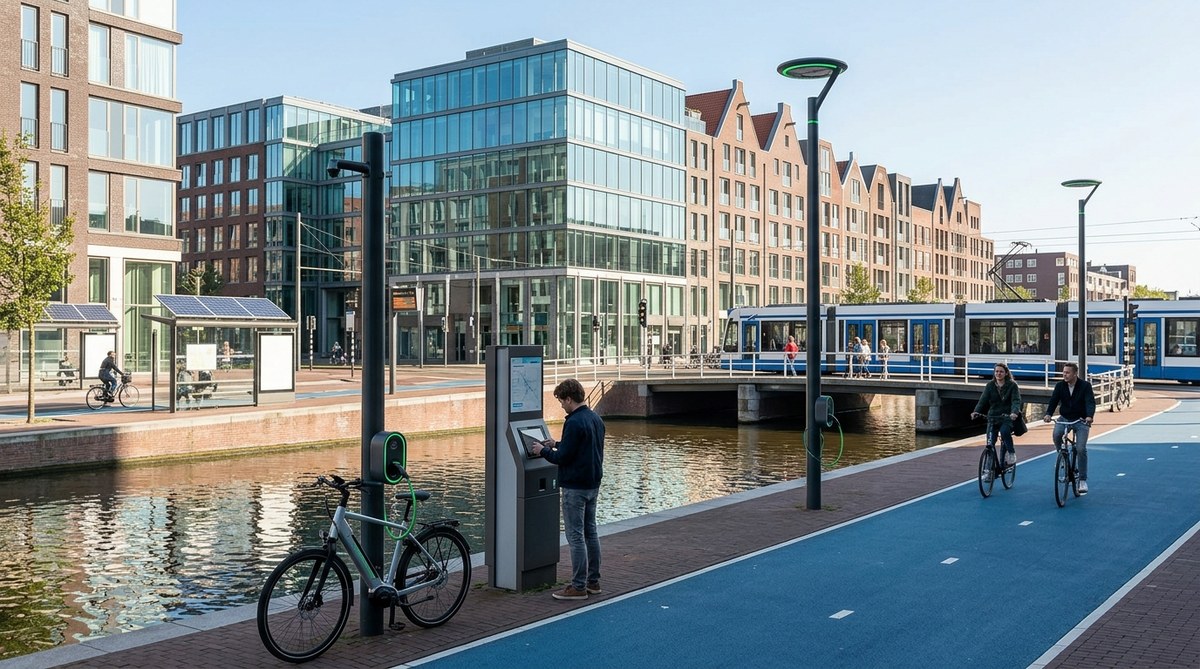
Amsterdam didn’t become a smart city by accident. It took years of collaboration, data sharing, and a willingness to let citizens lead the way. For UK planners and policymakers looking to create smarter, more liveable urban spaces, the Dutch capital offers a blueprint that is both practical and ambitious. The lessons are not about copying and pasting technology. They are about building trust, using data responsibly, and thinking long term.
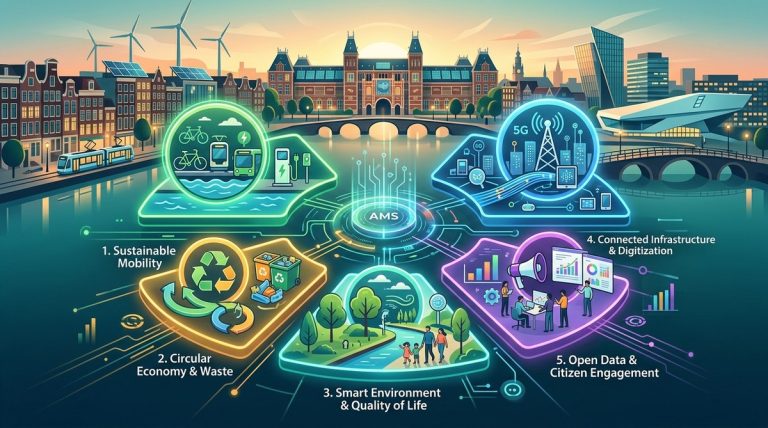
Amsterdam’s smart city success relies on three pillars: citizen co-creation, open data infrastructure, and public private partnerships. UK cities can adopt these principles by starting small, engaging communities early, and choosing projects that solve real local problems rather than chasing the latest technology. The result is more resilient, inclusive urban growth.
Why Amsterdam’s approach works for UK cities
Many UK towns and cities have launched smart city pilots over the past decade. Some succeeded. Many gathered dust. The difference in Amsterdam is scale and consistency. The city built a platform called Amsterdam Smart City (ASC) back in 2009 and kept iterating. It now involves over 200 partners, from universities to housing associations.
For UK planners, the key takeaway is that smart city programmes need a permanent home, not a temporary project team. Amsterdam treats its smart city strategy like a long term investment, not a three year funding cycle.
1. Start with citizen needs, not technology
Amsterdam begins every initiative by asking one question: What problem are we solving? The answer rarely starts with sensors or software. It starts with how people move, live, and work.
Take the city’s approach to traffic management. Instead of installing expensive cameras everywhere, Amsterdam used existing data from bike share schemes and public transport smart cards to optimise traffic light timing. The result? Shorter commute times and lower emissions, all without buying new hardware.
Three practical steps UK councils can take today:
- Run a community listening exercise before writing any specification. Use online surveys and street pop ups to understand what residents actually want.
- Map the data your council already collects. Often you already have the information you need, it is just sitting in different departments.
- Pick one neighbourhood, solve one problem, then scale. Amsterdam’s first smart grid pilot covered a handful of streets before expanding city wide.
2. Open data is not a buzzword, it is a foundation
Amsterdam makes most of its city data publicly available through the Amsterdam Open Data portal. This allows startups, researchers, and community groups to build services the council could never create on its own.
For example, a local app developer used open parking data to create an app that shows real time availability for disabled parking bays. The council paid nothing, but citizens got a better service.
UK cities can do the same. Start by releasing transport, energy, and planning data under open licences. Set clear standards so that data can be combined across councils.
“Amsterdam’s success shows that the most powerful smart city technology is often just data, shared freely and used creatively. UK cities should stop thinking of data as something to protect and start thinking of it as a public asset.” — Urban innovation advisor, AMS Amsterdam
3. Build real public private partnerships, not just contracts
Amsterdam does not treat private companies as vendors; they treat them as long term partners. The city’s public private partnership model means that businesses contribute funding, expertise, and risk sharing.
A good example is the City Data Exchange, where commercial partners like KPN and Philips share anonymised data with the municipality. In return, they get access to pilot sites and co branded research.
What UK planners should avoid: Tendering a single large contract for a turnkey smart city system. That approach often fails because it locks councils into a rigid platform that cannot adapt.
What to do instead: Create a framework agreement with multiple suppliers. Run small pilots. Evaluate outcomes before scaling.
A table of techniques and common mistakes
| Technique | What Amsterdam does | What UK cities often get wrong |
|---|---|---|
| Citizen engagement | Start with neighbourhood assemblies and co design workshops | Send out a consultation form with no follow up |
| Data governance | Publish a clear data ethics charter, reviewed annually | Write a vague privacy policy, then share data without consent |
| Procurement | Use innovation partnerships and challenge prizes | Write a 200 page tender, then choose the cheapest option |
| Scaling | Prove the concept in one district, then replicate | Try to roll out city wide from day one, then stall |
| Evaluation | Measure outcomes like reduced energy use and improved air quality | Measure outputs like number of sensors installed |
4. Think circular: waste becomes a resource
Amsterdam aimed to become fully circular by 2050. UK cities can learn from how they use smart technology to track materials and reduce waste.
One initiative places smart bins that monitor fill levels across the city. Instead of collecting rubbish on a fixed schedule, collection trucks are dispatched only when bins are full. That cuts fuel use by over 30 percent.
Another project uses blockchain to trace construction materials from demolition sites to new building projects, ensuring nothing goes to landfill unnecessarily. For UK councils struggling with fly tipping and recycling rates, this kind of circular economy approach holds immediate practical value.
5. Use AI ethically and transparently
Amsterdam was one of the first cities in Europe to publish a register of algorithms used by the city government. Every algorithm is listed, along with its purpose, data sources, and how it affects citizens.
This transparency built public trust. When the city used AI to predict which houses might need energy efficiency upgrades, residents did not object. They understood the system and could opt out.
UK cities considering AI for benefit fraud detection or planning decisions should follow Amsterdam’s lead. Publish what you are doing. Explain it in plain English. Give people a way to challenge decisions.
- Create a public register of algorithms
- Run an ethics review before deployment
- Include citizen representatives on oversight boards
- Review algorithms annually for bias
6. Mobility as a service, not just more buses
Amsterdam’s mobility strategy integrates trains, trams, bike share, electric scooters, and ferries into a single app with one payment system. This is the model UK city regions like Greater Manchester and the West Midlands are now trying to copy.
But Amsterdam went further. They used IoT sensors at traffic lights to give priority to buses, trams, and emergency vehicles. Cyclists also get longer green lights during peak times.
Key lesson for UK transport authorities: Do not just layer technology on top of existing systems. Rethink the whole journey. That means breaking down silos between bus companies, train operators, and local councils.
7. Let neighbourhoods lead the energy transition
Amsterdam’s smart grid pilot in the Nieuw West district was not designed by engineers alone. Residents helped decide where solar panels went and how battery storage would be shared.
The result was a community owned energy system that reduces bills and keeps power flowing during peak demand. UK cities with ambitious net zero targets could use this model for their own smart energy grids.
What works: Giving neighbourhoods a real stake in the outcomes, not just a consultation token.
What fails: Dumping a smart meter scheme on people without explaining the benefits.
What UK planners can do starting next week
You do not need a multi million pound budget to start moving in the right direction. Here is a practical checklist you can use:
- Identify one stubborn problem in your area: potholes, poor air quality, lonely isolation among older residents.
- Check what data your council already holds that could help solve it.
- Talk to three local community groups about their priorities.
- Find a small open data pilot you can run within existing budget.
- Write a one page ethics checklist for any new technology your team considers.
- Share your plan with a neighbouring council. Collaboration avoids duplication.
From Amsterdam to your local high street
Amsterdam’s smart city journey shows that technology is only as good as the people using it. The city did not try to reinvent itself overnight. It listened, tested, learned, and adapted. UK cities have the same opportunity: to build smarter, fairer, and greener communities by putting citizens at the heart of every decision.
Start small, stay open, and share what you learn. That is the real UK smart city lesson from Amsterdam.
About the Author