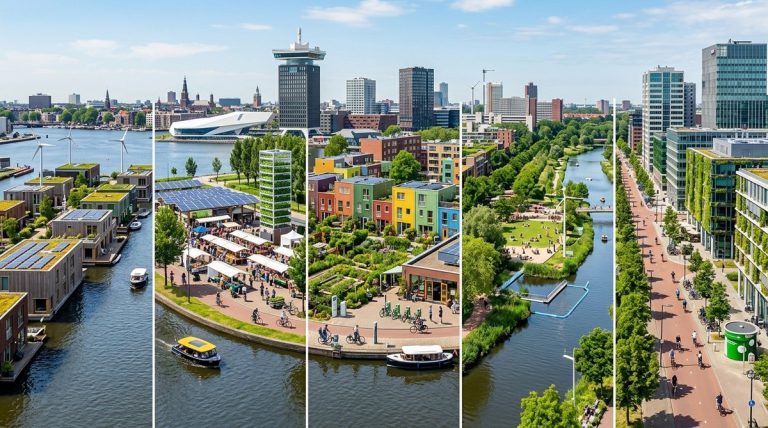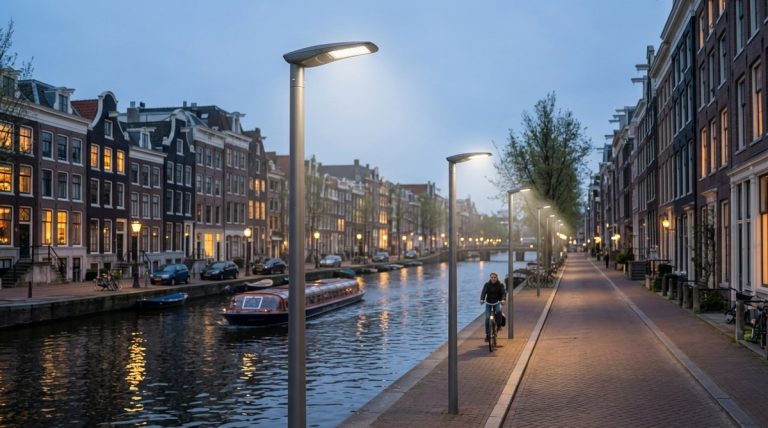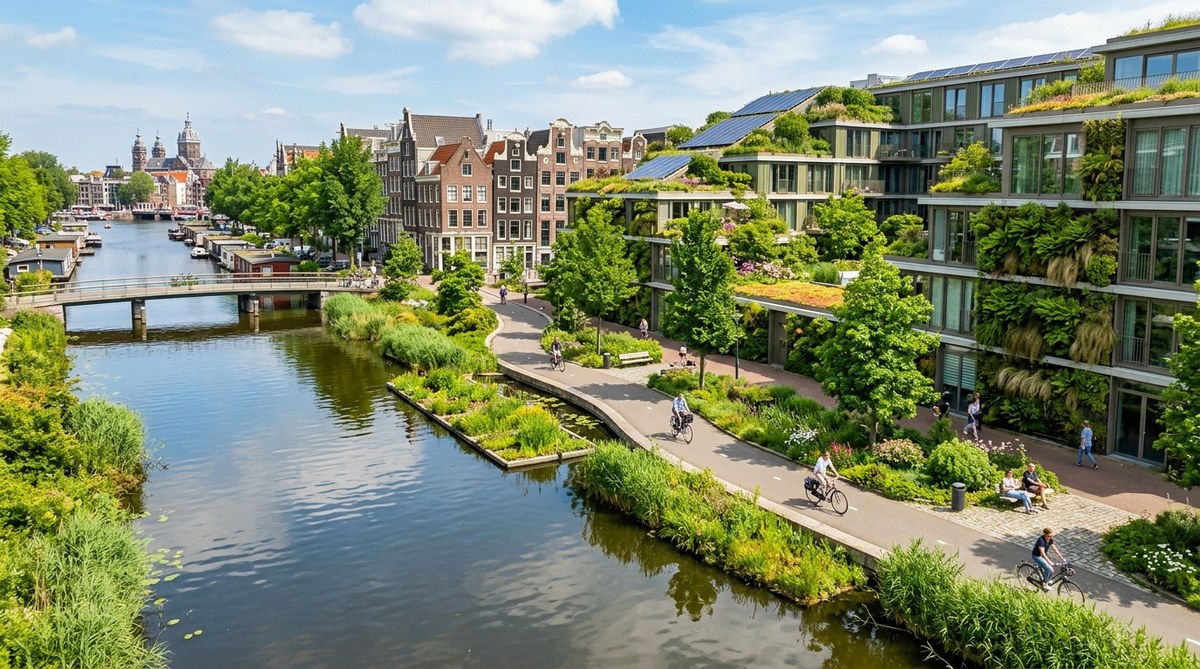
Amsterdam is proving that nature and city life are not opposites. In 2026, the Dutch capital has become a living laboratory for what happens when you treat rivers, parks, and soil as essential infrastructure rather than afterthoughts. The canals still glisten, but now they work alongside green roofs, floating wetlands, and permeable pavements to manage water, cool neighbourhoods, and support wildlife. For urban planners and policymakers looking for concrete examples of Amsterdam nature-based solutions urban planning, this city offers more than inspiration. It offers a replicable playbook.
Amsterdam’s approach to nature-based solutions (NBS) moves beyond isolated pilot projects. It embeds green infrastructure into every stage of spatial planning, from zoning codes to procurement rules. The result is a city that uses rain gardens, urban forests, and canal edge habitats to reduce flood risk, improve air quality, and boost biodiversity. This article shows you how they do it.
Why Amsterdam switched to nature based planning
For decades, Dutch water management relied on pumps, dykes, and concrete. It worked, but it came with hidden costs: heat islands, loss of soil biodiversity, and rising maintenance bills. After a series of extreme summer storms and heatwaves in the early 2020s, the city realised that grey infrastructure alone was not resilient enough. Instead of building bigger sewers, they started asking: can nature do this job for free?
That question led to a systemic shift. The city’s 2022 Green Infrastructure Strategy set a target that by 2030, every new public space must include at least one nature based feature. By 2026, that mandate is already reshaping streets, squares, and rooftops across every district. Planners now evaluate projects not just on cost and function, but on how much ecological value they generate.
The four pillars of Amsterdam’s NBS integration
Amsterdam did not jump straight into planting trees everywhere. They built a framework first. Here is how they did it:
- Rewrite planning rules to prioritise multifunctional land use. Every new development must now demonstrate how it manages water, provides habitat, and reduces heat stress onsite. Green roofs are mandatory for flat roofs over a certain size. Car parks must include tree pits or rain gardens.
- Map the city’s natural assets in a digital twin. The municipality created a high resolution 3D model that includes soil type, groundwater levels, existing vegetation, and heat exposure. This tool helps planners decide where rain gardens, swales, or urban forests will have the biggest impact.
- Use procurement to drive demand for NBS. Tenders for street reconstruction and public housing now include specific NBS criteria. Suppliers are asked to bid with solutions like permeable paving or bio retention basins instead of standard concrete. This has created a local market for green infrastructure materials.
- Monitor and adapt with citizen science. Amsterdam trains residents and school groups to record rainfall levels, plant growth, and wildlife sightings. That data feeds back into the digital twin and helps planners adjust designs when something is not working.
A table of key NBS techniques in Amsterdam
| Technique | Primary function | Co benefits |
|---|---|---|
| Green roofs | Stormwater retention, insulation | Habitat for pollinators, reduced urban heat, energy savings |
| Rain gardens (bioswales) | Slow and filter runoff | Improved air quality, roadside planting, amenity value |
| Depaved courtyards | Increase infiltration, reduce runoff | Community gardens, play spaces, groundwater recharge |
| Floating wetlands (canals) | Nutrient uptake, water purification | Biodiversity corridors, educational feature, aesthetic value |
| Urban forests (tree allees) | Shade, evaporative cooling | Carbon storage, noise reduction, property value uplift |
These techniques are not used in isolation. Amsterdam often stacks them on the same site. For example, a school redevelopment might combine a green roof, a rain garden play area, and a depaved courtyard. That layering maximises the return on every square metre.
Blockquote: a planner’s perspective
“We used to see nature as decoration. Now we see it as a utility. When we design a street, the first question is not ‘how many cars fit here’ but ‘how much water can this landscape handle and what life can it support’.”
Marlies van der Zeijden, senior urban designer at the City of Amsterdam
How policy and data work together
Planners often complain that NBS projects stall because they do not fit into existing departmental silos. Amsterdam tried to solve that by creating an inter departmental NBS unit. This team sits between public works, housing, and sustainability. They review every major planning application for NBS opportunities. They also run training sessions for engineers and architects who are more used to pipes than plants.
Data plays a central role. The city’s open data platform shares real time information on rainfall, temperature, and soil moisture. Researchers from the University of Amsterdam use that data to model how different NBS designs perform under future climate scenarios. Their findings feed directly into the planning rules. For instance, after a study showed that certain tree species lose leaves too early in autumn to provide shade during September heatwaves, the city updated its approved species list.
If you are interested in how Amsterdam combines these nature based approaches with digital tools, you might enjoy reading about how Amsterdam uses smart technologies to create a more sustainable city.
Common mistakes and how Amsterdam avoids them
Even a leading city makes errors. But Amsterdam learns from them. Here are some pitfalls they identified and fixed:
- Planting the wrong species in the wrong place. Early projects used exotic ornamental plants in rain gardens that died during dry spells or could not handle the pollutants from road runoff. Now they rely on native species like yellow iris and purple loosestrife, which are tough and support local insects.
- Underestimating maintenance costs. A green roof that is not weeded or irrigated becomes a brown roof. The city now budgets for three years of intensive care after installation and trains local contractors in green infrastructure maintenance.
- Ignoring the underground. Many planners focus only on what grows above ground. Amsterdam learned that soil compaction and poor drainage can kill a bioswale before it starts. They now require soil testing and compaction limits for any NBS project.
- Failing to communicate benefits to residents. A depaved courtyard looks messy to some people if you do not explain its purpose. The city now puts up explanatory signboards and organises community planting days to build understanding and ownership.
A look at citizen engagement in NBS projects
Amsterdam’s success with nature based solutions would not be possible without its residents. The city runs a programme called “Groen Buurt” (Green Neighbourhood) that gives small grants to local groups who want to create green spaces on their street. One example: in the Watergraafsmeer district, neighbours turned a neglected paved square into a community garden with swales and a wildflower meadow. The city provided the plants and technical advice; the residents do the watering and weeding.
This approach builds social resilience as well as ecological resilience. When a extreme rain event hits, those neighbours already know how to maintain the drainage features. And they have a stronger sense of community.
For more on how residents and city officials collaborate, have a look at harnessing citizen engagement to accelerate urban innovation in Amsterdam.
Scaling NBS beyond city limits
Amsterdam is also working with the wider metropolitan region. The city shares its NBS data and design guidelines with smaller municipalities in the province of North Holland. That way, a rain garden in a suburb like Diemen uses the same standards as one in the city centre. This regional consistency makes it easier for contractors to work across municipalities and for residents to recognise what a nature based street looks like anywhere in the area.
The approach also extends to water boards (waterschappen), which manage the canals and ditches. By coordinating with these bodies, Amsterdam ensures that neighbourhood level NBS connects to the larger water system. For example, a rain garden that drains into a canal is designed to release water slowly, preventing the canal from overflowing during heavy rain.
What planners elsewhere can learn from Amsterdam
If you are a policymaker or researcher looking to bring NBS into your own city, start with these lessons:
- Do not try to do everything at once. Pick one neighbourhood that is already due for road or sewer renewal. Use that as a demonstration project to build evidence and political will.
- Change the procurement language. Write tender documents that ask for “green infrastructure” instead of “drainage infrastructure”. That shifts the baseline expectation.
- Invest in a simple digital inventory. Even a spreadsheet with locations and photos of existing green spaces helps decision makers see opportunities. Amsterdam’s digital twin is advanced, but you can start small.
- Train your planners and engineers. A traditional civil engineer might not know how to design a bioswale. Run half day workshops and bring in landscape ecologists to co design early projects.
- Celebrate small wins. When a rain garden survives a summer storm without flooding the street, take a photo and share it. Success stories build momentum.
Amsterdam itself continues to evolve. In 2026, the city is piloting a “green factor” scoring system for private developments. Similar to systems used in Berlin and Malmö, it scores a building based on how much green it provides (roofs, walls, balconies). Developers must meet a minimum score to get planning permission. If it works, it will be rolled out citywide in 2027.
Making nature the backbone of Amsterdam’s planning
Amsterdam did not invent nature based solutions, but it has become one of the most systematic examples of how to embed them into everyday urban planning. The approach is not about creating a few parks. It is about redesigning how streets, canals, and rooftops function so that nature works alongside concrete and asphalt to make the city cleaner, cooler, and more resilient.
For anyone involved in planning or policy, the takeaway is simple: stop treating nature as a nice to have. Start treating it as critical infrastructure. Amsterdam has shown that when you do, the city itself begins to breathe again.
If you want to follow more of Amsterdam’s journey with urban innovation, check out innovative urban solutions shaping Amsterdam’s future in 2026. Or if you are specifically interested in green infrastructure strategies, this article on Amsterdam’s green infrastructure strategies goes deeper into the technical side.
Go ahead and share this with your team. And next time you walk through a city, look at the bare pavement and imagine what could grow there.
About the Author