Amsterdam has always been a city of bold experiments. From its canal ring to its cycling culture, innovation runs through its cobbled streets. Today, the city faces a new set of pressures: housing shortages, climate adaptation, mobility shifts, and digital inclusion. The question is not whether Amsterdam can solve these problems alone, but how it can team up with the private sector to do it faster and smarter. Public private partnerships (PPPs) are not new here, but their role in tackling urban challenges has grown significantly. Could they be the missing ingredient for a future-proof city?
Amsterdam’s public private partnerships are not a magic fix but a powerful tool when designed with clear roles, shared risk, and long term commitment. The city’s approach combines civic trust with commercial agility. For urban planners and researchers, the lesson is that successful PPPs depend on transparency, co-created goals, and continuous adaptation to emerging challenges.
How Amsterdam redefined the public private partnership model
In many cities, PPPs are still seen as a last resort. Amsterdam sees them as a first option. The city has built a reputation for collaborative governance, where the municipality acts as a partner rather than a gatekeeper. This shift has been most visible in areas like energy transition, smart mobility, and circular construction.
One standout example is the Amsterdam Smart City partnership. Launched over a decade ago, it brings together government, businesses, knowledge institutions, and residents to pilot new urban solutions. Projects range from smart grids in Nieuw West to autonomous boats in the canals. The model works because it shares risk and rewards openly. Private companies bring capital and technical expertise, while the city provides regulatory flexibility and access to real world testing grounds.
The results speak for themselves. Amsterdam ranks consistently high on global smart city indexes. Its PPP framework has become a reference for other European capitals. But it is not without friction. Tensions arise when profit motives clash with public interest, or when pilot projects struggle to scale. Understanding those tensions is crucial for anyone looking to replicate the model.
The core advantages of Amsterdam’s approach to urban PPPs
Why does Amsterdam succeed where others struggle? Part of the answer lies in its governance culture. The city has a long tradition of involving citizens in decisions. That same mindset extends to partnerships. Rather than treating private firms as contractors, Amsterdam treats them as co-creators.
Here are the main advantages that stand out:
- Shared risk and faster implementation. Public budgets alone cannot fund large scale infrastructure upgrades. By sharing costs with developers and utilities, Amsterdam speeded up its climate neutral goals.
- Access to cutting edge technology. Private partners often bring technologies that the city cannot develop in house, such as IoT sensors for waste management or AI driven traffic control.
- Flexibility within regulation. The city creates special zones or waivers for pilot projects, allowing innovation without compromising safety.
- Long term operational efficiency. Many PPPs include maintenance and operation contracts, ensuring the city does not get stuck with outdated infrastructure.
- Community trust through transparency. Amsterdam requires all PPP agreements to be published in some form, reducing concerns about backroom deals.
A roadmap for forming a successful public private partnership in Amsterdam
If you are a city planner or researcher interested in setting up a PPP, Amsterdam’s experience offers a practical process. The following numbered list outlines the typical steps, based on how the city approaches new partnerships.
- Identify a clear urban challenge. Start with a specific problem: flooding risk, energy poverty, or traffic congestion. Avoid broad missions like “sustainability” without measurable targets.
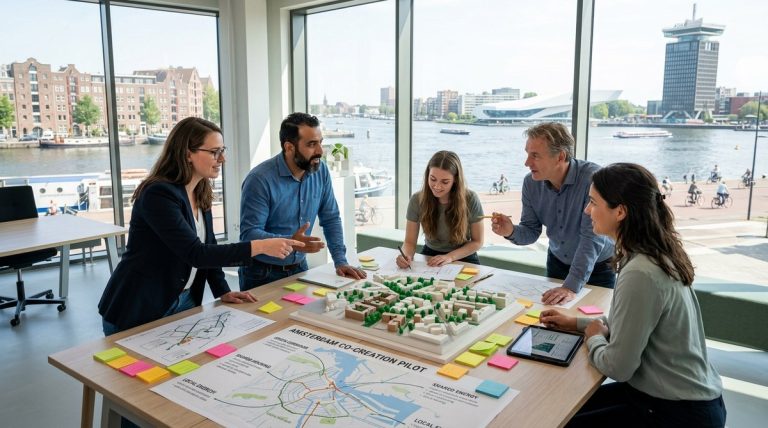
- Map stakeholders and their interests. List which private actors have the skills you need. Also include citizen groups, universities, and neighbouring municipalities. Amsterdam often uses a stakeholder mapping workshop.
- Define shared value and risk allocation. Use a public value framework. Decide who pays for what, who owns data, and how profits (or savings) are shared. A common mistake is to assume risk allocation can be decided later.
- Co design the project scope. Bring partners together in a series of open sessions. Amsterdam’s City Deal method is a good model: a short, binding agreement with clear milestones.
- Launch a pilot, not a full programme. Test the partnership on a small scale. The city’s ‘living lab’ approach allows failure without huge losses. Collect data and adjust.
- Scale with a formal contract. Once the pilot proves its worth, move to a multi year contract. Include clauses for renegotiation as circumstances change.
- Monitor, evaluate, and share learnings. Amsterdam publishes an annual PPP review. This transparency builds trust and attracts new partners.
Common pitfalls and how Amsterdam avoids them
No partnership is perfect. Even in Amsterdam, some collaborations have fallen short. The table below highlights frequent mistakes and the city’s countermeasures.
| Common mistake | How Amsterdam addresses it |
|---|---|
| Unclear division of responsibilities | Uses a ‘partner charter’ signed by all parties |
| Over reliance on private funding | Maintains a public fund for core services |
| Weak community engagement | Holds neighbourhood assemblies before project approval |
| Data ownership disputes | Specifies open data standards in the contract |
| Short term thinking | Requires a 10 year lifecycle plan from the start |
| Regulatory capture | Keeps a rotating team of civil servants in the partnership |
The city also has a rule: no single partner can dominate the board. This prevents large corporations from steering decisions away from public good. For example, the Schiphol area partnership includes equal votes from the airport, the municipality, local businesses, and environmental groups.
Expert insight: what happens when interests diverge?
“The hardest part is not signing the deal. It is the moment when a private partner wants to pivot because the market changed. In a PPP, you cannot just walk away. You have to have a shared exit strategy built into the agreement. Amsterdam’s smart city partnerships include a ‘pause and reflect’ clause that allows either side to call a review without penalty.”
— Lotte van der Heijden, Urban Policy Advisor at the City of Amsterdam (former PPP lead for climate neutral districts)
This advice is worth remembering. PPPs are relationships, not transactions. When the original conditions shift, the partnership must adapt. Amsterdam’s flexibility is one reason its collaborations survive election cycles and economic downturns.
Why Amsterdam’s model matters beyond the Netherlands
The principles used in Amsterdam are not tied to Dutch culture alone. They can be adapted to cities with different governance styles. The key is to build trust early, keep citizens informed, and ensure that private profit never overshadows public value. For researchers, Amsterdam offers a rich dataset: dozens of PPP case studies, from energy cooperatives to digital kiosks.
If you are studying urban innovation, you might also be interested in how the city uses smart technologies to create a more sustainable city or how data and AI are transforming urban policy. The links provide deeper dives into those topics.
What the future holds for Amsterdam’s public private partnerships
As Amsterdam moves towards its 2050 climate neutrality target, PPPs will become even more central. The city recently announced a new wave of partnerships focused on circular construction and nature based flood defences. Private developers are being asked to co fund green roofs and water squares in exchange for faster planning permissions.
Challenges remain. Some critics argue that PPPs can sideline low income residents if housing projects become too market driven. The city is experimenting with ‘social PPPs’ where a percentage of affordable homes is guaranteed in every private development. It is a delicate balance.
For now, Amsterdam continues to show that public private partnerships are not a cure all, but they are a vital tool in the urban planner’s kit. When done right, they unlock resources, spread risk, and bring fresh ideas into city hall. And in a world where urban challenges grow more complex each year, that kind of collaboration matters.
A final thought for planners and researchers
If you take one thing from this article, let it be this: start small, stay transparent, and never stop asking “who benefits?” Amsterdam’s success comes from asking that question at every stage. Whether you are drafting a policy paper, designing a pilot, or advising a mayor, carry that spirit with you. The challenges are big. But partnerships, built on trust and shared purpose, can make them manageable.
About the Author