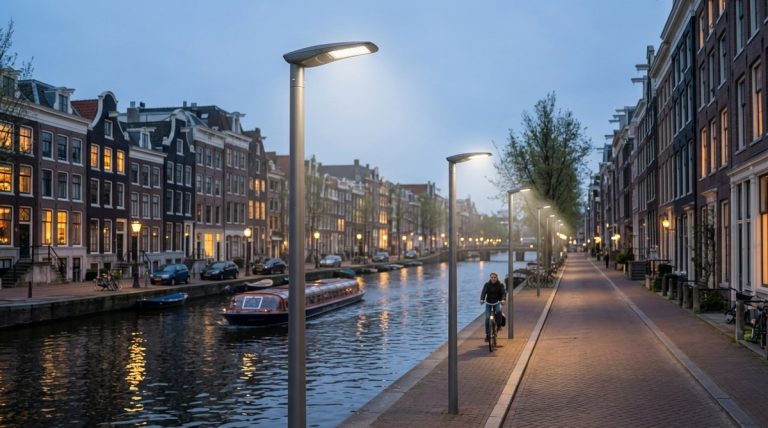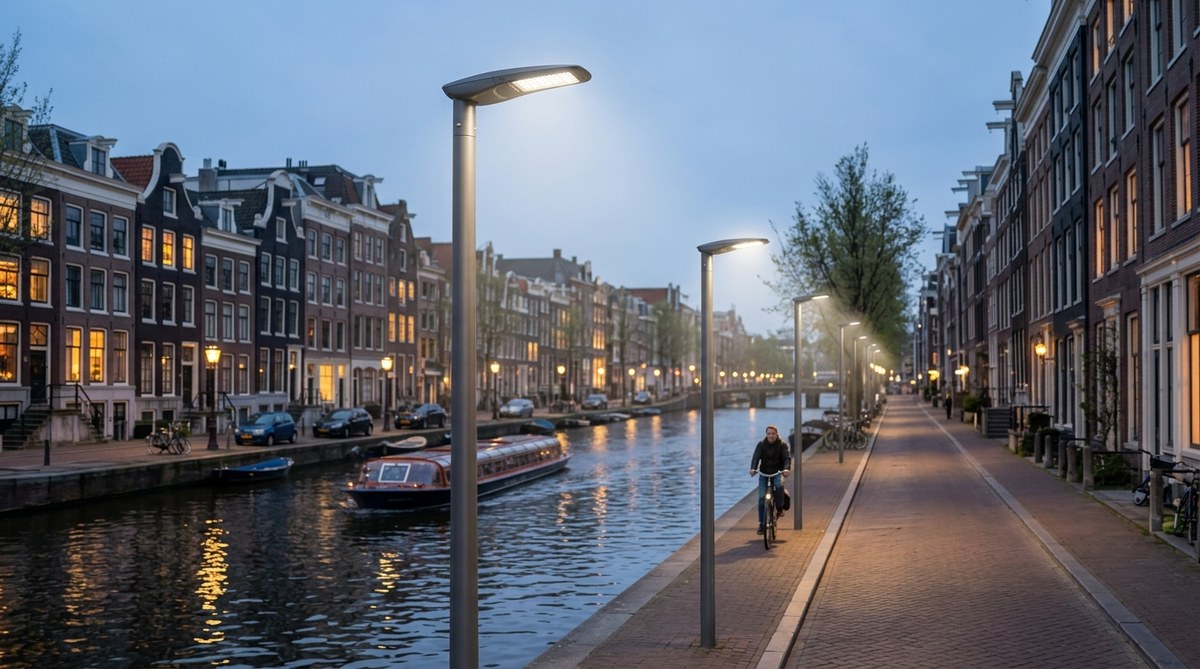
Amsterdam has always been a city of lights, from its glowing canal bridges to the warm glow of brown cafes. But beneath that familiar charm lies a quiet revolution. The city is retrofitting its entire public lighting network with smart controls, and the results are turning heads in municipal offices from Manchester to Munich. By replacing outdated sodium lamps with connected LED systems that dim and brighten based on real time conditions, Amsterdam is proving that sustainability and savings can go hand in hand.
Amsterdam’s smart street lighting programme shows how cities can cut energy use by 65% and carbon emissions by over 12,000 tonnes per year. By combining adaptive dimming, motion sensors, and a centralised management platform, the city saves millions in electricity costs while improving safety. Urban planners can replicate this model using off the shelf IoT tech and phased rollouts.
Why Amsterdam decided to rethink its street lights
Like many European cities, Amsterdam faced rising energy bills and a legal duty to reduce carbon emissions. Its old street lights were energy hungry and inflexible. They stayed at full brightness all night, even when no one was around. That wasted money and light pollution.
In 2015 the city started a pilot in the Nieuw West district. It replaced 1,500 lamps with LEDs that could be dimmed remotely. The pilot saved 50% on electricity. That success led to a city wide plan. By 2026, over 95% of Amsterdam’s 95,000 street lights are connected to a smart platform. The remaining older units are being upgraded this year.
The project is part of a broader push to make Amsterdam a climate neutral city by 2050. It supports the city’s how Amsterdam uses smart technologies to create a more sustainable city.
How the smart system actually works
The technology behind Amsterdam smart street lighting is simpler than you might think. Each lamppost contains an LED light module, a sensor node, and a wireless communication unit. The sensors measure ambient light, motion, and sometimes even air quality. The data flows to a central platform that adjusts brightness in real time.
- Adaptive dimming kicks in during quiet hours. Between 11pm and 6am, lights stay at 20% brightness unless a sensor detects a pedestrian or vehicle.
- Motion triggered brightening happens instantly. When someone walks or cycles past, the light ramps up to 70-100% for 30 seconds, then fades back down.
- Fault detection alerts the maintenance team to blown LEDs or connectivity issues before anyone reports it.
- Daylight harvesting keeps lights off when natural light is sufficient, like during summer evenings.
This approach cuts energy use by roughly 65% compared to the old sodium lamps. The city also installs the control units on existing poles, so no new infrastructure is needed.
Major benefits beyond energy savings
Smart street lighting does more than lower electricity bills. Here are the main advantages Amsterdam has recorded:
- Carbon reduction. The city saves about 12,000 tonnes of CO2 per year. That is equivalent to taking 2,600 cars off the road.
- Cost savings. Annual electricity costs dropped from EUR 9 million to around EUR 3 million.
- Less light pollution. By dimming when empty, the city reduces its glow, helping nocturnal wildlife and improving star visibility.
- Better public safety. Lights respond to movement, so residential streets feel safer without being overpowering.
- Lower maintenance. LEDs last 100,000 hours versus 12,000 for sodium lamps. The city now replaces bulbs much less often.
These outcomes align with the innovative urban solutions shaping Amsterdam’s future in 2026.
Traditional versus smart street lighting: a comparison
| Factor | Traditional sodium lighting | Amsterdam smart LED lighting |
|---|---|---|
| Energy consumption per fixture | 150-250 watts | 30-60 watts |
| Annual energy cost (per light) | ~ EUR 120 | ~ EUR 40 |
| Lamp lifetime | 12,000 hours | 100,000 hours |
| Dimming capability | None | 0-100% adaptive |
| Response to movement | No | Instant via PIR sensors |
| Carbon footprint per year (city wide) | ~ 18,500 tonnes | ~ 6,500 tonnes |
| Maintenance visits per year | 5-8 per 1,000 lights | Less than 1 per 1,000 lights |
The table makes it obvious why Amsterdam committed to a full smart network.
What urban planners can learn from Amsterdam’s rollout
“The key was not the technology but the partnership. We worked with residents, utilities, and installers from day one. That trust made the transition smooth. Other cities should start with a small pilot, measure everything, and then scale.”
– Kees van der Meulen, Smart Lighting Programme Manager, City of Amsterdam
His advice is echoed in the top strategies for implementing smart city technologies in Amsterdam. The city used a phased approach:
- Year 1: pilot in one district, gather data.
- Year 2-3: tender with performance guarantees from suppliers.
- Year 4-5: expand to all residential areas, then main roads.
One mistake they avoided was buying proprietary systems. Amsterdam insisted on open standards (DALI and Zigbee) so they could switch vendors later. That flexibility saved them money when hardware prices dropped.
Challenges Amsterdam faced and how it solved them
No project is without hiccups. Here are three common problems and Amsterdam’s solutions:
- Public concern about pitch darkness. Residents worried that dimmed lights would create dangerous shadows. The solution: set minimum brightness to 20% rather than turning off entirely, and use motion sensors so lights brighten before someone passes.
- Data privacy. Some people felt the motion sensors were surveillance. The city responded by storing only anonymised movement counts, not video.
- Integration with existing traffic systems. The lighting platform had to talk to traffic signals and emergency services. Amsterdam built a middleware layer that translates between different protocols.
These fixes are documented in the role of data and AI in transforming urban policy in Amsterdam.
The financial case for smart street lighting
Amsterdam spent about EUR 25 million on the upgrade across five years. That sounds like a lot, but the savings in energy and maintenance pay it back in under four years. After that, the city essentially earns money each year.
The business case works because LEDs have dropped in price by 80% since 2010, and IoT sensors now cost a few euros each. For UK cities looking at similar projects, the payback period is often three to five years, depending on local electricity rates. Grant funding from the European Union or national energy schemes can shorten that further.
Amsterdam’s investment also supports its broader climate goals. The city can use the same sensor network to monitor air quality and noise, as explained in how Amsterdam is using smart sensors to monitor and improve urban air quality in 2026.
How other cities can follow Amsterdam’s lead
If you are an urban planner or sustainability officer, you do not need to wait for a perfect plan. Amsterdam’s formula is straightforward:
- Choose a small area (500-1,000 lights) for your pilot.
- Select open standard hardware.
- Install controls that allow remote dimming and motion sensing.
- Measure baseline energy use and compare after six months.
- Share results with the public to build support.
- Scale up street by street.
The city’s impact of urban innovation on Amsterdam’s public spaces and quality of life shows how these improvements make neighbourhoods more livable.
What the future holds for Amsterdam smart street lighting
Amsterdam is not stopping at dimming lights. In 2026, it is testing integrated EV charging points inside lampposts. Some poles now host small air quality monitors and flood sensors. The city is also experimenting with wireless connectivity 5G nodes on street furniture to boost internet access in underserved areas.
All of this builds on the core lighting network. Once you have a connected grid of poles, you can add functions without digging up roads. That is the hidden value of smart street lighting.
For a deeper look at how technology is changing urban infrastructure, see future proofing Amsterdam’s urban infrastructure with cutting edge technology in 2026.
Practical steps for starting your own project
- Audit your current lighting. Count the number of fixtures, their wattage, and hours of operation.
- Define goals. Do you want carbon reduction, cost savings, or both? Set targets.
- Research funding. Check national grants, EU Horizon programmes, or local energy company partnerships.
- Select technology. Look for LED luminaires with integrated DALI drivers and Zigbee or LoRaWAN communication.
- Run a six month pilot. Measure everything: energy, dimming patterns, resident feedback.
- Analyse and adjust. Tweak dimming schedules based on actual usage data.
- Scale up with a phased procurement. Request open standards and performance guarantees.
Amsterdam’s experience shows that the hardest part is not the technology; it is convincing stakeholders that adaptive lighting does not mean unsafe streets. That is why good communication is essential.
A final thought on Amsterdam’s lighting revolution
Amsterdam smart street lighting is not about gadgets. It is about using modest technology to slash waste and pollution while keeping the city safe and welcoming. The city has shown that you do not need a massive budget or a decade long plan. Start small, measure honestly, and let the data guide you.
If you are involved in urban planning or municipal sustainability, consider visiting Amsterdam to see the system in action. Better yet, contact the city’s smart lighting team. They are open about sharing their blueprints. The light really is greener on this side of the North Sea.
For more lessons from Amsterdam, read what can UK cities learn from Amsterdam’s smart city success? and 10 key lessons from Amsterdam’s urban innovation labs.
About the Author