Most city officials know the struggle well. You invite residents to a public consultation, and the same five people show up. Meanwhile, thousands of others stay silent, even though new developments will directly affect their daily lives. That gap between who plans and who lives with the outcome has been a stubborn problem for decades. But something is shifting. A growing number of cities are using game mechanics, challenges, and digital rewards to turn passive residents into active co-creators. This is gamification in urban planning, and Amsterdam has become one of its most exciting testbeds.
Gamification transforms urban planning by making participation fun, accessible, and data rich. Amsterdam shows that simple game elements, from point scoring to role playing, can attract diverse voices and generate actionable insights. For planners, the lesson is clear: when you lower barriers and add a spark of play, citizens become genuine partners in shaping their city.
What does gamification mean for city planners
Gamification applies game design elements, like points, leaderboards, missions, and instant feedback, to non game contexts. In urban planning, it means replacing a dry public hearing with an interactive map where residents earn points for suggesting locations for new cycle lanes. Or turning a zoning debate into a simulation where players see the real world impact of density choices.
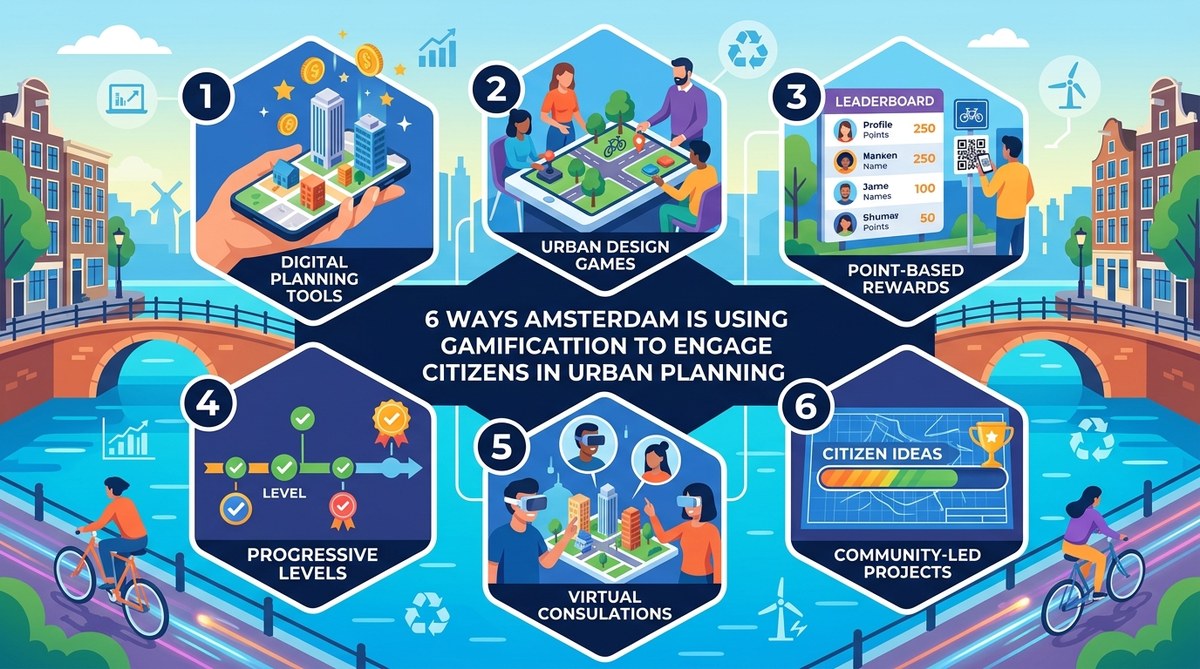
Amsterdam has embraced this approach across several projects. The city’s 6 ways Amsterdam is using gamification to engage citizens in urban planning highlight methods from virtual reality walkthroughs to neighbourhood budget games. The core idea is simple: make the complex, technical world of planning feel accessible and even enjoyable.
Why traditional participation methods often fail
Standard consultation tools have several weaknesses:
- Meetings are held at fixed times, excluding people with work or care commitments.
- Technical jargon and complex maps can alienate non experts.
- Feedback is usually qualitative and hard to aggregate into clear data.
- Only the most motivated, often older residents, tend to turn up.
- There is little incentive to participate beyond civic duty.
Gamification addresses each of these by being mobile friendly, using simple visuals, offering rewards or recognition, and collecting structured data that planners can analyse directly.
How Amsterdam puts gamification into practice
Amsterdam has developed a set of repeatable processes that any city can adapt. Here are four practical steps that emerge from their work.
-
Define the planning question in game terms. Instead of “Where should we build more housing?”, reframe it as “How can you design a block that includes homes, green space, and a playground using limited land tokens?” This creates a clear challenge with constraints.
-
Choose a digital platform that feels like a game. Amsterdam uses a mix of custom tools and off the shelf apps. For example, a “budget game” lets residents allocate virtual money to different infrastructure projects. The interface is clean, colourful, and gives immediate feedback on costs and trade offs. You can read more about how data and AI support these decisions in the role of data and ai in transforming urban policy in Amsterdam.
-
Incorporate real world rewards. Points earned in a planning game can be exchanged for small local benefits, like a coffee at a neighbourhood café or a tree planting certificate. This builds motivation beyond the initial novelty.
-
Analyse the gameplay patterns. Every click, choice, and comment becomes a data point. Planners can see which options are most popular, where trade offs are accepted, and which groups are underrepresented. This feeds directly into policy proposals.
A comparison of gamification techniques and common mistakes
Not all gamification is created equal. The table below contrasts effective approaches with frequent pitfalls.
| Effective Technique | Mistake to Avoid |
|---|---|
| Clear, simple rules that everyone understands | Overcomplicating the game with too many mechanics |
| Visible progress, like a level bar or milestone badge | Keeping scores hidden or irrelevant to the outcome |
| Tangible outcomes that link to real planning decisions | Letting the game be purely for entertainment with no actual influence |
| Inclusivity: mobile first, multilingual, offline friendly | Designing only for tech savvy, younger audiences |
| Iterative feedback from players to refine the game | Launching once and never updating based on user input |
Amsterdam’s approach consistently avoids these mistakes. Their games are tested with diverse community groups before going live, and the results are published transparently so residents see their input mattered.
Expert advice on starting your own gamified consultation
“The biggest mistake I see is treating gamification as a gimmick,” says Lotte van den Berg, a senior urban strategist at the Amsterdam Institute for Advanced Metropolitan Solutions. “You have to build the game around real planning constraints. If the choices in the game don’t match what the city can actually deliver, citizens feel tricked. Start small, test with a single neighbourhood, and let the game evolve based on what you learn.”
This advice echoes across many successful projects. Gamification is not a shortcut; it is a tool to deepen collaboration.
Key lessons from Amsterdam’s experience
- Start with a specific, bounded problem. A game about a whole district can overwhelm. Focus on one park, one street, or one housing block.
- Involve community leaders early. They help shape the game and spread the word.
- Mix digital and physical. Amsterdam sometimes runs live game sessions in community centres alongside online versions.
- Measure participation diversity, not just volume. A thousand responses from one demographic is less useful than two hundred from a cross section.
- Connect the game results to official planning documents. Show how player choices influenced the final proposal.
You can see how these lessons fit into the broader picture of innovative urban solutions shaping Amsterdam’s future in 2026.
Getting started in your own city
If you are an urban planner or civic tech professional ready to try gamification, here is a simple path.
- Pick a small, uncontroversial project first. A new pocket park or a cycle route redesign works well.
- Sketch the core loop: What does the player do? What feedback do they get? What is the reward?
- Choose a platform. Many open source tools exist, or you can adapt a survey tool with gamified elements.
- Recruit a test group of about 20 people from different age and income brackets.
- Run a pilot for two weeks, then interview participants about what worked and what confused them.
- Refine and scale.
Amsterdam’s example shows that you do not need a huge budget. What matters is genuine commitment to listening to the results. As harnessing citizen engagement to accelerate urban innovation in Amsterdam reveals, the best innovations come when residents and officials play on the same team.
Making play a permanent part of planning
Gamification is not a passing trend. It addresses a fundamental need: citizens want to shape their environment, but they often lack the tools or motivation. By adding elements of play, cities can unlock creativity, gather better data, and build trust. Amsterdam has proven that this works at scale. The same principles can work in a market town, a suburb, or a capital. The next time you design a consultation, ask yourself: what would make this a game people actually want to play?
Start small, stay honest about the constraints, and let the players guide you. Your city will be richer for it.
About the Author