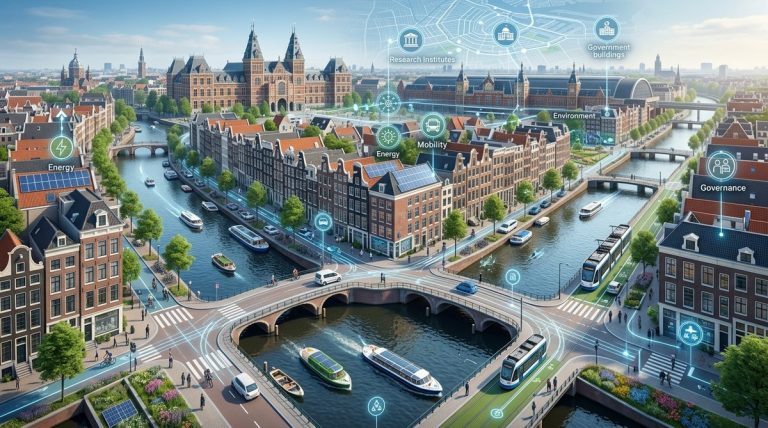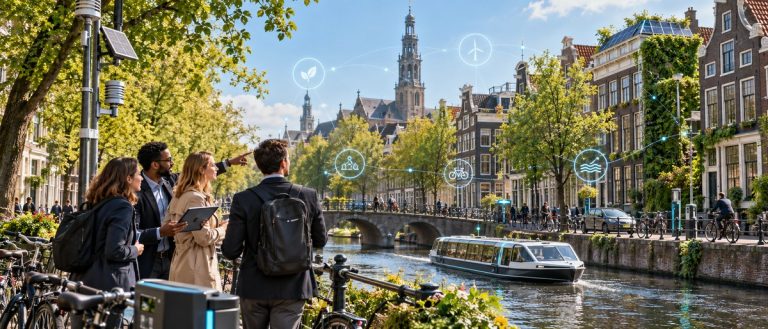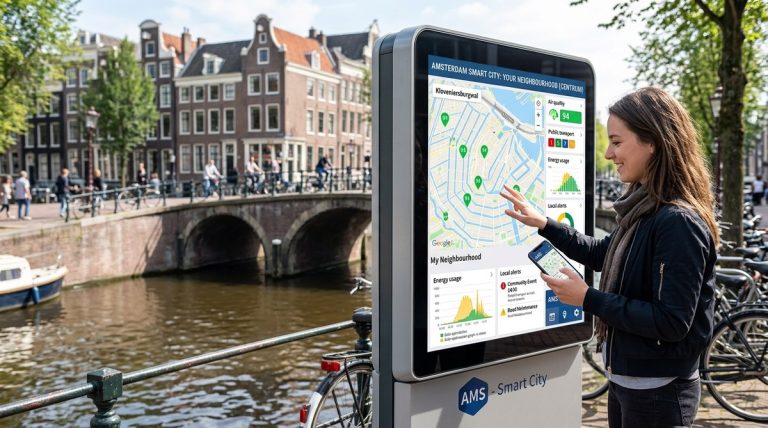
Amsterdam has a reputation for doing things its own way. Canals instead of highways. Bikes instead of cars. And a smart city platform that treats data as a public good rather than a corporate asset. For UK local government innovation officers and urban policy researchers, the Dutch capital offers something rare: a testbed that is big enough to matter, but small enough to adapt.
The Amsterdam smart city programme started over a decade ago. But in 2026, it has matured into something that UK innovators can actually use. Not just as a theoretical case study, but as a working model for how to blend technology, citizen engagement, and sustainability targets into everyday city management. If you are looking for cross-border case studies to benchmark or replicate, this is the place to start.
Amsterdam’s smart city platform works because it treats citizens as co-creators, not just data sources. UK innovators can adopt three core practices: open data policies that build public trust, living labs that test solutions before scaling them, and public-private partnerships that share risk. This article breaks down each approach with real examples from 2026.
How Amsterdam builds trust through open data
Trust is the currency of smart cities. If residents do not believe the system is fair, they will not participate. Amsterdam learned this lesson early.
The city runs an open data portal that publishes everything from air quality readings to energy consumption patterns. Any citizen or business can access it. Any developer can build on top of it. This transparency creates accountability. When the city launched a pilot for smart parking sensors in 2025, residents could see exactly how the data was being used, and more importantly, how it was not being sold.
For UK innovation officers, the lesson is straightforward. Start with openness. Publish the data before you ask for the feedback. That is how you build the social licence to operate.
“The smart city is not a technology project. It is a social contract. If you forget that, the sensors become surveillance, and the citizens become subjects.”
— Marijn van Doorn, Amsterdam Smart City Programme Lead
Three practical steps to replicate Amsterdam’s model
If you want to bring the Amsterdam approach to a UK town or city, here is a numbered process that works.
-
Map your existing data assets. Most councils already hold valuable data on traffic, waste, energy, and public space usage. Before buying new sensors, audit what you already have. Amsterdam did this in 2023 and found that 40% of the data they needed was already being collected by other departments.
-
Set up a living lab in one neighbourhood. Pick a district with a mix of housing types, businesses, and demographics. Install a small number of sensors. Run workshops with residents. Let them tell you what problems matter most. Amsterdam’s living labs in the Nieuw-West district have tested everything from smart street lighting to community composting schemes.
-
Create a shared governance model. Bring together the council, local universities, tech companies, and resident groups. Give each group a vote. This prevents any single stakeholder from dominating the agenda. The role of citizen engagement in shaping smart city initiatives cannot be overstated. Without it, the platform becomes a top-down system that nobody trusts.
What UK cities can learn from Amsterdam’s public-private partnerships
Amsterdam does not try to build everything itself. Instead, it uses public-private partnerships to share the cost and the risk. The city provides the regulatory framework and the data. Private companies bring the technology and the capital. Universities provide the research and the evaluation.
This model works particularly well for sustainability projects. The city’s smart grid programme, for example, was developed in partnership with the local energy utility, a consortium of tech startups, and the University of Amsterdam. Together, they built a system that balances energy demand across thousands of homes, reducing peak load and cutting carbon emissions.
The table below shows how different partnership models compare.
| Partnership type | Risk sharing | Speed of delivery | Citizen trust |
|---|---|---|---|
| Fully public | Low risk, slow | Slow | High trust |
| Fully private | High risk, fast | Fast | Low trust |
| Public-private with governance | Shared risk | Medium | High trust |
| Public-private with citizen board | Shared risk | Medium | Very high trust |
For UK local government innovation officers, the sweet spot is the bottom row. A partnership that includes a citizen oversight board. That is what Amsterdam does, and it is why their projects tend to stick.
Common mistakes and how to avoid them
UK innovators often try to copy the technology without copying the process. They buy the sensors, install the platform, and wonder why nobody uses it. Amsterdam made similar mistakes in the early years. Here are the most common ones, and how to sidestep them.
- Buying before asking. Do not install smart bins until you know whether residents actually want them. Run a survey first. Run a workshop. Let the problem define the solution, not the other way around.
- Ignoring digital exclusion. Not everyone has a smartphone. Not everyone is comfortable with apps. Amsterdam provides physical kiosks and paper-based feedback channels alongside digital tools.
- Treating data as a revenue stream. The temptation is to sell anonymised data to private companies. Amsterdam resists this. They treat data as a public utility, like water or electricity. That policy builds long-term trust.
- Scaling too fast. Start with one street, not one city. Prove the concept. Measure the impact. Then expand. Amsterdam’s 5 key performance indicators for smart city success include a simple rule: if the pilot does not improve resident satisfaction within six months, stop it.
How Amsterdam measures what matters
You cannot manage what you do not measure. Amsterdam tracks a set of indicators that go beyond technical performance. They measure social impact, environmental outcomes, and economic benefits.
The city uses a dashboard that is publicly accessible. Anyone can see how each neighbourhood is performing on metrics like air quality, green space access, energy efficiency, and resident satisfaction. This transparency creates a healthy competition between districts. Nobody wants to be the worst performing area on the dashboard.
For UK urban policy researchers, this is the most transferable part of the model. You do not need a multi-million pound platform to start. You need a commitment to openness and a willingness to be judged by the data.
What Amsterdam’s smart city platform means for UK innovators in 2026
The smart city landscape in the UK is fragmented. Some cities have made progress. Others are still stuck in pilot purgatory, running the same trial year after year without ever scaling up. Amsterdam offers a way out.
The Dutch approach is not about having the most advanced technology. It is about having the most inclusive process. The city treats its smart city platform as a commons, something that belongs to everyone. That is why it works. That is why UK innovators should pay attention.
If you are an innovation officer in a UK local authority, start small. Pick one problem. One neighbourhood. One partnership. Test it. Learn from it. Share the results. That is exactly what Amsterdam did, and it turned them into a global reference point for urban innovation.
The door is open. The data is available. The lessons are there for the taking. The only question is whether UK cities are ready to learn them.
Your next step as a smart city innovator
You do not need a plane ticket to Amsterdam to start learning. The city publishes its project evaluations, data sets, and governance models online. Start there. Read the case studies. Share them with your team. Then pick one small project to test in your own area.
The lessons from Amsterdam’s urban innovation labs are practical and repeatable. They do not require massive budgets or political buy-in at the highest level. They require curiosity, humility, and a willingness to let citizens lead.
That is the real secret of Amsterdam’s smart city. It is not smart because of the technology. It is smart because of the people. And that is something any UK city can replicate.
About the Author