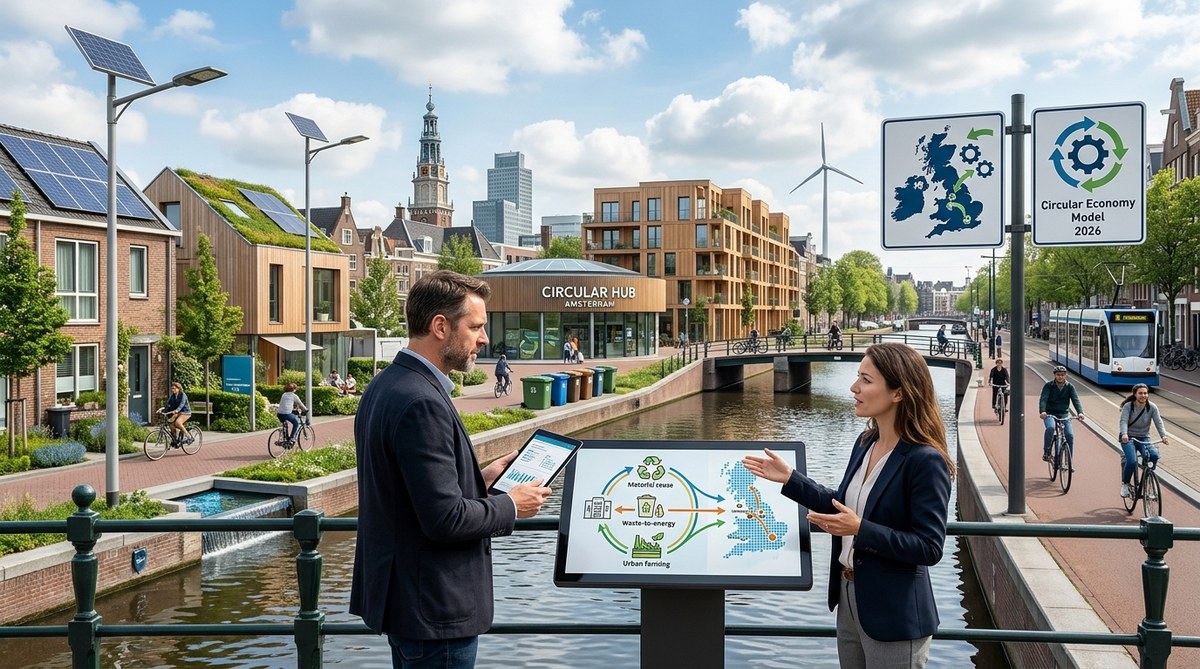
Amsterdam has spent the last decade proving that a circular economy is not just a lofty ambition. It is a working, breathing reality. From the repurposed industrial buildings in Noord to the climate resilient waterfronts in Zeeburgereiland, the Dutch capital has turned waste into a resource and citizens into partners. For British urban planners, policymakers, and sustainability consultants, the question is no longer whether to adopt circular principles. It is how to adapt them to the unique fabric of UK cities.
Amsterdam’s circular economy model offers British urban planners a proven framework for reducing waste, cutting carbon, and building community resilience. The key lessons include embedding circularity into procurement, using data to track material flows, and co designing policies with residents. UK cities can apply these strategies today to meet net zero targets and create liveable neighbourhoods.
Why Amsterdam leads the way in circular urban planning
Amsterdam declared its ambition to become a fully circular city by 2050 back in 2020. By 2026, it has already cut its primary material use by a significant margin. The city government does not treat circularity as a separate department. It weaves it into housing, transport, waste management, and public space design.
The approach rests on three pillars: reducing raw material consumption, extending product lifecycles, and regenerating natural systems. British planners often focus on recycling alone. Amsterdam shows that recycling is only the last step. The real gains come from designing out waste from the start.
Five practical lessons from Amsterdam for UK cities
1. Start with public procurement
Amsterdam uses its buying power to create demand for circular products. The city requires that all public contracts for construction, furniture, and IT equipment include circular criteria. For example, new市政 buildings must use at least 30 percent recycled or bio based materials.
British councils can do the same. If a local authority in Manchester or Bristol specifies circular materials in its procurement rules, suppliers will adapt. It is a simple shift that creates a market signal.
2. Map material flows before you act
Amsterdam created a material flow analysis for the entire city. It tracks where steel, concrete, wood, and plastics come from, how they are used, and where they end up. This data drives decisions. When planners know that 40 percent of construction waste comes from demolition, they can write policies that mandate deconstruction over demolition.
UK cities like Leeds and Glasgow have started similar mapping. But the Amsterdam example shows it works best when updated every year and shared publicly.
3. Design neighbourhoods as material banks
In the Buiksloterham district, buildings are designed so that every component can be disassembled and reused. Walls are bolted, not glued. Pipes are accessible without breaking concrete. The neighbourhood functions as a material bank. When a building reaches the end of its life, nothing goes to landfill.
British planners can apply this principle to new housing developments. It requires a shift in how we write planning conditions. Instead of asking for a recycling bin store, ask for a deconstruction plan.
4. Use public space for circular infrastructure
Amsterdam turns public space into circular infrastructure. Street furniture is made from recycled plastic collected in the city. Park benches become collection points for small electronics. Pavements are laid with modular tiles that can be lifted and reused when utilities need access.
This approach makes circularity visible. Residents see it every day. It normalises the behaviour and builds public support.
5. Measure what matters
Amsterdam tracks five key indicators: material use, waste generation, carbon emissions, jobs in the circular economy, and citizen satisfaction. It publishes these in an open dashboard. This transparency builds trust and allows planners to adjust policies based on real outcomes.
UK cities often measure waste diversion rates but ignore upstream material use. Amsterdam’s dashboard shows that upstream metrics are more powerful for driving change.
A step by step process for adopting Amsterdam’s model
Here is a practical sequence that any British planning department can follow:
- Conduct a baseline material flow analysis for your city or borough. Identify the top three waste streams.
- Set a clear target. For example, reduce primary material use by 20 percent by 2030.
- Update procurement rules to require circular criteria in all council contracts.
- Identify one neighbourhood for a pilot project. Use it to test circular design standards.
- Create a public dashboard to share progress. Invite feedback from residents and businesses.
- Review and adjust every two years. Circularity is not a one time fix.
Common mistakes and how to avoid them
British planners can learn from Amsterdam’s early stumbles too. Here is a table of common mistakes and the Dutch solutions.
| Mistake | Amsterdam’s solution |
|---|---|
| Treating circularity as a waste management issue | Embed circular criteria into housing, transport, and public space policies from day one |
| Focusing only on recycling | Prioritise waste prevention and material reuse before recycling |
| Ignoring the supply chain | Use procurement to create demand for circular products |
| Designing in isolation | Involve residents, builders, and waste collectors in the design process |
| Measuring only tonnage | Track material flows, carbon, jobs, and citizen satisfaction together |
What British planners can apply right now
You do not need to wait for a new government strategy. Some changes are immediate.
- Add a circularity clause to the next planning brief you write.
- Ask your procurement team to include recycled content requirements in the next tender.
- Start a conversation with your local waste authority about sharing data on material flows.
- Visit Buikslaterham or one of Amsterdam’s circular districts online. The principles are well documented.
“We stopped thinking of waste as something to get rid of. We started seeing it as a resource that belongs in the wrong place.”
– An Amsterdam urban planner, speaking at a 2025 conference on circular cities.
This mindset shift is the most important lesson. British cities have the talent, the tools, and the public will. What they need is a clear set of principles to follow. Amsterdam provides that blueprint.
How citizen engagement makes circular planning stick
Amsterdam did not impose circularity from the top. It ran neighbourhood workshops, school programmes, and online platforms where residents could propose ideas. One example is the “circular street” initiative, where residents compete to reduce household waste the most. The winning street gets funding for a community project.
This approach builds ownership. When people feel part of the solution, they adopt the behaviours that make circular systems work. For British planners, this means investing time in genuine co creation, not just consultation.
For more on how citizen participation drives innovation, read about the role of citizen engagement in shaping Amsterdam’s smart city initiatives.
Key differences between Amsterdam and UK cities
It would be naive to copy Amsterdam without adapting. UK cities have older housing stock, different governance structures, and less direct control over land. But those differences do not stop progress. They just change the route.
- Housing stock: Amsterdam builds new circular districts from scratch. UK cities like Birmingham or Newcastle need to retrofit existing buildings. That is harder, but the principles of deconstruction and material tracking still apply.
- Governance: Amsterdam’s city government has more power over land use than a typical UK council. British planners need to partner with private developers and housing associations to get circular standards into planning conditions.
- Scale: Amsterdam is a compact city. Greater Manchester is a region. Circular strategies need to work across multiple boroughs. The solution is to agree shared material flow targets and procurement rules at the combined authority level.
What Amsterdam’s circular economy means for UK net zero targets
The built environment accounts for around 40 percent of UK carbon emissions. A large portion of that comes from the materials we use. Concrete, steel, and aluminium have huge embodied carbon footprints. Circular planning reduces the need for new materials. That directly cuts emissions.
Amsterdam has shown that circularity and decarbonisation go hand in hand. Its circular strategy is expected to cut carbon emissions by 50 percent by 2030 compared to 2015 levels. British cities aiming for net zero by 2040 or 2050 cannot afford to ignore this lever.
A table of circular techniques used in Amsterdam
| Technique | Application | UK relevance |
|---|---|---|
| Material passports | Each building has a digital record of all materials used | Useful for large scale developments and regeneration projects |
| Urban mining | Recovering materials from existing buildings before demolition | Essential for retrofit heavy UK cities |
| Circular procurement | Contracts require recycled content and design for disassembly | Easy to adopt in any council |
| Shared mobility hubs | Reduce car parking and provide bike share, car share, and cargo bike hire | Works well in dense UK urban centres |
| Decentralised water systems | Rainwater harvesting and greywater recycling at neighbourhood level | Useful for new developments in flood prone areas |
How data and AI support Amsterdam’s circular planning
Amsterdam uses a digital twin of the city to model material flows and test circular scenarios. Planners can see the impact of changing a procurement rule or adding a new recycling facility before spending any money. This reduces risk and speeds up decision making.
British cities are beginning to adopt similar tools. For a deeper look at how data transforms policy, see the role of data and AI in transforming urban policy in Amsterdam.
Three things to stop doing today
- Stop designing for single use. Every new building, street, or park should be designed for disassembly and adaptation.
- Stop measuring only recycling rates. Track material use, carbon, and social outcomes.
- Stop working in silos. Circularity needs housing, transport, waste, and economic development teams to talk to each other.
Amsterdam’s circular economy lessons for British planners: a summary
- Embed circularity into procurement first. It is the fastest way to create change.
- Map material flows before setting targets. You cannot manage what you do not measure.
- Design neighbourhoods as material banks. Make disassembly standard practice.
- Use public space to make circularity visible and normal.
- Involve citizens in co creating solutions. Ownership drives adoption.
- Adapt the model to your local context. Do not copy, translate.
Why UK cities can learn from Amsterdam’s circular model in 2026
The year 2026 is a turning point. British cities face tighter budgets, rising material costs, and urgent climate targets. Amsterdam’s circular economy model offers a way to do more with less. It reduces waste, creates local jobs, and builds stronger communities. The lessons are not locked in a Dutch policy document. They are being applied on the ground every day. British urban planners have everything they need to start. The only missing piece is the decision to begin.
Take one of the steps listed above. Write that circularity clause. Start that material flow conversation. Visit a circular district online or in person. The journey is incremental, but the direction is clear. Amsterdam has shown the way. Now it is time for UK cities to follow.
About the Author