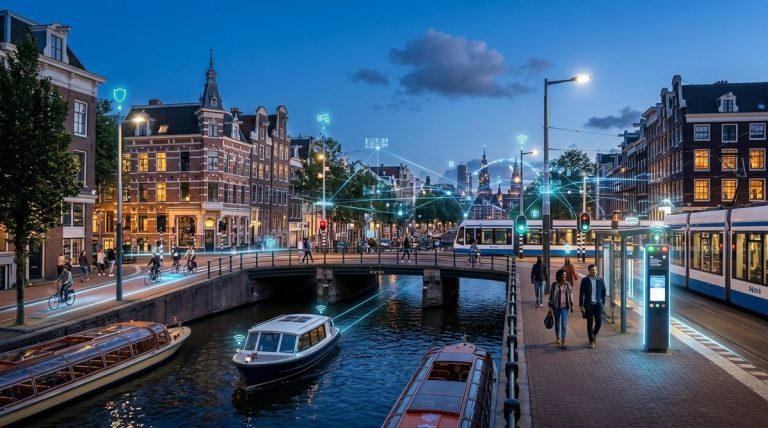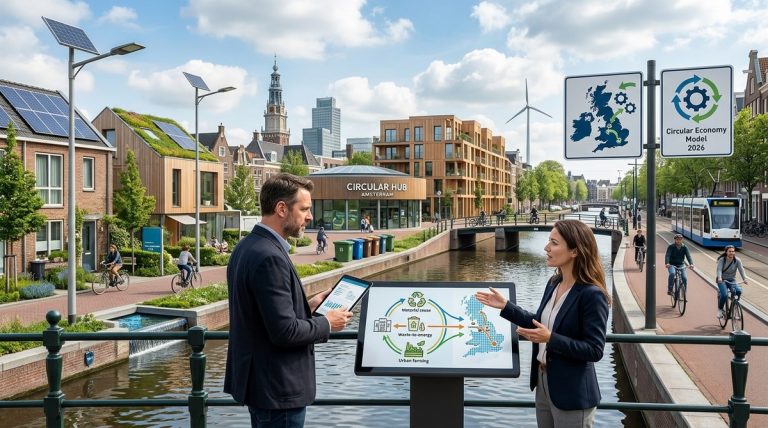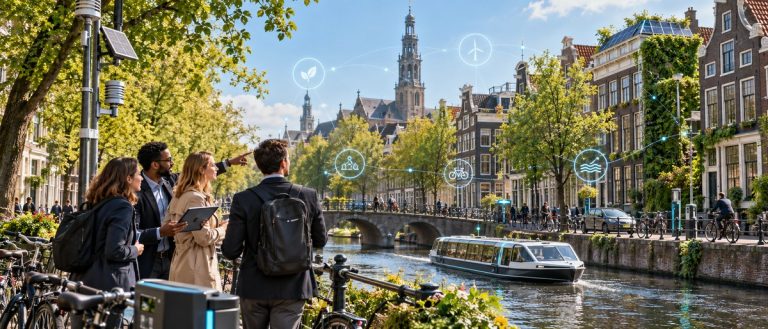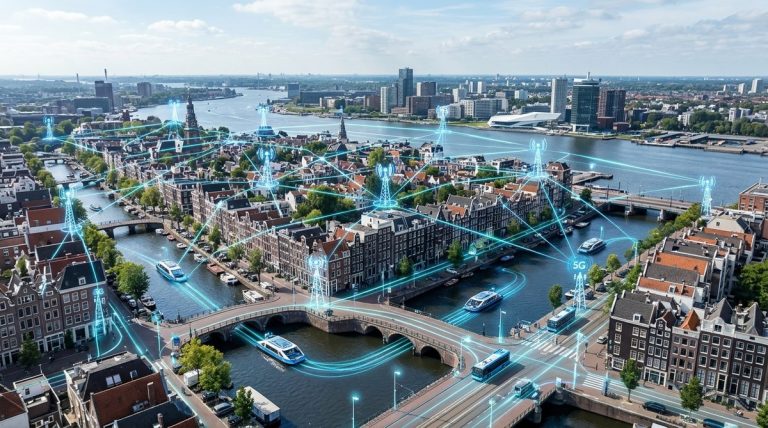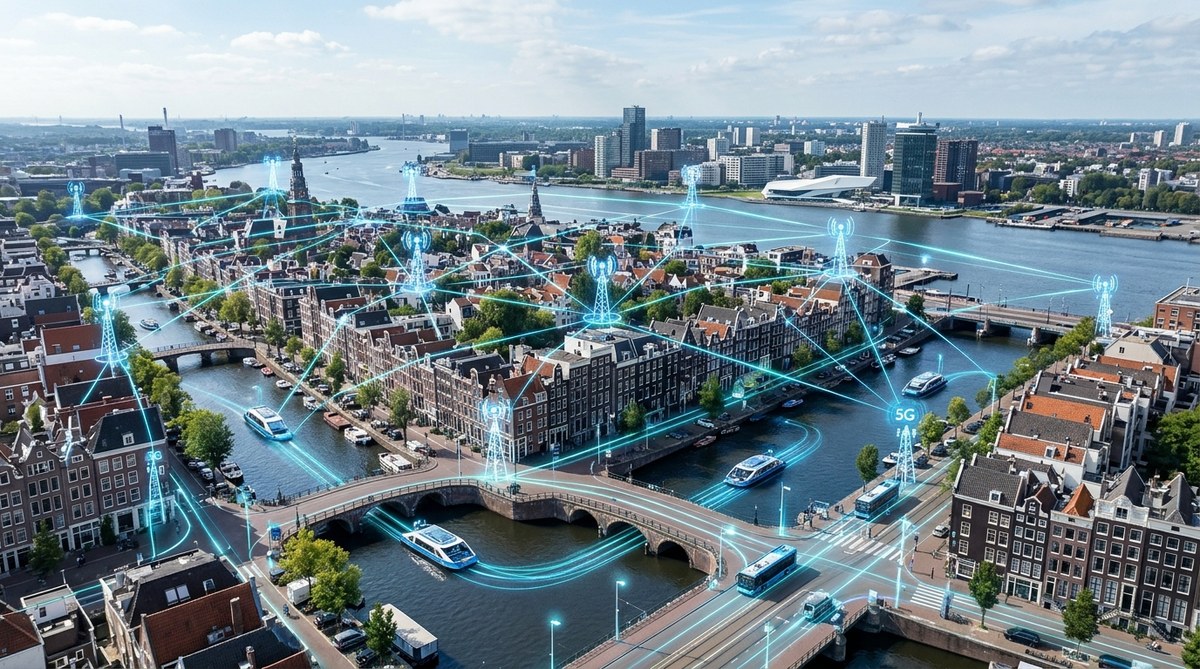
Amsterdam has always been a city of clever compromises. Canals double as flood defences. Bike lanes weave through tram tracks. Now, the city is adding a new layer to its urban fabric: a 5G network that treats every lamppost, sensor, and bus stop as a node in a living digital system. For urban planners and policymakers, the question is no longer whether 5G will change cities, but how to design services that actually use it well.
5G smart city Amsterdam is not about faster phone downloads. It is about ultra-reliable, low-latency connections that allow traffic lights to talk to trams, waste bins to alert collection crews, and energy grids to balance load in milliseconds. This article maps the real infrastructure behind those services and gives planners a practical framework for deploying them.
What makes 5G different for city services
You have heard the marketing. 5G means lower latency, higher bandwidth, and more devices per square kilometre. For a smart city, those technical specs translate into three practical capabilities that 4G simply cannot deliver at scale.
First, massive machine-type communication. Amsterdam can connect thousands of sensors per neighbourhood without clogging the network. Second, ultra-reliable low-latency communication. Emergency vehicles can receive priority routing with delays under ten milliseconds. Third, enhanced mobile broadband that lets city cameras stream 4K video for real-time crowd monitoring during Kings Day or the Amsterdam Dance Event.
These capabilities are not theoretical. They are already running on the small cell sites attached to street furniture across the city centre and Zuidas business district.
How Amsterdam deployed its 5G smart city infrastructure
The rollout did not happen overnight. Amsterdam worked with mobile operators, the Dutch national spectrum regulator, and technology partners to create a zoning framework that balanced coverage with heritage restrictions. Here is the process they followed, which any city can adapt.
- Audit existing street furniture. Amsterdam mapped every lamppost, traffic signal pole, and bus shelter for potential small cell sites. This saved the cost of digging new foundations.
- Create a digital permitting system. The city built an online portal where operators could apply for pole attachments. Approval times dropped from six months to three weeks.
- Run a pilot in a controlled zone. The first 5G smart city corridor ran along the A10 ring road and into the city centre. It tested connected traffic lights, air quality sensors, and waste monitoring.
- Publish open data standards. Amsterdam mandated that all 5G-enabled city sensors must feed data into the public data platform. This allows third-party developers to build citizen apps.
- Scale by district. Each of Amsterdam’s seven stadsdelen (districts) now has a local 5G deployment plan that matches its specific needs. Noord focuses on port logistics, while Centrum prioritises crowd management.
For a deeper look at how the city uses smart technologies to meet sustainability targets, read our article on how Amsterdam uses smart technologies to create a more sustainable city.
Five urban services that 5G makes possible today
The table below shows how 5G smart city Amsterdam is already delivering next-generation municipal services. Each row links a technical capability to a real use case.
| 5G capability | Urban service | What changes for residents |
|---|---|---|
| Ultra-low latency | Adaptive traffic signals for trams and emergency vehicles | Trams get green lights automatically. Ambulances save 30 seconds per trip across the city. |
| Massive device density | Smart waste bins with fill-level sensors | Collection crews empty bins only when they are 80% full, cutting truck journeys by a quarter. |
| High bandwidth video | Real-time crowd density analysis at Dam Square | Security teams can redirect foot traffic before bottlenecks form during events. |
| Network slicing | Separate virtual network for water management sensors | The water authority gets guaranteed bandwidth even during peak tourist season. |
| Edge computing | Local processing of air quality data at street level | Pollution alerts update every 30 seconds instead of every 15 minutes. |
Avoiding the common pitfalls of 5G urban deployments
Many cities rush to install 5G infrastructure without thinking about maintenance, security, or citizen trust. Amsterdam learned some lessons the hard way. Here are the mistakes to watch for.
- Over-reliance on a single vendor. The first pilot used one provider for all small cells. When that provider delayed firmware updates, half the sensors went offline. Amsterdam now requires multi-vendor interoperability.
- Ignoring digital exclusion. Not every resident owns a 5G smartphone. The city ensures that all services also have a non-digital touchpoint, like a physical information panel or a phone hotline.
- Neglecting cybersecurity. Each connected sensor is a potential entry point. Amsterdam runs a dedicated security operations centre for its IoT estate.
- Forgetting about power supply. Small cells need electricity. The city now co-locates sensors with solar-powered street lights to avoid grid connection delays.
- Skipping community consultation. The first deployment in Oud-West faced pushback from residents worried about radiation. The city responded with public information sessions and independent electromagnetic field testing.
If you are planning a similar deployment, our guide on top strategies for implementing smart city technologies in Amsterdam offers a practical checklist.
The role of data and AI in making 5G services smarter
A 5G network is just a pipe. What makes it smart is the data that flows through it and the artificial intelligence that interprets that data. Amsterdam runs a central data platform called the City Data Hub, which ingests feeds from over 12,000 connected sensors.
The platform uses machine learning to predict traffic congestion up to 45 minutes in advance. It also powers a digital twin of the city. This twin models how changes to one system, like closing a street for a market, will affect surrounding traffic, air quality, and noise levels.
For a detailed explanation of how data and AI shape urban policy, see our article on the role of data and AI in transforming urban policy in Amsterdam.
“The digital twin lets us test a policy change in software before we try it on the street. We can run a thousand simulations of a new bike lane layout in the time it used to take to hold one committee meeting.”
Amsterdam Smart City programme manager, 2026
Measuring success: key performance indicators for 5G smart city projects
Amsterdam tracks five main metrics to evaluate whether its 5G investments are delivering value. You can use these as a template for your own projects.
- Network reliability percentage. Target: 99.99% uptime for critical services like traffic management and flood warning.
- Service response time. How fast does the city react to an incident? For example, the average time between a waste bin reporting full and a collection truck arriving.
- Citizen satisfaction score. The city runs a quarterly survey asking residents whether digital services have improved their daily life.
- Carbon reduction per service. Each 5G-enabled service must show a measurable drop in CO2 emissions compared to the previous non-digital method.
- Cost per connected device. This includes hardware, installation, backhaul, and electricity. Amsterdam aims to keep this under 15 euros per device per month.
For more details on these metrics, read about 5 key performance indicators Amsterdam uses to measure smart city success.
What UK cities can learn from Amsterdam’s approach
British urban planners often ask whether Amsterdam’s model can transfer to UK cities. The answer is yes, with some adjustments. Amsterdam’s success depends on three factors that UK cities can replicate.
Integrated governance. The city’s smart city team sits inside the urban planning department, not inside the IT department. This means digital infrastructure is considered at the same time as roads, parks, and housing.
Open data by default. Amsterdam publishes almost all sensor data under an open licence. This encourages startups and universities to build applications that the city would never have thought of itself.
Citizen co-creation. Residents are invited to propose new uses for 5G services through the city’s online participation platform. One winning idea turned connected air quality sensors into a route planner for joggers with asthma.
For a direct comparison, read our analysis of what can UK cities learn from Amsterdam’s smart city success.
Building your own 5G smart city roadmap
If you are an urban planner or policymaker looking to bring 5G services to your municipality, start with these three actions.
First, map your existing assets. You probably already own thousands of poles, signs, and cabinets that can host small cells. Commission a street furniture audit before you talk to any telecom operator. You will negotiate from a position of strength.
Second, write a digital infrastructure strategy that sits alongside your local plan. Do not treat 5G as a separate project. Treat it as a utility, like water or electricity, that enables every other service.
Third, run a small pilot with a clear problem. Do not deploy 5G for the sake of it. Pick a specific pain point, such as congestion around a hospital or slow waste collection in a dense neighbourhood, and measure the improvement.
Amsterdam’s journey shows that 5G smart city projects succeed when they start small, involve residents, and focus on services that people actually notice. The network is invisible. The cleaner streets, shorter commutes, and fresher air are what matter.
The future of 5G and urban innovation in Amsterdam
Amsterdam is already looking beyond the current generation of 5G. The city is testing 5G-Advanced, sometimes called 5.5G, which promises even better support for autonomous vehicles and drone deliveries. The port of Amsterdam is running a private 5G network that coordinates autonomous electric barges.
The lesson for other cities is clear. 5G smart city Amsterdam works because the city treats connectivity as infrastructure, not as a technology project. It builds services on top of that infrastructure with a clear eye on sustainability, equity, and citizen engagement.
If you want to see how Amsterdam’s urban innovation ecosystem drives sustainable growth, read our piece on how Amsterdam’s urban innovation ecosystem is accelerating sustainable city solutions in 2026.
Putting the framework into practice
You now have a map of Amsterdam’s 5G smart city approach. You know the process, the pitfalls, and the performance indicators. The next step is to adapt that map to your own city’s terrain.
Start with one street, one service, and one clear metric. Measure the before and after. Talk to the people who live and work there. Then scale what works. That is how Amsterdam did it, and that is how your city can do it too.
About the Author